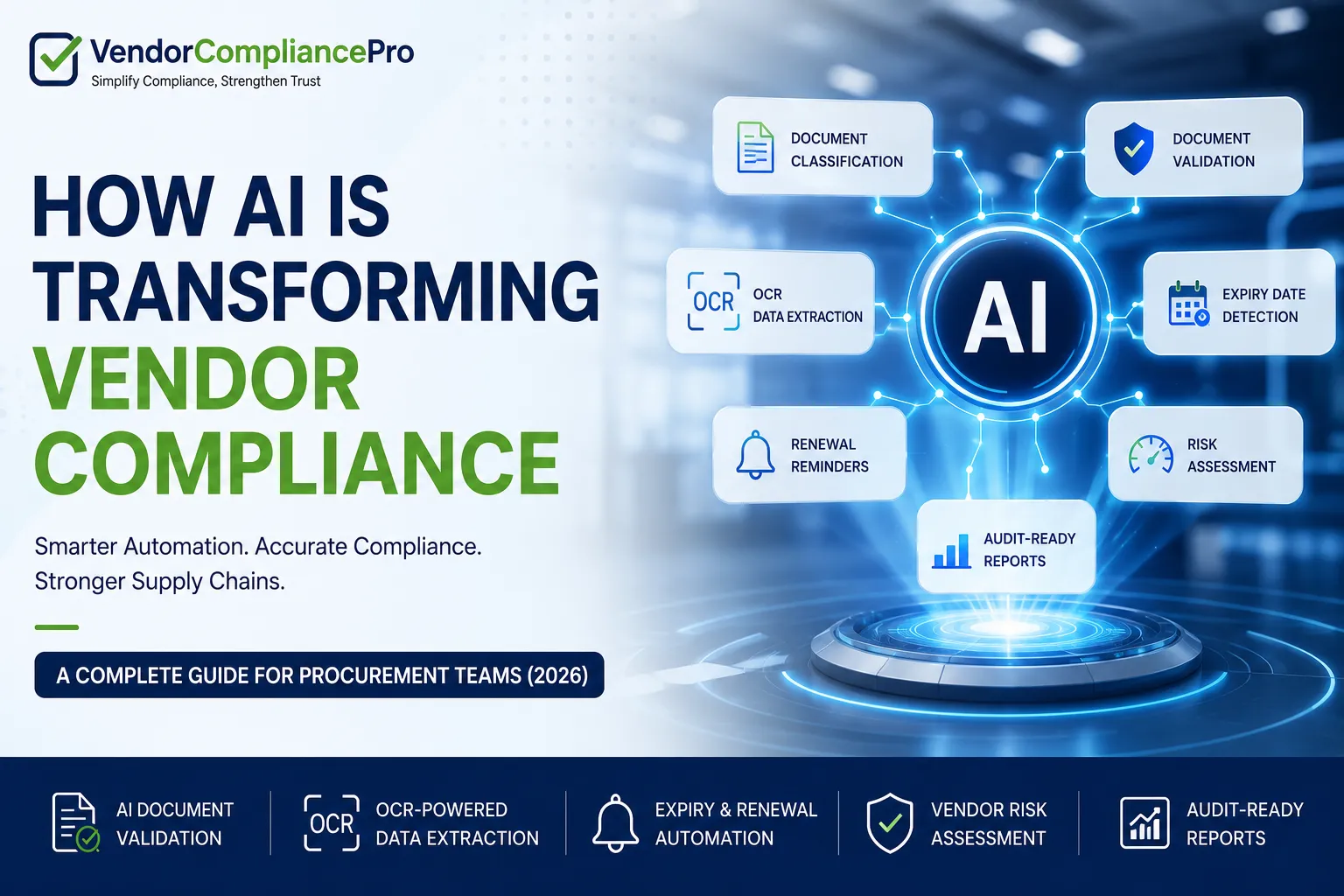
How AI is Transforming Vendor Compliance: A Complete Guide for Procurement Teams (2026)
Vendor compliance has become significantly more complex over the past decade. Procurement teams are no longer responsible for simply collecting supplier documents—they must verify statutory registrations, monitor document expiry dates, assess supplier risks, comply with customer audit requirements, and ensure vendors remain compliant throughout their business relationship.
For organizations managing dozens or even hundreds of suppliers, these activities quickly become time-consuming. Many companies still rely on Excel spreadsheets, email reminders, shared folders, and manual document verification, making it difficult to maintain an accurate and up-to-date compliance program.
Artificial Intelligence (AI) is changing the way organizations manage vendor compliance. By combining AI, Optical Character Recognition (OCR), and workflow automation, businesses can automate repetitive compliance tasks, improve document accuracy, reduce human error, and prepare for audits more efficiently.
Rather than replacing procurement professionals, AI acts as an intelligent assistant that helps teams work faster while making better compliance decisions.
In this guide, we’ll explain how AI is transforming vendor compliance, where it delivers the greatest value, and why AI-powered compliance platforms are becoming an important investment for procurement and compliance teams.
What Is AI in Vendor Compliance?
AI in vendor compliance refers to the use of Artificial Intelligence technologies to automate and improve supplier compliance processes throughout the vendor lifecycle.
Instead of relying entirely on manual document reviews, AI helps procurement teams analyze vendor documents, identify compliance issues, extract important information, and automate repetitive administrative tasks.
Modern AI-powered vendor compliance platforms can assist with activities such as:
- Document classification
- Vendor document validation
- OCR-based text extraction
- Expiry date detection
- Compliance monitoring
- Vendor risk identification
- Renewal reminders
- Audit preparation
For example, when a supplier uploads a GST Registration Certificate, AI can identify the document type, extract important information such as the GST number and registration details, detect the certificate’s validity, and verify whether it satisfies the organization’s compliance requirements.
Similarly, if a vendor accidentally uploads a PAN Card instead of a Factory License, AI can identify the mismatch and notify the compliance team before the document is approved.
By automating these repetitive activities, procurement teams spend less time reviewing paperwork and more time managing supplier relationships and reducing business risks.
Why Is AI Important for Vendor Compliance?
Organizations today work with more vendors than ever before.
A manufacturing company may manage hundreds of suppliers providing raw materials, packaging materials, transportation services, engineering support, housekeeping services, security personnel, contractors, and equipment maintenance.
Each vendor may be required to submit multiple statutory documents, including:
- GST Registration Certificate
- PAN Card
- MSME / Udyam Registration
- Factory License
- Labour License
- PF Registration
- ESIC Registration
- Professional Tax Registration
- Insurance Certificates
- Fire Safety Certificates
- Pollution Control Board Approvals
These documents often require periodic renewal.
Tracking them manually becomes increasingly difficult as the number of suppliers grows.
Missing even a single expired document may result in:
- Audit observations
- Regulatory penalties
- Customer non-compliance
- Delays in vendor approval
- Increased supplier risks
- Business interruptions
AI helps organizations manage these challenges by continuously monitoring compliance information and assisting procurement teams in identifying potential issues before they become business problems.
Instead of reacting after documents expire, organizations can proactively manage compliance through intelligent monitoring and automation.
Why Traditional Vendor Compliance Falls Short
Despite significant advances in procurement technology, many organizations still manage vendor compliance using manual processes.
Typical workflows include:
- Receiving documents by email
- Saving files in shared folders
- Updating Excel spreadsheets
- Manually checking expiry dates
- Sending reminder emails
- Preparing audit documents manually
While these methods may work for a small supplier base, they become increasingly difficult to manage as organizations expand.
Some of the most common challenges include:
Manual Document Verification
Compliance teams often spend considerable time opening each uploaded document, verifying its contents, checking whether the correct document has been submitted, and recording important information manually.
This process is repetitive, time-consuming, and susceptible to human error.
Poor Visibility
When documents are stored across multiple folders, emails, and spreadsheets, it becomes difficult to answer questions such as:
- Which vendors have expired documents?
- Which suppliers are awaiting approval?
- Which mandatory documents are missing?
- Which vendors present the highest compliance risks?
Without centralized visibility, compliance teams often spend valuable time searching for information instead of managing supplier risks.
Missed Renewal Deadlines
One of the biggest challenges in vendor compliance is tracking document expiry dates.
Organizations frequently miss renewal deadlines because reminders depend on manual calendars or spreadsheets.
Expired statutory documents can delay procurement activities, increase audit findings, and expose organizations to regulatory risks.
Time-Consuming Audit Preparation
Preparing for customer audits, ISO audits, or internal compliance reviews often requires collecting documents from multiple sources.
Procurement teams may spend several days identifying expired documents, locating missing certificates, and preparing compliance reports.
As the number of suppliers increases, audit preparation becomes even more resource-intensive.
Increasing Administrative Workload
Every new supplier adds additional compliance documents that must be collected, verified, stored, monitored, and renewed.
Without automation, procurement professionals spend a significant portion of their time performing repetitive administrative work instead of focusing on supplier development, strategic sourcing, and risk management.
In the next section, we’ll explore the seven practical ways Artificial Intelligence is transforming vendor compliance, including AI-powered document validation, OCR-based information extraction, intelligent renewal reminders, vendor risk assessment, and faster audit preparation.