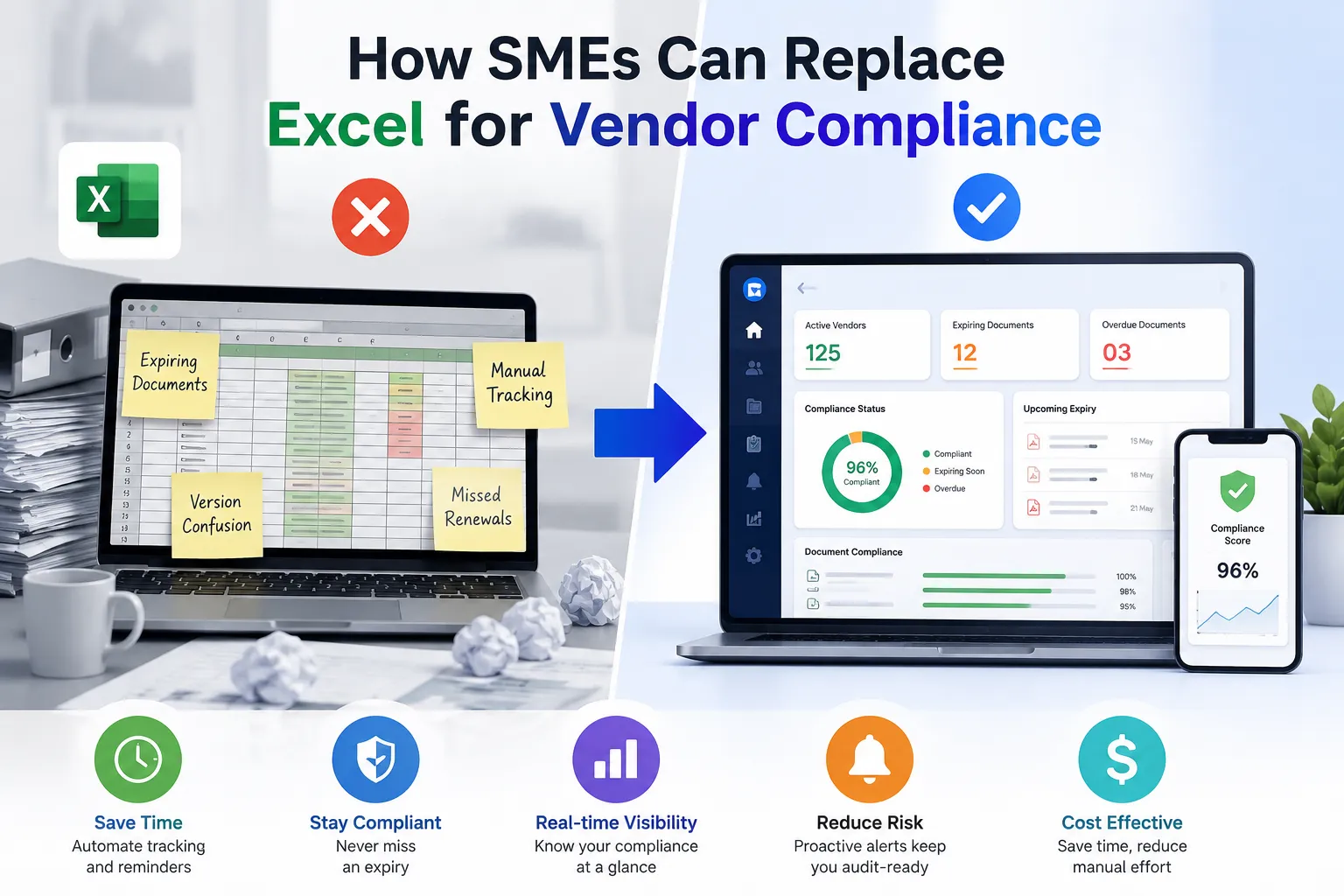
How SMEs Can Replace Excel for Vendor Compliance (Without Increasing Costs)
For many small and medium-sized businesses (SMEs), Microsoft Excel is the first tool used to manage vendor compliance.
It’s free, familiar, and easy to set up.
However, as your business grows, spreadsheets become increasingly difficult to manage. What starts as a simple tracking sheet quickly turns into multiple files, endless email chains, and hours spent searching for vendor documents.
This article explains why many SMEs outgrow Excel and how modern vendor compliance software helps streamline document management, compliance tracking, and audit readiness.
Why SMEs Love Excel
Excel remains popular because it offers several advantages:
- Low cost
- Easy to learn
- Quick setup
- Flexible customization
- Familiar to almost every employee
The problem isn’t starting with Excel.
The problem is continuing to rely on spreadsheets after your vendor network has grown.
Signs You’ve Outgrown Excel
Your organization has likely outgrown Excel if:
- You manage hundreds of vendors.
- Vendor documents are stored in multiple folders.
- Multiple departments update compliance records.
- Expiry dates are tracked manually.
- Audit preparation takes several days.
- Different versions of the spreadsheet exist.
1. Document Tracking Becomes Manual
Teams spend significant time locating vendor documents across:
- Email inboxes
- Shared drives
- Local computers
- Cloud storage
Finding the latest document becomes difficult and time-consuming.
2. Expiry Dates Are Easy to Miss
Tracking document expiry manually increases the risk of missing renewals for:
- GST Registration
- Insurance Policies
- Labour Licenses
- PF Registration
- ESIC Registration
Without automated reminders, expired documents often go unnoticed.
3. Multiple People Edit the Same Spreadsheet
As more employees access the spreadsheet, problems begin to appear:
- Duplicate records
- Broken formulas
- Incorrect status updates
- Version conflicts
- Accidental deletions
Maintaining data accuracy becomes increasingly difficult.
4. Vendors Cannot Upload Documents Themselves
Every document request requires emails, follow-ups, and manual uploads by procurement teams.
A self-service vendor portal eliminates this repetitive work.
5. Audit Preparation Takes Days
During audits, employees often search through:
- Excel files
- Email conversations
- Shared folders
- Local drives
This wastes valuable time and increases stress.
6. No Approval Workflow
Excel cannot manage structured approval workflows.
Procurement, Finance, Compliance, and Management often rely on emails or phone calls to approve vendor documents.
7. No Real-Time Dashboard
Managers need instant visibility into:
- Compliant vendors
- Missing documents
- Pending approvals
- Expired certificates
- Overall compliance percentage
Excel cannot provide real-time dashboards without significant manual effort.
The Hidden Cost of Excel
Although Excel appears inexpensive, the hidden costs include:
- Lost productivity
- Compliance risks
- Delayed vendor onboarding
- Audit preparation time
- Human errors
- Missed document renewals
As vendor numbers increase, these costs continue to grow.
What Modern Vendor Compliance Software Provides
Modern platforms replace manual spreadsheets with automation.
Typical features include:
Centralized Document Repository
Store every vendor document securely in one location.
Automated Expiry Reminders
Receive notifications before documents expire.
Vendor Self-Service Portal
Allow vendors to upload and update documents directly.
AI-Powered Document Validation
Automatically identify document types and detect missing information.
Approval Workflows
Route documents through Procurement, Finance, Compliance, and Management automatically.
Real-Time Dashboards
Track vendor compliance instantly.
Audit Reports
Generate audit-ready reports in minutes.
Is Vendor Compliance Software Expensive?
Many SMEs assume specialized software is expensive.
In reality, a single compliance issue or delayed audit can cost far more than the annual subscription for a cloud-based compliance platform.
Modern SaaS solutions also eliminate the need for expensive infrastructure and reduce administrative effort.
How VendorCompliancePro Helps SMEs
VendorCompliancePro is designed specifically for growing businesses.
Key capabilities include:
- Centralized document management
- Vendor self-service portal
- Automated expiry reminders
- AI-powered document validation
- Approval workflows
- Compliance dashboards
- Audit-ready reporting
- Cloud-based deployment
SMEs can implement the platform quickly without investing in additional IT infrastructure.
Frequently Asked Questions
Can Excel manage vendor compliance?
Yes, for a small number of vendors. As vendor numbers grow, spreadsheets become difficult to maintain.
When should SMEs replace Excel?
When manual tracking, document searches, and audit preparation begin consuming significant time.
Is cloud-based vendor compliance software secure?
Most modern platforms use enterprise-grade security, backups, and role-based access controls.
How long does implementation take?
Cloud-based solutions can often be implemented within a few days.
Can vendors upload their own documents?
Yes. Modern vendor portals allow vendors to securely upload and update compliance documents.
Conclusion
Excel is an excellent starting point for vendor compliance management, but it isn’t designed to handle hundreds of vendors, expiring documents, approval workflows, and audit requirements.
As SMEs grow, replacing spreadsheets with a centralized vendor compliance platform helps improve efficiency, reduce compliance risks, and simplify audit preparation.
The transition from Excel to automation isn’t just about technology—it’s about creating a scalable compliance process that supports long-term business growth.