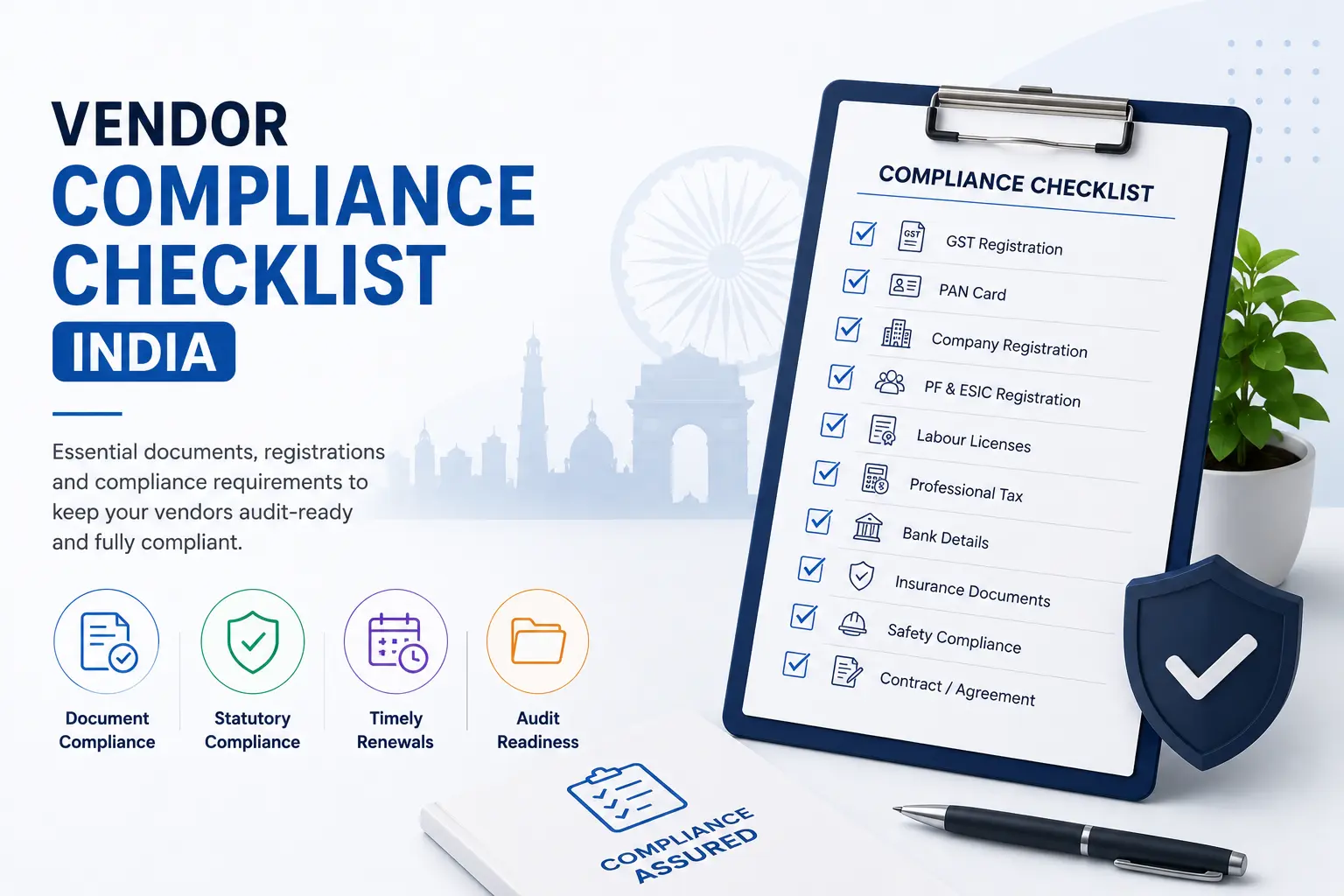
Vendor Compliance Checklist India: Complete Guide for Suppliers and Contractors
Managing vendors in India involves more than purchase orders, invoices, and contracts.
Depending on the vendor relationship, organizations may need to collect, verify, monitor, and maintain business, tax, statutory, labour, insurance, safety, and other compliance records.
When vendor documents are scattered across emails, Excel files, shared folders, and paper records, procurement and compliance teams may struggle to determine:
- Which documents are required
- Which documents have been received
- Which documents are valid
- Which documents are expiring
- Which documents are missing
- Which vendors have compliance gaps
- Who reviewed or approved a document
A structured vendor compliance checklist for India helps organizations establish consistent requirements, monitor vendor documentation, and maintain better audit readiness.
This guide covers:
- What vendor compliance means
- Why vendor compliance matters in India
- A practical vendor compliance checklist
- Common vendor compliance documents
- PF and ESIC-related records
- Labour and contractor records
- Insurance and safety documentation
- Expiry and renewal tracking
- Vendor compliance workflows
- Best practices
- Manual vs automated compliance management
- How AI can support vendor compliance
- How VendorCompliancePro helps
What Is Vendor Compliance?
Vendor compliance is the process of ensuring that suppliers, contractors, service providers, and other third parties meet the organization’s applicable legal, statutory, contractual, operational, safety, and internal requirements.
Vendor compliance can include:
- Vendor registration
- Document collection
- Document verification
- Compliance approval
- Expiry tracking
- Renewal management
- Periodic reviews
- Exception management
- Audit reporting
The exact requirements vary by:
- Vendor type
- Industry
- State or location
- Nature of work
- Contract
- Risk level
- Applicable legal and regulatory requirements
- Organization policy
Therefore, there is no single document list that is mandatory for every vendor in India.
A good compliance program defines requirements based on the vendor relationship.
Why Is Vendor Compliance Important in India?
Organizations often depend on suppliers, contractors, logistics providers, manpower agencies, facility-management vendors, and other third parties.
Incomplete or outdated vendor records can create:
- Compliance gaps
- Audit observations
- Operational disruption
- Delayed approvals
- Increased administrative work
- Contractual risk
- Safety concerns
- Difficulty producing supporting evidence
A structured vendor compliance process helps organizations maintain better visibility and identify issues before they become urgent.
Vendor compliance is particularly important when third parties perform work at company facilities, provide labour, handle critical operations, or are subject to specific contractual or regulatory requirements.
Vendor Compliance Checklist for Indian Businesses
The following checklist is a practical starting point. Organizations should adapt it to their industry, vendor categories, contracts, locations, and applicable requirements.
1. Vendor Master Information
Maintain accurate vendor information such as:
- Legal vendor name
- Vendor ID
- Registered address
- Business address where applicable
- Contact person
- Email address
- Phone number
- Vendor category
- Products or services
- Business unit
- Vendor status
- Risk classification where applicable
The vendor master should be kept consistent with the approved vendor record.
See Vendor Master Data Management for more information.
2. Business and Registration Documents
Depending on the vendor, collect applicable business and registration information.
Examples may include:
- GST Registration Certificate
- PAN
- Certificate of Incorporation or business registration
- MSME/Udyam Certificate where applicable
- Shop and Establishment registration where applicable
- Other applicable registrations
These documents help establish the vendor’s business identity and registration status.
Requirements should be determined based on the vendor and applicable obligations rather than assuming every document is mandatory.
3. PF and ESIC Compliance Records
For applicable manpower, contractor, and service-provider relationships, organizations may need to review records such as:
- PF Registration Certificate
- ESIC Registration Certificate
- PF challans
- ESIC challans
- Contribution records
- Other applicable statutory evidence
The exact records and review frequency should be determined according to the applicable requirements and the organization’s compliance process.
For a focused guide, see PF and ESIC Vendor Compliance Guide.
4. Labour and Contractor Compliance
Where vendors or contractors provide labour or manpower, organizations may need to maintain or review:
- Applicable labour licenses
- Contractor licenses where applicable
- Employee lists
- Attendance records
- Wage records
- Salary records
- Other required labour compliance evidence
Requirements can vary by the nature of the work, location, workforce arrangement, and applicable requirements.
See Contractor Compliance Management for more information.
5. Insurance Documents
Where insurance is required, maintain applicable records such as:
- Workmen’s compensation insurance
- Public liability insurance
- Group medical insurance
- Other contractually required insurance
For each relevant policy, track:
- Policy number
- Issue date
- Expiry date
- Coverage information where required
- Renewal status
Insurance requirements should be based on the vendor relationship and contractual or organizational requirements.
6. Safety and Training Records
For vendors working at company facilities or performing safety-sensitive activities, relevant records may include:
- Safety training records
- PPE compliance records
- Risk assessment documents
- Safety certifications
- Emergency procedures
- Inspection records
The required evidence should be defined according to the work being performed and the organization’s safety process.
7. Environmental and Operational Documents
For applicable industries and vendor activities, organizations may need to monitor:
- Pollution-control consents
- Factory-related licenses
- Environmental clearances
- Hazardous-waste authorizations
- Other applicable permits
Manufacturing, engineering, construction, and other industrial activities may require additional documentation depending on the specific activity and location.
8. Contract and Commercial Records
Vendor compliance should also connect with the commercial relationship.
Maintain or reference:
- Signed vendor contracts
- Service agreements
- Purchase-related agreements
- Contract start date
- Contract expiry date
- Notice period where applicable
- Renewal status
- Approval history
For contract expiry tracking, see Vendor Contract Expiry Reminder.
9. Document Expiry and Renewal Tracking
Not every vendor document has a fixed expiry date.
For documents with validity periods, track:
- Issue date
- Expiry date
- Review date where applicable
- Renewal status
- Responsible owner
Examples of documents that may require expiry tracking include:
| Document | Tracking Approach |
|---|---|
| Labour License | Track validity where applicable |
| Contractor License | Track validity where applicable |
| Insurance Policy | Track expiry |
| Certification | Track validity period |
| Pollution-control consent | Track validity where applicable |
| Factory-related license | Track validity where applicable |
| GST registration | Monitor status and changes |
| PAN | Monitor status and changes |
| PF registration | Monitor status and changes |
| ESIC registration | Monitor status and changes |
The exact validity and renewal requirements should be determined from the applicable document and organizational process.
For more information, see Vendor Document Expiry Reminder.
10. Approval and Audit Trails
A compliance program should maintain evidence of important actions.
Track, where applicable:
- Submission date
- Review date
- Approval date
- Reviewer
- Approver
- Rejected documents
- Resubmissions
- Document changes
- Status changes
- User activity
An audit trail helps demonstrate how vendor compliance information was reviewed and managed.
Vendor Compliance Process
A practical vendor compliance workflow can be:
Step 1: Vendor Registration
Collect core vendor information.
Step 2: Define Requirements
Determine which documents and checks apply to the vendor.
Step 3: Document Collection
Collect required records from the vendor.
Step 4: Verification
Review submitted information and documents.
Step 5: Approval
Obtain required procurement, compliance, finance, legal, or management approvals.
Step 6: Vendor Activation
Activate the vendor according to the organization’s process.
Step 7: Expiry Monitoring
Monitor time-limited documents and other review dates.
Step 8: Renewal
Collect and review replacement documents before expiry where applicable.
Step 9: Periodic Review
Review vendor compliance according to risk and organizational policy.
Step 10: Audit Reporting
Maintain reports and evidence for internal or external reviews.
This connects vendor registration with ongoing compliance rather than treating compliance as a one-time onboarding activity.
Vendor Compliance Checklist by Vendor Type
Different vendors may require different levels of review.
| Vendor Type | Example Compliance Areas |
|---|---|
| Raw-material supplier | Business, tax, quality, contractual requirements |
| Labour contractor | Labour, PF, ESIC, insurance, employee-related records |
| Transport vendor | Business, insurance, vehicle or permit-related requirements |
| Facility-management vendor | Labour, insurance, safety, contractual requirements |
| Engineering contractor | Business, licenses, insurance, safety, project requirements |
| IT service provider | Business, contract, information-security, and applicable compliance requirements |
These are examples only. The organization should define its own vendor-specific requirements.
Common Vendor Compliance Challenges
Excel-Based Tracking
Spreadsheets require people to maintain document status, dates, and follow-up actions.
As the vendor network grows, keeping the information current can become difficult.
Missing Documents
Vendors may submit incomplete information or forget required documents.
Expired Documents
A document that was valid during onboarding may become outdated later.
Scattered Records
Vendor documents may be distributed across email, folders, and different systems.
Manual Follow-Up
Procurement teams may spend significant time requesting missing or renewed documents.
Limited Visibility
Management may not have a current view of compliant, non-compliant, expiring, or pending vendors.
Audit Pressure
Finding documents and proving approval history can take significant time when records are not organized.
Manual Vendor Compliance Tracking vs Compliance Software
| Manual Process | Compliance Software |
|---|---|
| Excel spreadsheets | Centralized vendor records |
| Email follow-ups | Automated notifications |
| Scattered documents | Organized document repository |
| Manual expiry checks | Automated expiry tracking |
| Manual approvals | Workflow-based approvals |
| Difficult reporting | Compliance dashboards |
| Limited history | Audit trails |
| Last-minute audit preparation | Continuous compliance visibility |
Software can reduce repetitive administrative work, but organizations still need clearly defined requirements, ownership, review processes, and appropriate human judgment.
Best Practices for Vendor Compliance in India
1. Define Requirements by Vendor Type
Do not use one document list for every supplier and contractor.
Create requirements based on:
- Vendor category
- Industry
- Risk
- Work performed
- Location
- Contract
- Applicable obligations
2. Centralize Vendor Records
Maintain vendor information and supporting documents in a controlled repository.
3. Validate Before Approval
Review vendor information and documents before the vendor is activated.
4. Track Expiry Dates
Monitor documents that have validity periods and begin renewal activities early.
5. Assign Responsibility
Define who is responsible for:
- Collecting documents
- Reviewing documents
- Approving documents
- Following up on missing information
- Monitoring renewals
6. Maintain an Audit Trail
Record important submissions, approvals, rejections, changes, and status updates.
7. Conduct Risk-Based Reviews
Not every vendor requires the same depth or frequency of review.
Higher-risk or business-critical vendors may require additional controls.
8. Review Compliance Periodically
Do not wait until an audit is announced.
9. Protect Sensitive Information
Use appropriate access controls for financial, personal, and other sensitive vendor information.
10. Connect Compliance With Vendor Lifecycle Management
A strong process connects:
Vendor Registration → Vendor Master → Documents → Compliance → Contracts → Risk → Audit Readiness
How AI Can Support Vendor Compliance
AI and OCR technologies can support parts of vendor compliance management.
Depending on the implementation, they can help:
- Identify document types
- Extract vendor information
- Extract registration numbers
- Extract dates
- Support document validation
- Identify potential missing information
- Reduce manual data entry
- Flag documents for human review
AI should support human review rather than automatically treating every extracted value as correct.
This is particularly important when vendor compliance decisions have legal, financial, safety, or operational implications.
Vendor Compliance Audit Preparation Checklist
Before an audit or compliance review, check:
- Vendor master records are complete
- Vendor information is current
- Required documents are defined
- Required documents are available
- Documents have been reviewed
- Expiry dates are tracked where applicable
- Expiring documents are being renewed
- Missing documents are identified
- Rejected documents are tracked
- PF/ESIC records are available where applicable
- Labour records are available where applicable
- Insurance records are current where required
- Contract information is accessible
- Approval history is available
- Audit trails are maintained
- Open compliance issues have owners
- Compliance reports are current
For a more detailed audit-focused checklist, see Vendor Audit Readiness Checklist.
Industries That Benefit From Vendor Compliance Management
Vendor compliance is particularly important for:
Manufacturing
Manage supplier, contractor, labour, safety, and statutory requirements.
Logistics
Monitor transport vendors, service providers, insurance, and applicable documentation.
Warehousing
Track contractors, maintenance providers, facility vendors, and compliance records.
Engineering
Manage supplier, project, safety, and statutory documentation.
Construction
Track contractors, subcontractors, labour, safety, and insurance records.
Facility Management
Manage manpower, housekeeping, security, maintenance, and other service providers.
The exact compliance requirements depend on the organization, vendor relationship, location, and applicable obligations.
How VendorCompliancePro Helps With Vendor Compliance
VendorCompliancePro provides a centralized workflow for vendor information, documents, and compliance monitoring.
Organizations can use the platform for:
- Vendor registration
- Vendor self-service portal
- Centralized vendor document repository
- Configurable document requirements
- AI-powered document validation
- OCR processing
- Approval workflows
- Document expiry tracking
- Automated renewal reminders
- Compliance dashboards
- Audit trails
- Reports and analytics
The platform connects:
Vendor → Documents → Verification → Approval → Expiry → Renewal → Compliance Status
VendorCompliancePro can complement an existing ERP or procurement system by focusing on vendor information, document collection, compliance workflows, expiry monitoring, and audit readiness.
Vendor Compliance Checklist
Use this condensed checklist for periodic reviews:
- Vendor master information is complete
- Vendor registration documents are available
- Applicable tax information is recorded
- Applicable statutory documents are available
- PF and ESIC records are reviewed where applicable
- Labour and contractor records are reviewed where applicable
- Insurance records are current where required
- Safety records are maintained where applicable
- Environmental documents are maintained where applicable
- Contract information is accessible
- Document expiry dates are monitored
- Renewal reminders are configured
- Missing documents are tracked
- Approval history is available
- Audit trails are maintained
- Compliance issues have assigned owners
- Periodic compliance review is completed
- Audit reports are available
Frequently Asked Questions
What is a vendor compliance checklist in India?
A vendor compliance checklist is a structured list of vendor information, documents, reviews, approvals, and monitoring activities used to help ensure suppliers and contractors meet applicable organizational and compliance requirements.
Which documents should be collected from vendors in India?
The exact documents depend on the vendor relationship and applicable requirements. Common examples may include GST registration, PAN, business registration, MSME/Udyam information where applicable, PF and ESIC records where applicable, labour-related documents, insurance, safety, environmental, and contractual records.
Is GST registration mandatory for every vendor?
Not necessarily. Whether GST registration applies depends on the vendor’s circumstances and applicable requirements. Organizations should define their vendor document requirements based on the applicable tax and business rules rather than assuming every vendor must provide the same document.
Should every vendor submit PF and ESIC documents?
No. PF and ESIC requirements depend on the vendor relationship, workforce arrangement, and applicable requirements. They are particularly relevant to certain manpower and contractor relationships.
How often should vendor compliance be reviewed?
There is no single review frequency for every vendor. The appropriate frequency can depend on vendor risk, document validity, business criticality, contractual requirements, and applicable obligations.
How do organizations track vendor compliance?
Organizations can use a combination of vendor master data, document repositories, compliance checklists, expiry tracking, approval workflows, periodic reviews, and compliance reports.
Can vendor compliance be automated?
Yes. Organizations can automate document collection, reminders, approval workflows, expiry tracking, dashboards, reporting, and some document-validation tasks.
Human review remains important for significant legal, financial, safety, and compliance decisions.
What is the difference between vendor compliance and vendor onboarding?
Vendor onboarding is the broader process of bringing a supplier into the organization.
Vendor compliance focuses on ensuring that the vendor continues to meet applicable requirements.
Compliance therefore continues after onboarding.
Conclusion
A strong vendor compliance checklist for India should not be treated as a one-time document collection exercise.
A sustainable process connects:
Vendor Registration → Requirement Definition → Document Collection → Verification → Approval → Expiry Monitoring → Renewal → Periodic Review → Audit Readiness
The exact compliance requirements vary by vendor, industry, location, contract, risk, and applicable obligations.
Organizations that define vendor-specific requirements, centralize records, monitor expiry dates, maintain approval history, and review compliance periodically can improve visibility and reduce the effort required to respond to audits.
The goal is simple:
Know what each vendor is required to provide, verify it, keep it current, and maintain evidence throughout the vendor relationship.
Related Articles
- Vendor Registration Process
- Vendor Master Data Management
- Vendor Document Management
- Vendor Document Tracking
- Vendor Document Expiry Reminder
- Vendor Contract Expiry Reminder
- Supplier Master Data Management: Best Practices
- Supplier Risk Assessment Process
- Vendor Audit Readiness Checklist
- PF and ESIC Vendor Compliance Guide
- Contractor Compliance Management
- What Is Vendor Compliance?