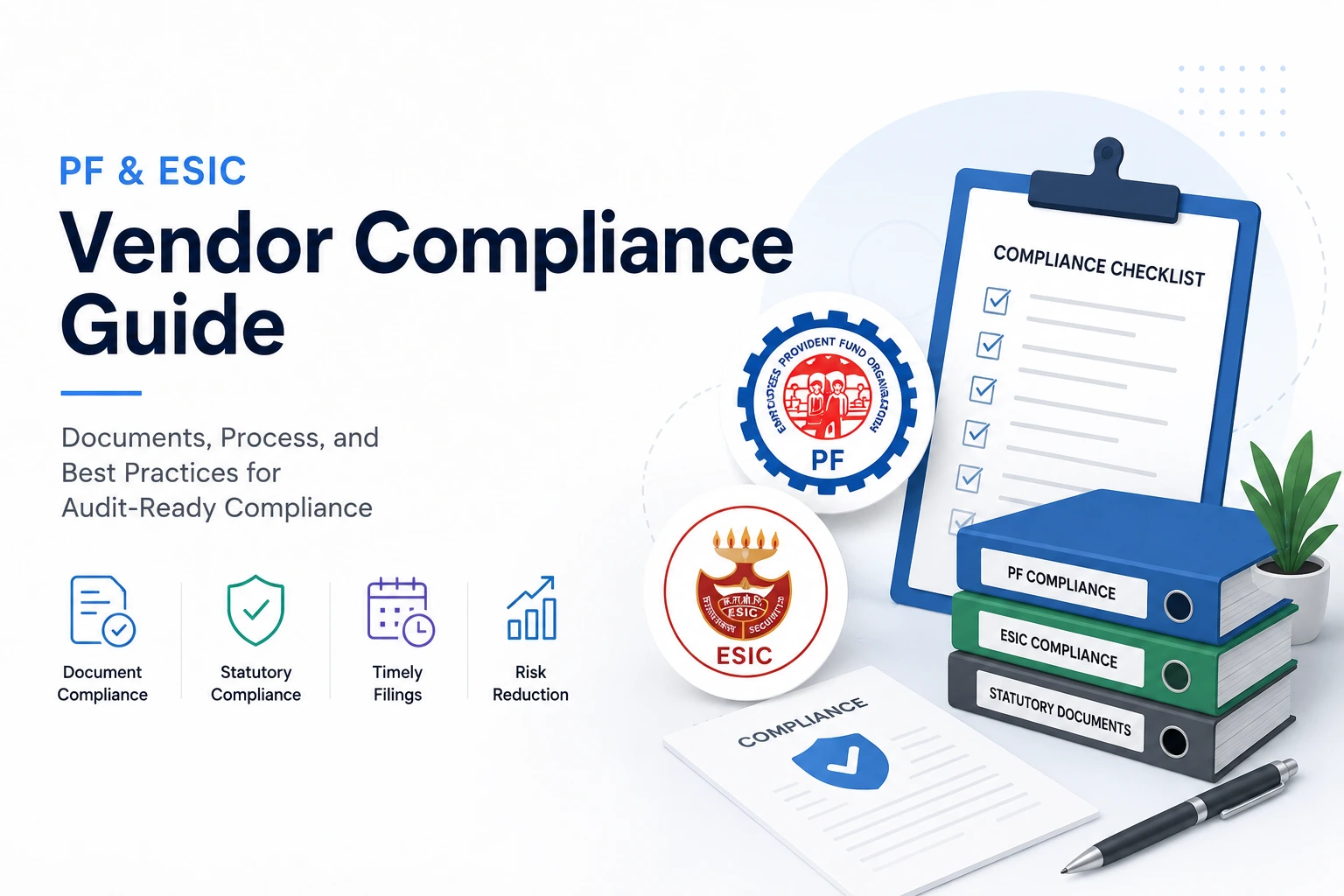
PF and ESIC Vendor Compliance Guide India: Documents, Checklist and Best Practices
Organizations that work with manpower suppliers, labour contractors, housekeeping agencies, security contractors, maintenance providers, and other service providers may need to monitor PF and ESIC-related compliance where applicable.
Managing these records manually can become difficult when contractors submit documents every month and the organization works with multiple sites or vendors.
Compliance teams may need to know:
- Which contractors are required to provide PF and ESIC records
- Whether required registrations are available
- Whether monthly records have been submitted
- Whether supporting employee and wage information is available
- Which submissions are pending
- Which records were reviewed and approved
- What evidence is available for an audit
A structured PF and ESIC vendor compliance process helps organizations collect, review, track, and report relevant contractor records.
This guide explains the common documents, review process, checklist, challenges, and software capabilities that can help organizations manage PF and ESIC vendor compliance more efficiently.
Important: PF and ESIC applicability and obligations depend on the relevant establishment, workforce arrangement, and applicable rules. This article is a vendor-management and record-tracking guide, not legal advice. Organizations should verify specific obligations with qualified compliance professionals or the relevant authorities.
What Is PF Vendor Compliance?
PF vendor compliance refers to the process of monitoring applicable provident-fund-related records submitted by contractors or vendors.
For organizations using manpower or labour contractors, the compliance process may include reviewing:
- PF registration information
- Establishment details
- Monthly contribution records
- Challans
- ECR-related records
- Employee-related information
- Wage records
- Attendance records
The exact evidence required should be defined according to the contractor relationship and the organization’s compliance process.
What Is ESIC Vendor Compliance?
ESIC vendor compliance refers to the process of monitoring applicable Employees’ State Insurance-related records submitted by contractors or vendors.
Depending on the relationship and applicability, organizations may review:
- ESIC registration information
- Employer or establishment details
- Monthly contribution records
- Challans
- Employee insurance-related information
- Wage records
- Attendance records
The required records should be determined according to the applicable requirements and the organization’s contractor compliance policy.
Why PF and ESIC Vendor Compliance Matters
Organizations often rely on contractors for:
- Manufacturing support
- Housekeeping
- Security
- Maintenance
- Logistics
- Facility management
- Engineering services
- Other outsourced activities
Where PF or ESIC requirements apply, incomplete or outdated records can make compliance monitoring difficult.
Common challenges include:
- Missing monthly submissions
- Incomplete records
- Delayed contractor responses
- Expired or outdated supporting documents
- Scattered records
- Difficult audit preparation
- Limited visibility across contractors
A structured process helps organizations identify issues earlier and maintain evidence of their reviews.
Who Should Monitor PF and ESIC Contractor Compliance?
Not every vendor requires the same PF or ESIC documentation.
The need for monitoring can depend on:
- Contractor type
- Workforce arrangement
- Number and nature of workers
- Location
- Applicable requirements
- Contract terms
- Organization policy
PF and ESIC compliance is particularly relevant when organizations engage manpower, labour, housekeeping, security, maintenance, or similar contractors where applicable.
Instead of assigning the same checklist to every vendor, organizations should create requirements based on the contractor relationship.
PF and ESIC Vendor Compliance Documents
The exact document set can vary, but organizations commonly manage the following categories.
PF-Related Records
Depending on applicability:
- PF registration information
- Establishment code or identifier
- Monthly PF challans
- ECR-related records
- Contribution records
- Employee-related PF information
- Wage records
- Attendance records
ESIC-Related Records
Depending on applicability:
- ESIC registration information
- Employer or establishment code
- Monthly ESIC challans
- Contribution records
- Employee insurance-related information
- Wage records
- Attendance records
Supporting Contractor Records
Where applicable:
- Labour-related licenses
- Contractor-related licenses
- Employee list
- Attendance register
- Wage register
- Salary records
- Insurance documents
- Contract details
The organization should define exactly which records are required for each contractor category.
PF and ESIC Vendor Compliance Checklist
Use this as a practical starting checklist.
Contractor Information
- Contractor name recorded
- Contractor ID recorded
- Contact details available
- Contractor category defined
- Work location recorded
- Contract owner assigned
PF Records
- Applicable PF registration information collected
- Establishment details recorded
- Monthly PF challans submitted where required
- ECR-related records submitted where required
- Contribution records available
- Supporting employee or wage records available where required
ESIC Records
- Applicable ESIC registration information collected
- Establishment details recorded
- Monthly ESIC challans submitted where required
- Contribution records available
- Supporting employee or wage records available where required
Contractor Records
- Applicable labour documents available
- Applicable contractor licenses available
- Insurance records available where required
- Contract information available
- Safety records available where applicable
Review and Audit
- Monthly submissions reviewed
- Missing records identified
- Rejected records tracked
- Follow-up actions assigned
- Approval or review history maintained
- Audit evidence is accessible
PF and ESIC Compliance Process for Contractors
A practical workflow can be:
Step 1: Identify Applicability
Determine whether PF and ESIC-related requirements apply to the contractor relationship.
Step 2: Register the Contractor
Capture contractor information and classify the relationship.
Step 3: Define Required Records
Create the applicable document and submission checklist.
Step 4: Collect Initial Documents
Collect registration and other required records.
Step 5: Verify the Information
Review the submitted records according to the organization’s process.
Step 6: Approve the Contractor
Complete required internal approvals.
Step 7: Collect Periodic Submissions
Collect applicable monthly records and supporting evidence.
Step 8: Review Submissions
Check whether the required records were submitted and whether follow-up is required.
Step 9: Track Exceptions
Identify:
- Missing submissions
- Delayed submissions
- Rejected records
- Incomplete records
- Other compliance issues
Step 10: Maintain Audit Evidence
Keep the records and review history organized for future audits and inspections.
Monthly PF and ESIC Compliance Review
For applicable contractors, a monthly review process can include:
| Review Area | Status |
|---|---|
| Contractor submission received | Pending / Complete |
| PF records received | Pending / Complete / N/A |
| ESIC records received | Pending / Complete / N/A |
| Supporting records received | Pending / Complete / N/A |
| Documents reviewed | Pending / Complete |
| Issues identified | Yes / No |
| Follow-up assigned | Yes / No |
| Review completed | Yes / No |
This simple structure gives compliance teams a consistent way to monitor contractor submissions.
Common PF and ESIC Compliance Challenges
Missing Monthly Records
Contractors may not submit required records on time.
Delayed Follow-Up
Teams may notice missing submissions only after the expected review date.
Scattered Documents
Monthly records can be stored across emails, folders, and spreadsheets.
Manual Data Entry
Compliance teams may repeatedly update spreadsheets with submission status and dates.
Limited Contractor Visibility
Organizations may not have a single view of which contractors have completed their submissions.
Difficult Audits
Finding several months of records for multiple contractors can take significant time.
Manual Tracking vs Automated PF and ESIC Compliance
| Manual Tracking | Automated Compliance Platform |
|---|---|
| Excel checklists | Centralized contractor records |
| Email follow-ups | Automated notifications |
| Manual status updates | Submission status tracking |
| Scattered documents | Centralized document repository |
| Manual reporting | Compliance dashboards |
| Difficult history | Audit trails |
| Reactive follow-up | Proactive reminders |
Automation does not replace compliance judgment. It helps organize repetitive collection, tracking, and reporting activities.
Best Practices for PF and ESIC Vendor Compliance
1. Define Applicability First
Do not assume every vendor needs the same PF and ESIC records.
Classify contractors based on the relevant relationship and requirements.
2. Create a Monthly Submission Calendar
Define expected submission dates and assign responsibility.
3. Centralize Contractor Records
Keep registration details, monthly records, supporting documents, and review history together.
4. Track Missing Submissions
Maintain a clear list of pending records and responsible owners.
5. Maintain Review Evidence
Record when documents were received, reviewed, approved, rejected, or returned for correction.
6. Escalate Delays
Create an escalation process for overdue submissions.
7. Conduct Periodic Reviews
Do not wait until an audit to discover missing records.
8. Protect Personal Information
Contractor records may contain employee and other sensitive information. Apply appropriate access controls and data-protection practices.
9. Use Risk-Based Monitoring
Higher-risk contractor relationships may require more frequent or detailed review.
How PF and ESIC Compliance Software Helps
A contractor compliance platform can help teams manage recurring PF and ESIC records through:
- Contractor profiles
- Configurable document requirements
- Monthly submission tracking
- Document upload
- Approval workflows
- Automated reminders
- Missing-document reports
- Compliance dashboards
- Audit trails
- Search and filtering
- Document history
The objective is to make the compliance process visible and repeatable.
How AI and OCR Can Support PF and ESIC Compliance
AI and OCR can assist with parts of document management.
Depending on the system, they can help:
- Identify document types
- Extract contractor information
- Extract dates and identifiers
- Detect potentially missing information
- Compare submitted documents with expected document types
- Reduce manual data entry
- Flag records for human review
AI should be used as an assistive tool.
Organizations should not rely on automated extraction alone for important statutory or compliance decisions.
Industries That Commonly Manage Contractor PF and ESIC Records
PF and ESIC-related contractor compliance can be relevant to organizations using outsourced or manpower services in areas such as:
Manufacturing
Monitor applicable records for production-support, maintenance, housekeeping, and other contractors.
Logistics
Manage manpower and service contractors supporting logistics operations.
Warehousing
Track applicable records for facility and operational contractors.
Construction
Manage contractor and workforce-related records.
Engineering
Monitor applicable records for project and maintenance contractors.
Facility Management
Track housekeeping, security, maintenance, and manpower service providers.
The applicable requirements depend on the contractor relationship and relevant rules.
Contractor PF and ESIC Audit Readiness Checklist
Before an audit or compliance review, verify:
- Contractor master information is complete
- PF applicability has been determined
- ESIC applicability has been determined
- Applicable registration information is available
- Monthly PF records are available where required
- Monthly ESIC records are available where required
- Supporting records are available where required
- Missing submissions are identified
- Delayed submissions have assigned owners
- Review history is available
- Rejected or corrected records are tracked
- Contractor contracts are accessible
- Relevant insurance records are available where required
- Audit reports can be generated
For broader contractor audit readiness, see Contractor Compliance Management.
How VendorCompliancePro Helps
VendorCompliancePro helps organizations centralize contractor and vendor compliance records.
Relevant capabilities include:
- Contractor registration
- Vendor self-service portal
- Centralized document repository
- Configurable document requirements
- Monthly document submission tracking
- Automated reminders
- Approval workflows
- Compliance dashboards
- Audit reports
- Audit trails
- AI-powered document validation
- OCR processing
The workflow can connect:
Contractor → Requirements → Monthly Submission → Review → Follow-Up → Approval → Audit Evidence
VendorCompliancePro can complement an existing ERP, HR, or procurement system by focusing on vendor and contractor document collection, compliance monitoring, recurring submissions, expiry tracking, and audit readiness.
Frequently Asked Questions
What is PF vendor compliance?
PF vendor compliance is the process of monitoring applicable provident-fund-related records and submissions from contractors or vendors.
What is ESIC vendor compliance?
ESIC vendor compliance is the process of monitoring applicable ESIC-related records and submissions from contractors or vendors.
Do all vendors need to submit PF and ESIC records?
No. Applicability depends on the contractor relationship, workforce arrangement, and applicable requirements.
Which PF documents should contractors provide?
Depending on applicability, organizations may manage PF registration information, establishment details, monthly challans, ECR-related records, contribution records, and supporting workforce or wage records.
Which ESIC documents should contractors provide?
Depending on applicability, organizations may manage ESIC registration information, establishment details, monthly challans, contribution records, and supporting workforce or wage records.
How often should PF and ESIC records be reviewed?
For contractors subject to recurring monthly submissions, organizations commonly use a monthly review process. The exact frequency should match the applicable requirements and internal compliance policy.
Can PF and ESIC compliance be tracked in Excel?
Yes. Excel can work for a small number of contractors.
As the number of contractors, sites, and monthly submissions grows, specialized software can provide automated reminders, centralized records, dashboards, workflows, and audit trails.
Can PF and ESIC compliance be automated?
Organizations can automate parts of the process, including document collection, reminders, submission tracking, approvals, reporting, and some document-validation tasks.
Human review remains important for significant statutory and compliance decisions.
Conclusion
PF and ESIC vendor compliance requires more than collecting registration documents during contractor onboarding.
For applicable contractor relationships, organizations need an ongoing process for:
Applicability → Registration → Monthly Submission → Review → Follow-Up → Approval → Record Keeping → Audit Readiness
A structured process helps procurement and compliance teams identify missing submissions, maintain review evidence, and reduce the administrative effort involved in recurring contractor compliance.
Automation can further improve visibility by connecting contractor records, monthly submissions, reminders, workflows, and audit reporting in one place.
The goal is simple:
Know which contractors have submitted the required records, identify gaps early, document the review, and maintain evidence throughout the contractor relationship.