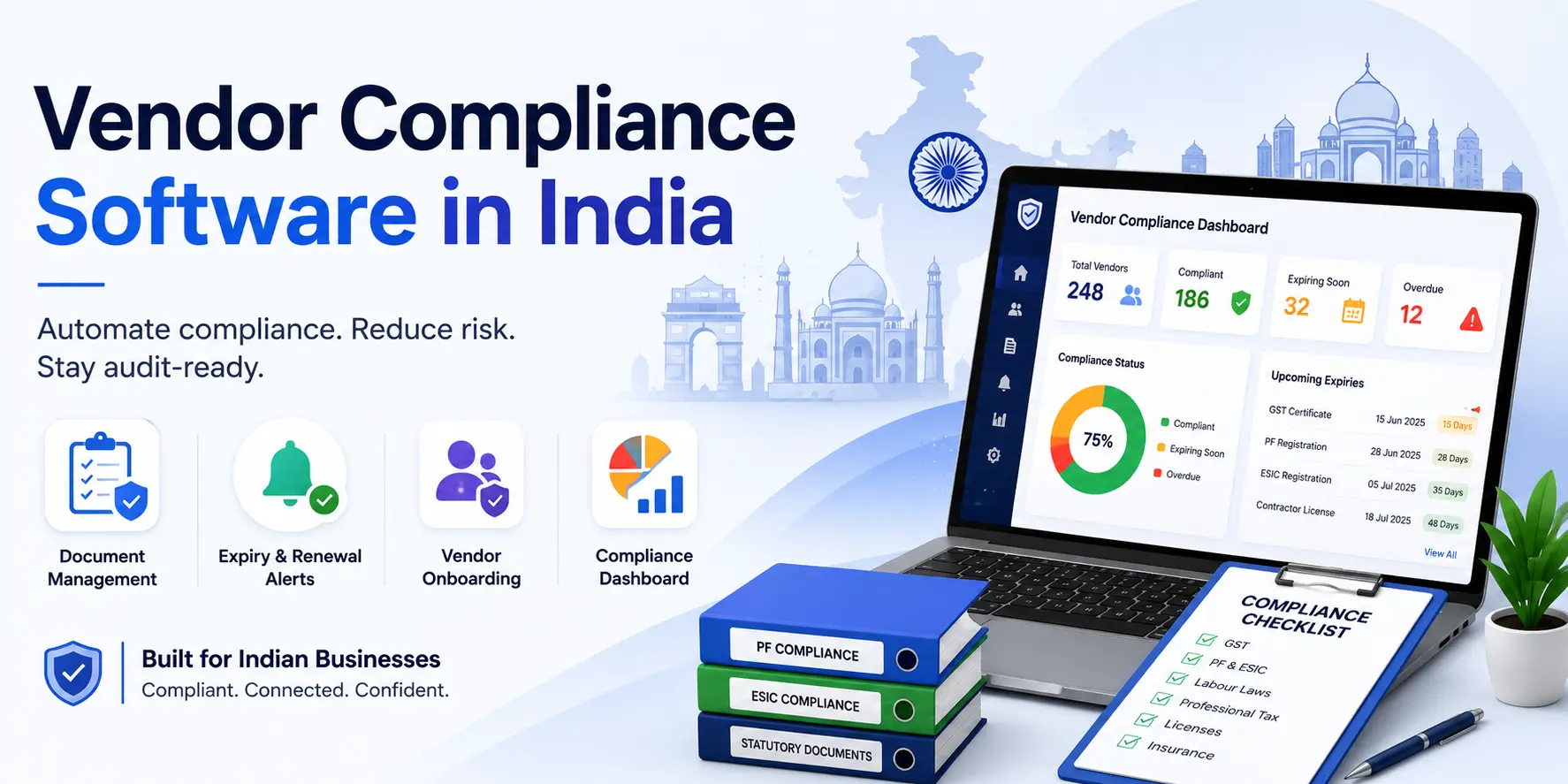
Vendor Compliance Software India: Complete Guide to Features, Benefits and Buying
Managing suppliers and contractors with Excel spreadsheets, email follow-ups, shared folders, and personal reminders can become difficult as an organization grows.
Procurement and compliance teams may need to keep track of:
- Vendor information
- Required documents
- Missing submissions
- Document approvals
- Expiry dates
- Renewal requests
- Compliance status
- Audit evidence
A vendor compliance software platform brings these activities into a structured workflow.
For Indian businesses, the right solution can help procurement, compliance, HR, EHS, finance, and operations teams manage vendor information and supporting compliance records more efficiently.
This guide explains what vendor compliance software is, which features to look for, how to compare software with spreadsheets, what to consider before buying, and how automation can improve vendor compliance management.
What Is Vendor Compliance Software?
Vendor compliance software is a software platform used to collect, organize, track, review, and monitor information and documents associated with suppliers, contractors, and other third parties.
Depending on the product, it may support:
- Vendor onboarding
- Vendor registration
- Document collection
- Document verification
- Approval workflows
- Document expiry tracking
- Renewal reminders
- Compliance dashboards
- Audit reporting
- Role-based access
- Audit trails
- Vendor self-service
Instead of maintaining vendor compliance information across multiple spreadsheets and folders, teams can manage the process through a centralized system.
The exact features vary between products, so organizations should evaluate software against their own vendor-management requirements.
Why Do Companies Need Vendor Compliance Software?
As vendor networks grow, the number of documents and renewal dates also increases.
A company may work with:
- Suppliers
- Contractors
- Manpower agencies
- Transport vendors
- Maintenance providers
- Security agencies
- Facility-management companies
- Engineering contractors
- Service providers
Manual processes can create challenges such as:
Missing Documents
Teams may not know which required documents have not yet been submitted.
Expiring Documents
Important time-limited documents may approach expiry without timely follow-up.
Repeated Vendor Follow-Up
Procurement teams may spend considerable time requesting missing or renewed documents.
Scattered Records
Documents can be distributed across emails, shared drives, and local folders.
Difficult Audits
Finding current documents and approval history can take significant time.
Limited Visibility
Management may not have a current view of vendor compliance status.
Vendor compliance software is designed to organize these activities into a repeatable process.
What Does Vendor Compliance Software Manage?
The exact document set depends on the vendor relationship and applicable requirements.
Common categories may include:
Business and Registration Information
- GST registration information
- PAN
- Business registration documents
- MSME/Udyam information where applicable
Statutory and Labour Records
For applicable vendors:
- PF registration
- ESIC registration
- Labour-related licenses
- Contractor-related records
- Employee or workforce records
Insurance Records
Where required:
- Workmen’s compensation insurance
- Public liability insurance
- Other contractually required insurance
Safety Records
Depending on the work:
- Safety training records
- PPE records
- Risk assessments
- Safety certifications
Environmental and Operational Records
Where applicable:
- Pollution-control consents
- Factory-related licenses
- Environmental documentation
- Other permits
Organizations should define document requirements based on vendor category, industry, location, contract, risk, and applicable obligations.
Key Features to Look for in Vendor Compliance Software
The right feature set depends on the size and complexity of your vendor program.
1. Centralized Vendor Repository
The system should provide a structured location for:
- Vendor profiles
- Vendor documents
- Compliance status
- Approvals
- Important dates
- Vendor history
A centralized record reduces the need to search multiple systems.
2. Vendor Self-Service Portal
A vendor portal allows suppliers and contractors to:
- Register
- Update information
- Upload documents
- View document requirements
- Respond to renewal requests
- Track submission status
This can reduce manual data collection by internal teams.
3. Configurable Document Requirements
Different vendor categories may require different documents.
Look for the ability to define requirements based on:
- Vendor type
- Industry
- Location
- Risk
- Contract
- Business activity
This is more useful than forcing every vendor through the same checklist.
4. Document Verification and Approval
The system should support workflows for:
- Submitted
- Under Review
- Approved
- Rejected
- Resubmission
Approval history should be retained where appropriate.
5. Document Expiry Tracking
For time-limited documents, the system should record relevant dates and identify documents approaching expiry.
This helps teams begin renewal activities earlier.
See Vendor Document Expiry Reminder for more information.
6. Automated Renewal Reminders
A useful system should support configurable reminders for vendors or internal owners.
Example schedules may include:
- 90 days before expiry
- 60 days before expiry
- 30 days before expiry
- 15 days before expiry
- 7 days before expiry
These are examples only. Reminder schedules should depend on document type, vendor risk, and renewal lead time.
7. Compliance Dashboards
Dashboards can provide visibility into:
- Compliant vendors
- Vendors with missing documents
- Expiring documents
- Expired documents
- Pending approvals
- Renewal status
- Open compliance issues
Good dashboards should help teams identify actions rather than simply display numbers.
8. Reports and Audit Readiness
Look for reports covering:
- Vendor compliance status
- Missing documents
- Expiring documents
- Expired documents
- Pending approvals
- Renewal activity
- Document history
A structured reporting process can reduce the effort required to prepare for audits and reviews.
9. Role-Based Access
Vendor compliance information may involve sensitive business and personal information.
A system should provide appropriate access controls for roles such as:
- Administrators
- Procurement users
- Compliance users
- Auditors
- Vendors
Access should follow the organization’s security and data-governance requirements.
10. Audit Trail
The system should record important activities such as:
- Document uploads
- Approvals
- Rejections
- Status changes
- Updates
- User activity
Audit history can improve accountability and help reconstruct important actions.
11. Search and Filtering
When hundreds or thousands of documents are involved, search becomes important.
Useful filters may include:
- Vendor
- Vendor category
- Document type
- Status
- Expiry date
- Compliance status
- Business unit
12. API and System Integration
Larger organizations may want integration with:
- ERP systems
- Procurement systems
- HR systems
- Finance systems
- Identity providers
- Other internal applications
Integration requirements should be evaluated before selecting a product.
Vendor Compliance Software vs Excel
Excel is not automatically the wrong solution.
For a small vendor portfolio, a spreadsheet may be sufficient.
However, as vendor and document volumes increase, teams may need capabilities that are difficult to maintain manually.
| Capability | Excel | Vendor Compliance Software |
|---|---|---|
| Vendor records | Yes | Yes |
| Document storage | Basic / external | Centralized |
| Expiry tracking | Manual | Automated |
| Renewal reminders | Manual | Configurable |
| Vendor portal | No | Often available |
| Approval workflow | Limited | Workflow-based |
| Compliance dashboard | Basic | Dedicated |
| Audit trail | Limited | Built-in |
| Role-based access | Limited | Supported |
| Reporting | Manual | Automated |
| Scalability | Depends on process | Designed for larger workflows |
The right choice depends on vendor volume, process complexity, risk, and budget.
Benefits of Vendor Compliance Software
Better Compliance Visibility
Teams can identify missing, expiring, expired, and pending documents more easily.
Reduced Manual Work
Automation can reduce repetitive spreadsheet updates and email follow-ups.
Faster Vendor Onboarding
Structured document requirements and workflows can make onboarding more consistent.
Proactive Renewal Management
Expiry tracking and reminders can help teams begin renewals before deadlines.
Better Audit Preparation
Current records, status information, and audit trails are easier to retrieve.
Improved Accountability
Assigned owners and workflow history make responsibilities clearer.
Better Vendor Collaboration
A self-service portal can give vendors a structured way to submit and update documents.
How Vendor Compliance Software Fits Into the Vendor Lifecycle
Vendor compliance should not be treated as a one-time onboarding task.
A broader workflow can be:
Vendor Registration
↓
Vendor Master Data
↓
Document Collection
↓
Verification
↓
Approval
↓
Compliance Monitoring
↓
Expiry and Renewal
↓
Contract Management
↓
Periodic Review
↓
Audit Readiness
This approach helps organizations manage vendor compliance throughout the relationship.
How to Choose Vendor Compliance Software in India
Before selecting a solution, evaluate the following.
1. Vendor Volume
Estimate:
- Number of vendors
- Number of documents
- Number of internal users
- Expected growth
2. Vendor Categories
Determine whether different vendor types need different compliance requirements.
3. Document Requirements
List the documents you actually need to manage.
Avoid selecting software based only on a generic feature list.
4. Workflow Requirements
Identify who needs to:
- Submit
- Review
- Approve
- Reject
- Follow up
- Escalate
5. Reminder Requirements
Define which documents require reminders and how much lead time is needed.
6. Reporting Requirements
Identify the reports procurement and management need.
7. Integration
Check whether the solution needs to connect with existing ERP, procurement, HR, or finance systems.
8. Security and Access
Evaluate:
- Role-based access
- Authentication
- Data protection
- Audit logs
- Backup and recovery
- Organization’s security requirements
9. Vendor Experience
The solution should be easy for external vendors to use.
A complicated vendor portal can reduce adoption.
10. Total Cost
Consider:
- Subscription
- Implementation
- User licensing
- Vendor licensing if applicable
- Integration
- Support
- Data migration
The cheapest product is not always the lowest-cost solution if it creates additional administrative work.
Questions to Ask Before Buying
Use this checklist when evaluating vendors:
- Can vendors upload documents themselves?
- Can document requirements vary by vendor type?
- Can expiry dates be tracked?
- Can reminder schedules be configured?
- Can renewal status be tracked?
- Can documents go through approval workflows?
- Can users see missing documents?
- Can users identify expired documents?
- Are audit trails available?
- Are role-based permissions supported?
- Can reports be exported?
- Is there an API?
- Can the system integrate with existing applications?
- Is OCR or AI-assisted validation available?
- Can sensitive vendor information be protected appropriately?
- Is the vendor experience simple enough for external users?
- Is pricing suitable for the organization’s vendor volume?
Implementation Best Practices
Buying software is only one part of improving vendor compliance.
Start With a Document Matrix
Define required documents by:
- Vendor category
- Risk
- Business activity
- Location
- Contract
Clean Existing Vendor Data
Before migration, identify:
- Duplicate vendors
- Inactive vendors
- Missing information
- Outdated documents
Define Ownership
Decide who is responsible for:
- Vendor onboarding
- Document review
- Approval
- Renewal follow-up
- Compliance escalation
Configure Reminder Rules
Set reminder schedules based on actual renewal lead times.
Pilot With a Small Vendor Group
Start with a manageable group of vendors before expanding across the organization.
Measure Results
Useful measures may include:
- Missing-document rate
- Expired-document count
- Average renewal lead time
- Pending approval count
- Vendor onboarding time
- Compliance issue resolution time
How AI Can Support Vendor Compliance Software
AI and OCR can support parts of vendor document management.
Depending on the implementation, they can help:
- Identify document types
- Extract vendor names
- Extract registration numbers
- Extract dates
- Identify potential missing information
- Support document validation
- Reduce manual data entry
- Flag records for human review
AI should be treated as an assistive capability rather than a guarantee of compliance.
Important legal, financial, safety, and compliance decisions should remain subject to appropriate human review.
Industries That Benefit From Vendor Compliance Software
Manufacturing
Manage supplier and contractor documents, compliance requirements, and renewal dates.
Logistics
Track transport vendors, insurance, service-provider records, and applicable documentation.
Warehousing
Manage facility, maintenance, security, labour, and service vendors.
Construction
Track contractors, subcontractors, labour-related documentation, insurance, and safety records.
Engineering
Manage supplier, engineering-service, safety, and compliance records.
Facility Management
Monitor housekeeping, security, maintenance, manpower, and other service providers.
The exact requirements depend on the organization and the vendor relationship.
How VendorCompliancePro Helps
VendorCompliancePro is designed to help organizations manage vendor information, documents, compliance workflows, and expiry monitoring in one platform.
Capabilities include:
- Vendor registration
- Vendor self-service portal
- Centralized vendor repository
- Configurable document requirements
- Document collection
- AI-powered document validation
- OCR processing
- Approval workflows
- Document expiry tracking
- Automated expiry reminders
- Compliance dashboards
- Audit trails
- Reports and analytics
The platform connects:
Vendor → Documents → Verification → Approval → Expiry → Renewal → Compliance Status
VendorCompliancePro can complement an existing ERP or procurement system by focusing on vendor document collection, compliance monitoring, expiry tracking, renewal reminders, and audit readiness.
Frequently Asked Questions
What is vendor compliance software?
Vendor compliance software is a platform that helps organizations manage supplier and contractor information, documents, compliance status, approvals, expiry dates, renewals, and reporting.
Who should use vendor compliance software?
It can be useful for organizations managing multiple suppliers, contractors, manpower agencies, service providers, or other third parties.
Manufacturing, logistics, warehousing, construction, engineering, and facility-management organizations are common examples.
What is the difference between vendor compliance software and supplier management software?
The terms can overlap.
Vendor compliance software generally focuses on compliance documents, requirements, approvals, expiry dates, renewals, and compliance monitoring.
Supplier-management platforms may cover a broader set of activities such as sourcing, purchasing, performance management, contracts, and supplier relationships.
The right product depends on the organization’s needs.
Can vendor compliance software replace an ERP?
Usually, vendor compliance software and an ERP serve different purposes.
An ERP may manage purchasing, finance, inventory, and other core business processes, while a vendor compliance platform can focus on vendor documents, compliance workflows, expiry monitoring, and audit readiness.
Integration between systems may be appropriate.
Can Excel be replaced with vendor compliance software?
For organizations with growing vendor and document volumes, software can provide capabilities that are difficult to maintain manually, such as automated reminders, approval workflows, dashboards, audit trails, and vendor self-service.
For small vendor portfolios, Excel may still be sufficient.
Does vendor compliance software send expiry reminders?
Many vendor compliance platforms provide configurable notifications for documents approaching expiry.
The exact reminder capabilities vary by product.
Can vendors upload their own documents?
Some platforms provide vendor self-service portals that allow suppliers and contractors to register, upload documents, and respond to renewal requests.
Can AI validate vendor documents?
AI and OCR can assist with document classification, information extraction, and validation checks.
Human review may still be required for important compliance decisions.
Conclusion
Vendor compliance software can help organizations move from manual vendor-document tracking to a more structured and proactive compliance process.
The strongest solutions bring together:
Vendor Records → Documents → Verification → Approvals → Expiry Tracking → Renewal → Reporting → Audit Readiness
Before selecting software, organizations should define their vendor categories, document requirements, workflows, reminder rules, reporting needs, integrations, security requirements, and budget.
For growing organizations, the goal is not simply to store vendor documents.
The goal is to know:
Which vendors are compliant, which documents are missing or expiring, what action is required, and who is responsible for it.
Related Articles
- Vendor Compliance Checklist India
- Vendor Document Management
- Vendor Document Tracking
- Vendor Document Expiry Reminder
- Vendor Contract Expiry Reminder
- Vendor Registration Process
- Vendor Master Data Management
- Supplier Master Data Management: Best Practices
- Supplier Risk Assessment Process
- Vendor Audit Readiness Checklist
- What Is Vendor Compliance?