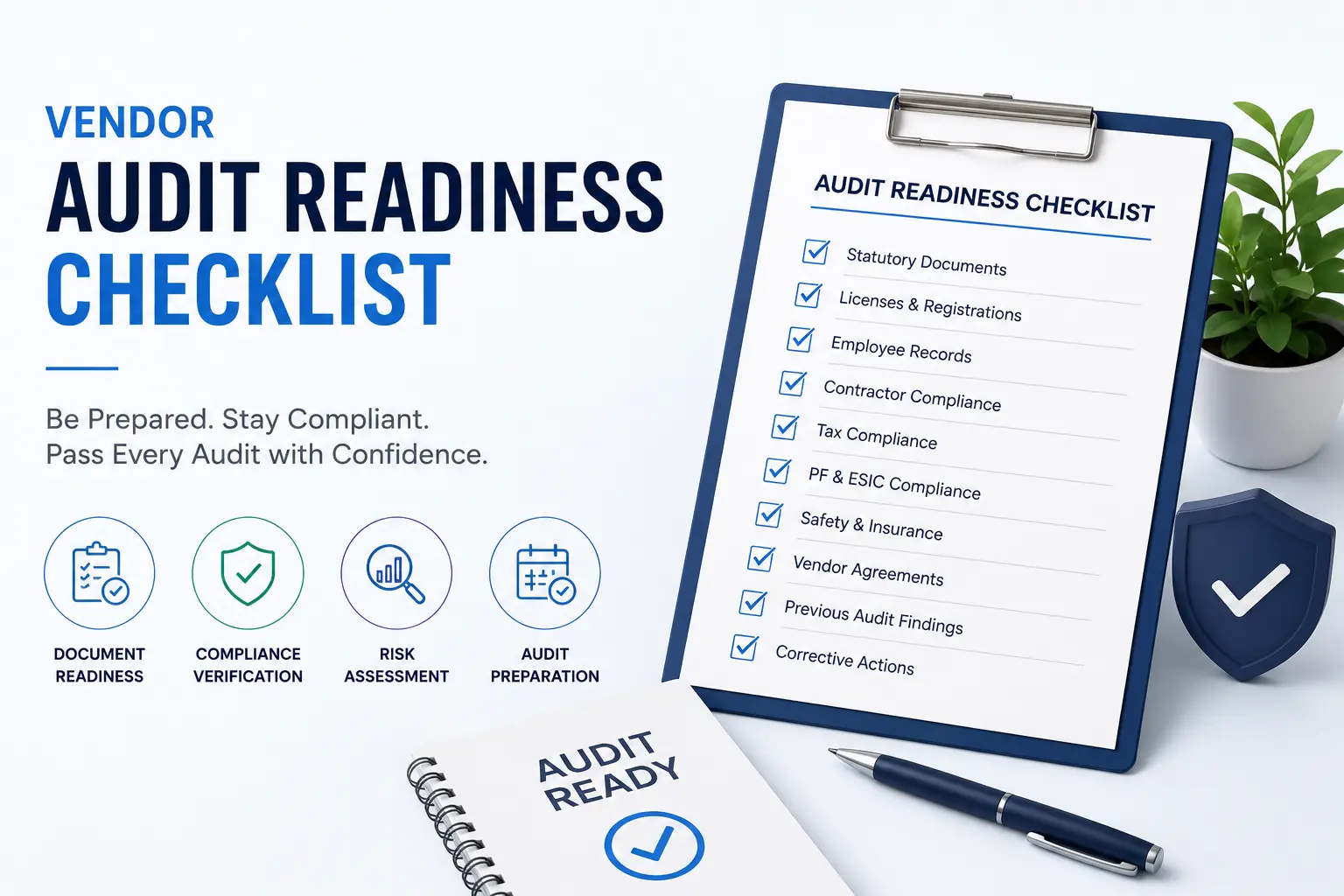
Vendor Audit Readiness Checklist: Complete Guide for Staying Audit-Ready
Are you able to produce the right vendor records and compliance documents quickly when an auditor asks for them?
For many procurement and compliance teams, the problem is not that documents do not exist. The problem is that vendor information is scattered across emails, Excel files, shared drives, paper records, and different systems.
Missing documents, expired licenses, incomplete vendor records, and unclear approval history can make an audit more difficult and increase compliance risk.
A vendor audit readiness checklist provides a structured way to verify that vendor records, compliance documents, approvals, and audit evidence are complete and current.
This guide explains:
- What vendor audit readiness means
- Why vendor audit readiness matters
- Which vendor records and documents to review
- A practical vendor audit readiness checklist
- How to prepare before an audit
- Common vendor audit challenges
- Manual vs automated audit management
- How to use technology and AI for audit readiness
- How VendorCompliancePro supports ongoing vendor compliance
What Is Vendor Audit Readiness?
Vendor audit readiness means maintaining complete, accurate, current, and traceable vendor records so that an organization can provide supporting evidence when required during an audit or inspection.
Vendor audit readiness may be relevant to:
- Internal audits
- Customer audits
- ISO audits
- Regulatory inspections
- Labour compliance audits
- Safety audits
- Contractor compliance reviews
- Supplier audits
Being audit-ready means an organization does not have to start searching for documents only after an audit is announced.
Instead, vendor information and compliance evidence are maintained continuously.
Why Is Vendor Audit Readiness Important?
Vendor-related audit issues can arise when organizations cannot quickly demonstrate that required controls are working.
Common problems include:
- Missing vendor documents
- Expired licenses
- Incomplete vendor records
- Missing approval evidence
- Unclear document ownership
- Inconsistent vendor information
- No history of document changes
- Delayed compliance submissions
A structured audit readiness process helps organizations:
- Improve document visibility
- Identify compliance gaps earlier
- Reduce audit preparation effort
- Improve traceability
- Support procurement governance
- Maintain better vendor compliance records
- Respond to auditors more efficiently
Audit readiness should therefore be treated as an ongoing process, not a last-minute exercise.
Vendor Audit Readiness Checklist at a Glance
Use the following checklist as a starting point:
| Area | What to Check | Status |
|---|---|---|
| Vendor master | Vendor identity and contact information | ☐ |
| Tax records | GST, PAN, and applicable tax information | ☐ |
| Statutory documents | Required registrations and licenses | ☐ |
| Insurance | Required insurance policies and validity | ☐ |
| Labour compliance | PF, ESIC, labour-related records where applicable | ☐ |
| Vendor documents | Required documents submitted and valid | ☐ |
| Document expiry | Expiry dates monitored | ☐ |
| Approvals | Vendor and document approvals traceable | ☐ |
| Audit trail | Changes and activity recorded | ☐ |
| Non-compliance | Missing or expired items identified | ☐ |
| Reports | Current compliance status available | ☐ |
| Review | Periodic vendor compliance review completed | ☐ |
The exact checklist should be adapted to the organization’s industry, vendor categories, contractual obligations, and applicable requirements.
Vendor Audit Readiness Checklist
1. Maintain Accurate Vendor Master Records
Start with the vendor master record.
Ensure the following information is available and current:
- Vendor legal name
- Vendor ID
- Contact information
- Vendor category
- Registered address
- GST number where applicable
- PAN number where applicable
- Business unit
- Vendor status
- Risk classification where applicable
The vendor master should be consistent with the organization’s approved vendor information.
For more information, see Vendor Master Data Management.
2. Verify Statutory and Registration Documents
Identify the documents required for each vendor category.
Depending on the organization and vendor relationship, these may include:
- GST Registration Certificate
- PAN Card
- MSME/Udyam Certificate
- PF Registration Certificate
- ESIC Registration Certificate
- Labour License
- Contractor License
- Business registration documents
- Other applicable registrations
Do not assume that every document is mandatory for every vendor.
Create a vendor-specific document requirement matrix based on applicable requirements.
3. Track Document Expiry Dates
Some vendor documents have defined validity periods.
Examples may include:
- Labour licenses
- Contractor licenses
- Insurance certificates
- Factory-related licenses
- Pollution-control certificates
- Certifications
- Other time-limited documents
For each applicable document, track:
- Issue date
- Expiry date
- Current status
- Renewal status
- Responsible person
- Submission date
- Approval date
Expiry tracking is one of the most important parts of ongoing vendor compliance management.
4. Maintain Insurance Records
Where insurance is required, verify that the appropriate policies are available and current.
Depending on the vendor relationship, this may include:
- Workmen’s compensation insurance
- Public liability insurance
- Group medical insurance
- Other contractually required insurance
The organization should define which insurance documents are required for each relevant vendor category.
5. Review Labour and Contractor Records
Where vendors or contractors provide personnel or labour services, additional records may be relevant.
Depending on the applicable requirements, maintain records such as:
- Employee list
- Attendance records
- Wage records
- Salary records
- PF records
- ESIC records
- Contractor-related licenses
- Other required statutory evidence
These records should be reviewed according to the organization’s compliance process.
6. Verify Periodic Compliance Submissions
Some vendor relationships require documents or evidence to be submitted periodically.
Examples may include:
- PF challans
- ESIC challans
- Contribution statements
- Attendance records
- Wage records
- Other recurring compliance submissions
A recurring compliance process should track what is expected, what has been received, what is pending, and what has been approved.
7. Maintain Approval Workflows
Audit readiness is not only about having documents.
You should also be able to demonstrate that required reviews and approvals took place.
Maintain evidence of:
- Submission date
- Review date
- Approval date
- Reviewer
- Approver
- Rejected documents
- Resubmissions
- Revision history
A clear approval history helps establish accountability.
8. Centralize Vendor Documents
Avoid storing vendor documents across disconnected locations such as:
- Email inboxes
- Individual computers
- Excel files
- Shared folders
- Paper files
A centralized vendor document repository makes it easier to:
- Search for documents
- Check document status
- Retrieve audit evidence
- Identify missing documents
- Review vendor history
Centralization should also include appropriate access controls.
9. Monitor Non-Compliant Vendors
Create a process for identifying vendors with compliance gaps.
Look for:
- Missing documents
- Expired documents
- Documents awaiting review
- Rejected documents
- Delayed submissions
- Overdue renewals
- Other unresolved compliance issues
A compliance dashboard can make these exceptions easier to identify.
The objective is to address problems before they become audit findings where possible.
10. Maintain Audit Trails
An audit-ready vendor record should provide a history of important activity.
Track information such as:
- Document upload history
- Approval history
- Rejection history
- Document replacements
- User activity
- Status changes
- Vendor record changes
An audit trail provides evidence of how vendor compliance was managed over time.
Vendor Audit Preparation: What to Review Before an Audit
Before an audit, procurement and compliance teams should perform a structured review.
Vendor Records
- Vendor master records are complete
- Vendor names and IDs are consistent
- Contact information is current
- Vendor status is accurate
Documents
- Required documents are available
- Documents are readable
- Documents belong to the correct vendor
- Required documents are approved
- Expired documents are identified
Compliance
- Statutory registrations are current where applicable
- Insurance records are current where required
- Periodic submissions are complete
- Open compliance issues are tracked
Approvals
- Vendor approval history is available
- Document approvals are traceable
- Rejected submissions are recorded
- Resubmissions are traceable
Reporting
- Current vendor compliance status is available
- Missing-document reports are available
- Expired-document reports are available
- Pending approval reports are available
Common Challenges During Vendor Audits
Documents Are Stored in Multiple Locations
When vendor documents are spread across email, spreadsheets, shared drives, and paper files, retrieval can become difficult.
A centralized repository can improve organization and searchability.
Vendor Records Are Incomplete
A vendor may have a name and contact information but lack important tax, statutory, or compliance information.
A standardized vendor registration process helps prevent incomplete records.
Documents Have Expired
A document may have been valid when the vendor was approved but become invalid later.
Ongoing expiry monitoring is therefore essential.
Approval History Is Missing
An organization may have the document but be unable to show who reviewed or approved it.
Controlled workflows and audit trails help address this problem.
Compliance Gaps Are Identified Too Late
If compliance is reviewed only immediately before an audit, there may be insufficient time to resolve missing documents or expired certificates.
Periodic monitoring helps identify issues earlier.
Manual Tracking vs Automated Vendor Audit Management
| Manual Process | Automated Process |
|---|---|
| Excel-based tracking | Centralized vendor compliance records |
| Email reminders | Automated notifications |
| Scattered documents | Organized vendor repository |
| Manual searches | Searchable records |
| Manual status updates | Real-time compliance status |
| Difficult approval tracking | Workflow-based approvals |
| Limited audit history | Activity and approval history |
| Last-minute audit preparation | Continuous audit readiness |
Automation does not remove the need for human review.
Instead, it can reduce repetitive administrative work and make important exceptions easier to identify.
Best Practices for Staying Audit-Ready
Centralize Vendor Documentation
Maintain vendor records and supporting documents in a controlled repository.
Define Vendor-Specific Requirements
Different vendor categories may require different documents and reviews.
Review Compliance Periodically
Use a defined schedule for reviewing vendor records and compliance status.
Monitor Expiry Dates
Track time-limited documents and initiate renewal processes before they expire.
Maintain Approval Evidence
Record who reviewed and approved vendor documents.
Track Exceptions
Maintain a clear list of missing, expired, rejected, or overdue compliance items.
Maintain an Audit Trail
Keep evidence of important document and vendor-record activity.
Assign Ownership
Define who is responsible for collecting, reviewing, approving, and following up on vendor compliance.
Keep Audit Evidence Accessible
Make sure authorized users can retrieve relevant vendor information without searching across multiple systems.
How AI Can Improve Vendor Audit Readiness
AI and document-processing technologies can support parts of the vendor compliance workflow.
Depending on the technology and implementation, AI/OCR can help:
- Extract information from uploaded documents
- Identify document types
- Extract dates and identifiers
- Detect missing information
- Support document validation
- Reduce manual data entry
- Flag documents that require human review
AI should be used as a support mechanism rather than assuming every extracted value is automatically correct.
For important compliance decisions, appropriate human review and validation should remain part of the process.
How VendorCompliancePro Supports Audit Readiness
VendorCompliancePro helps procurement and compliance teams manage vendor compliance information throughout the year.
The platform provides capabilities such as:
- Centralized vendor document repository
- Vendor self-service portal
- Vendor registration
- Configurable document requirements
- Automated expiry reminders
- Compliance dashboards
- Approval workflows
- Audit trails
- Role-based access
- AI-powered document validation
- Compliance reporting
Instead of preparing vendor records only when an audit is announced, organizations can maintain compliance information continuously.
This supports a more proactive approach:
Collect → Validate → Approve → Monitor → Renew → Audit
VendorCompliancePro can complement an organization’s existing ERP or procurement system by focusing on vendor documents, compliance workflows, expiry monitoring, and audit readiness.
Vendor Audit Readiness Checklist for Procurement Teams
Use this condensed checklist during periodic reviews:
- Vendor master record is complete
- Vendor contact information is current
- Required vendor documents are identified
- Required documents have been received
- Documents are valid and readable
- Expiry dates are recorded
- Renewal reminders are configured where applicable
- Statutory documents are reviewed
- Insurance documents are reviewed where required
- Labour/contractor records are reviewed where applicable
- Periodic compliance submissions are checked
- Approval history is available
- Audit trail is available
- Missing documents are identified
- Expired documents are identified
- Rejected documents are tracked
- Open compliance issues have owners
- Compliance reports are current
- Audit evidence can be retrieved quickly
Frequently Asked Questions
What is vendor audit readiness?
Vendor audit readiness means maintaining complete, accurate, current, and traceable vendor records and compliance evidence so the organization can respond efficiently to audits and inspections.
What documents are commonly reviewed during vendor audits?
The documents depend on the organization and vendor relationship. Common examples may include GST certificates, PAN, business registrations, PF and ESIC records, labour licenses, insurance certificates, contractor licenses, and other required compliance documents.
Why is vendor audit readiness important?
It helps organizations identify compliance gaps earlier, improve document visibility, reduce audit preparation effort, and provide evidence when required.
How often should vendor compliance documents be reviewed?
The appropriate frequency depends on the document type, vendor risk, business requirements, and applicable compliance obligations. Periodic reviews can help identify missing or outdated information before an audit.
Can Excel be used for vendor audit management?
Excel can be useful for smaller processes, but managing large numbers of vendors, documents, expiry dates, approvals, and audit trails can become difficult. A centralized system can provide stronger visibility and workflow control.
What is the difference between a vendor audit and vendor audit readiness?
A vendor audit is an actual review or examination of vendor-related information, controls, documents, or performance.
Vendor audit readiness is the ongoing preparation and maintenance of records so the organization can respond effectively when an audit occurs.
How can organizations prepare vendors for an audit?
Organizations can define document requirements, collect required evidence, verify documents, track expiry dates, maintain approval history, identify compliance gaps, and conduct periodic reviews.
Can vendor audit readiness be automated?
Yes. Organizations can automate parts of the process, including document collection, expiry reminders, approval workflows, compliance dashboards, reporting, and some document-validation tasks.
Human review may still be required for important compliance decisions.
Conclusion
Vendor audit readiness should not be treated as a last-minute activity.
A strong process continuously maintains:
- Accurate vendor master records
- Required compliance documents
- Current expiry information
- Approval evidence
- Audit trails
- Compliance status
- Open issue tracking
The process can be summarized as:
Vendor Records → Document Collection → Verification → Approval → Expiry Monitoring → Periodic Review → Audit Evidence
When vendor compliance information is organized and monitored throughout the year, procurement and compliance teams can respond to audits with greater confidence and less last-minute effort.
The goal is simple:
Keep vendor records complete, current, traceable, and ready when an audit requires them.