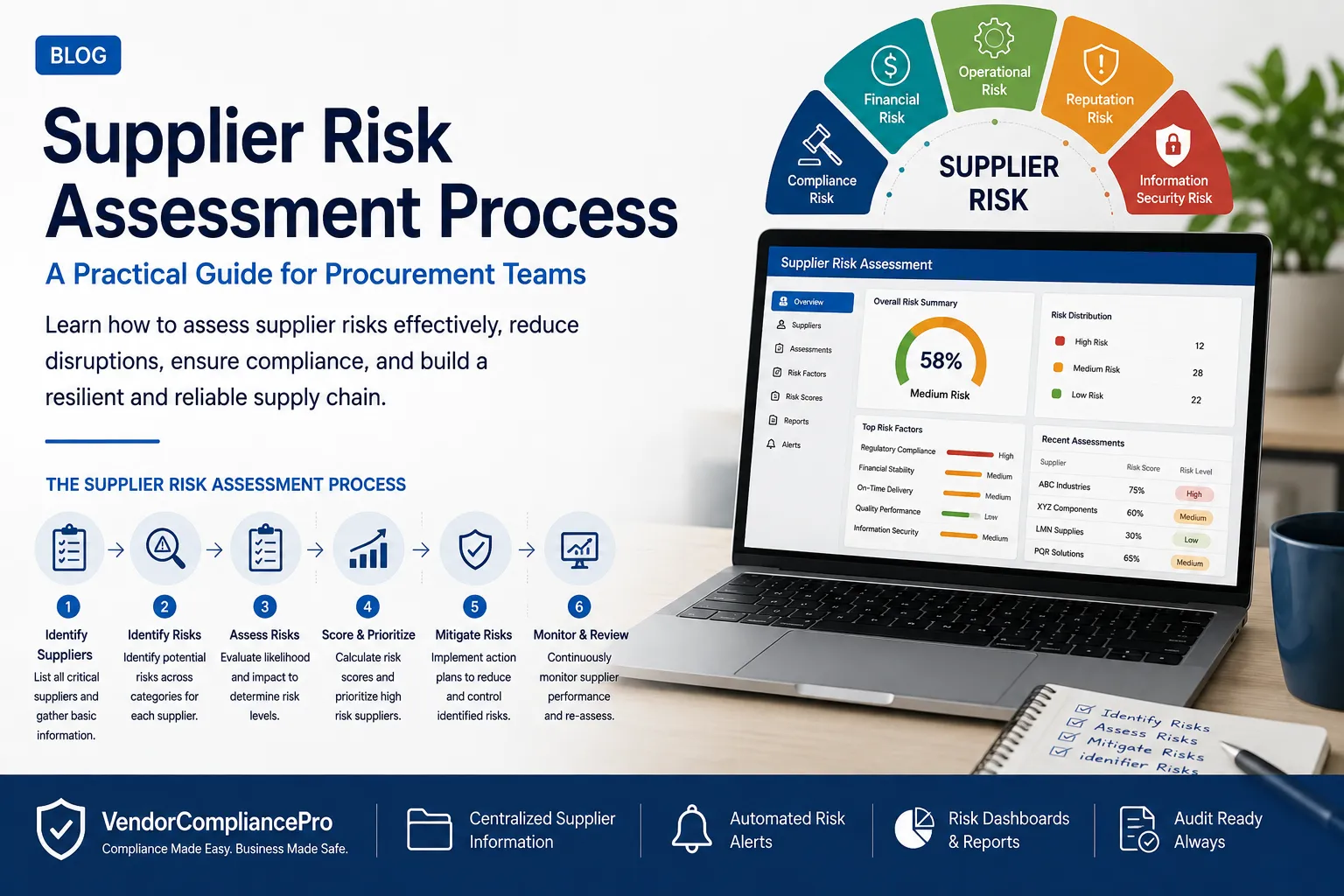
Supplier Risk Assessment Process: A Practical Guide for Procurement Teams
A supplier may look reliable when everything is going well.
But what happens when a critical supplier suddenly stops delivering, an important compliance document expires, quality problems increase, or the supplier experiences financial difficulties?
Supplier risk assessment helps procurement teams identify these risks before they become serious business problems.
Instead of treating every supplier in the same way, organizations can evaluate suppliers based on their importance, risk exposure, compliance status, performance, and business impact.
In this article, we’ll explore a practical supplier risk assessment process that procurement teams can use to identify, evaluate, score, mitigate, and continuously monitor supplier risks.
What Is Supplier Risk Assessment?
Supplier risk assessment is the process of identifying and evaluating the risks associated with a supplier before and during the supplier relationship.
The objective is not to eliminate every possible risk.
The objective is to understand:
- Which suppliers create the greatest risk?
- What type of risk does each supplier create?
- How serious could the impact be?
- How likely is the risk to occur?
- What controls are already in place?
- What action should be taken?
A structured risk assessment allows procurement teams to prioritize their efforts instead of treating every supplier equally.
Why Supplier Risk Assessment Matters
Organizations often depend on suppliers for critical products, services, raw materials, logistics, maintenance, technology, and other business activities.
A supplier problem can therefore become an organizational problem.
Supplier risks can lead to:
- Supply chain disruptions
- Production delays
- Quality problems
- Compliance issues
- Financial losses
- Customer dissatisfaction
- Increased procurement costs
- Data security concerns
- Reputational damage
- Audit findings
The larger and more complex the supplier network becomes, the more important a structured risk assessment process becomes.
Common Types of Supplier Risk
Supplier risk is not limited to financial problems.
A useful assessment should consider multiple categories.
1. Financial Risk
Financial problems can affect a supplier’s ability to continue operations.
Potential indicators include:
- Financial instability
- Significant debt
- Cash-flow problems
- Declining business performance
- Payment difficulties
- Dependence on a small number of customers
Critical suppliers may require more frequent financial reviews.
2. Operational Risk
Operational risk relates to the supplier’s ability to deliver products or services consistently.
Examples include:
- Capacity limitations
- Production interruptions
- Poor delivery performance
- Lack of backup facilities
- Dependence on a single location
- Inadequate processes
- Weak business continuity planning
Operational risk is particularly important when a supplier provides critical materials or services.
3. Compliance Risk
Suppliers may need to meet legal, regulatory, contractual, or industry-specific requirements.
Compliance risk can involve:
- Expired licenses
- Missing registrations
- Expired insurance
- Missing statutory documents
- Non-compliance with contractual requirements
- Incomplete supplier documentation
Compliance risk can increase over time because documents and certificates may expire.
This is why supplier compliance should be monitored continuously rather than checked only during onboarding.
4. Quality Risk
Supplier quality problems can affect production, customers, and the organization’s reputation.
Indicators may include:
- High rejection rates
- Repeated quality complaints
- Failed inspections
- Product defects
- Inconsistent specifications
- Corrective actions that remain unresolved
Quality performance should be considered when assessing supplier risk.
5. Delivery Risk
A supplier may be financially stable but still create significant operational risk if deliveries are unreliable.
Consider:
- On-time delivery performance
- Lead times
- Delivery delays
- Capacity
- Geographic dependency
- Transportation risks
- Emergency response capability
Critical suppliers should have clearly defined delivery expectations.
6. Cybersecurity and Information Security Risk
Suppliers may have access to business systems, confidential information, customer data, or operational information.
Depending on the relationship, organizations may need to assess:
- Security controls
- Access management
- Data protection
- Incident response
- Business continuity
- Security certifications
- Third-party access
The level of assessment should depend on the supplier’s access and the sensitivity of the information involved.
7. Reputation and Business Risk
A supplier’s actions can affect the reputation of the organization they serve.
Potential concerns include:
- Regulatory violations
- Serious customer complaints
- Ethical concerns
- Negative business practices
- Repeated contractual problems
Organizations should consider reputational exposure when assessing strategically important suppliers.
The Supplier Risk Assessment Process
A practical supplier risk assessment process can be divided into six stages:
- Identify suppliers
- Identify risk factors
- Assess the risks
- Score and prioritize suppliers
- Mitigate identified risks
- Monitor and review continuously
Let’s look at each stage.
1. Identify the Suppliers
The first step is to understand which suppliers are part of the organization’s supply network.
Create a supplier inventory containing information such as:
- Supplier name
- Supplier category
- Products or services
- Business location
- Criticality
- Departments using the supplier
- Contract information
- Compliance requirements
Not every supplier will have the same importance.
For example:
A supplier providing office stationery may have a relatively low business impact.
A supplier providing a critical production component may have a much higher impact.
Supplier criticality should therefore be considered early in the assessment process.
2. Identify Supplier Risk Factors
After identifying suppliers, determine which risk factors are relevant.
A procurement team can create a standard risk assessment questionnaire or checklist.
Typical areas include:
Business Risk
- Supplier criticality
- Dependency on the supplier
- Number of alternative suppliers
- Geographic dependency
Financial Risk
- Financial stability
- Business continuity
- Customer concentration
Operational Risk
- Production capacity
- Delivery performance
- Business continuity planning
Quality Risk
- Quality history
- Rejection rates
- Customer complaints
Compliance Risk
- Required registrations
- Licenses
- Insurance
- Statutory documents
- Contractual requirements
Security Risk
- Data access
- System access
- Information security controls
The assessment should be appropriate to the supplier and the nature of the relationship.
3. Assess the Risks
Once the risk factors are defined, evaluate each supplier.
A simple approach is to consider two primary dimensions:
Likelihood
How likely is the risk to occur?
Impact
How serious would the business impact be if the risk occurred?
For example:
Likelihood Impact Risk Level
Low Low Low Low High Medium Medium Medium Medium High Medium High High High Critical
Organizations can create more detailed scoring models when required.
4. Score and Prioritize Suppliers
A risk score helps procurement teams prioritize suppliers.
For example, an organization might use a simple 1-to-5 scale.
Likelihood
- 1 = Very Low
- 2 = Low
- 3 = Medium
- 4 = High
- 5 = Very High
Impact
- 1 = Very Low
- 2 = Low
- 3 = Medium
- 4 = High
- 5 = Very High
A basic risk score can then be calculated using:
Risk Score = Likelihood × Impact
For example:
Likelihood = 4
Impact = 5
Risk Score = 20
The organization can then define its own thresholds for low, medium, high, or critical risk.
The exact scoring model should be aligned with the organization’s risk framework.
5. Create a Supplier Risk Matrix
A risk matrix makes supplier risk easier to understand.
For example:
Low Risk
The supplier has limited business impact and few significant risk indicators.
Typical action:
- Standard monitoring
- Periodic review
Medium Risk
The supplier has some important risk factors that require attention.
Typical action:
- Increased monitoring
- Additional documentation
- Periodic reassessment
High Risk
The supplier has significant operational, financial, compliance, quality, or other risks.
Typical action:
- Risk mitigation plan
- Management review
- More frequent monitoring
- Alternative supplier evaluation
Critical Risk
The supplier creates a significant potential impact on the organization.
Typical action:
- Immediate risk review
- Executive involvement
- Business continuity planning
- Alternative supplier strategy where practical
6. Mitigate Supplier Risks
Identifying a risk is only the beginning.
The next step is to decide what action should be taken.
Possible risk mitigation strategies include:
- Request additional documentation
- Improve contractual protections
- Increase supplier monitoring
- Establish backup suppliers
- Increase safety stock
- Define corrective action plans
- Conduct supplier audits
- Increase quality inspections
- Require updated compliance documents
- Limit system or data access
- Develop business continuity plans
The appropriate action depends on the type and severity of the risk.
Supplier Compliance as Part of Risk Management
Supplier compliance should be an important component of supplier risk assessment.
A supplier may initially pass an assessment but become higher risk later because required documents expire.
For example:
A supplier has:
- Valid insurance
- Valid labor license
- Valid registration
- Required statutory documents
At the time of onboarding, the supplier may be considered compliant.
Six months later, an insurance certificate expires.
The supplier’s compliance risk has now changed.
This demonstrates why supplier risk assessment should not be treated as a one-time activity.
7. Monitor Suppliers Continuously
Supplier risk changes over time.
Procurement teams should periodically review:
- Supplier performance
- Delivery performance
- Quality issues
- Compliance status
- Document expiry
- Contract changes
- Business changes
- Risk scores
- Corrective actions
High-risk suppliers may require more frequent reviews than low-risk suppliers.
A risk assessment process should therefore include a defined review schedule.
Supplier Risk Assessment During Vendor Onboarding
Risk assessment should ideally begin before a supplier becomes fully active.
A practical onboarding flow can be:
Supplier Identification
↓
Supplier Information Collection
↓
Document Collection
↓
Supplier Risk Assessment
↓
Compliance Review
↓
Approval
↓
Supplier Activation
↓
Ongoing Monitoring
This approach helps organizations identify significant risks before they become embedded in the supplier relationship.
Supplier Risk Assessment Checklist
Procurement teams can use the following checklist as a starting point:
- Supplier identity verified
- Supplier category identified
- Supplier criticality assessed
- Financial risk reviewed
- Operational risk reviewed
- Quality risk reviewed
- Delivery risk reviewed
- Compliance requirements identified
- Required supplier documents collected
- Document validity checked
- Information security risk considered where applicable
- Risk score calculated
- Supplier risk level assigned
- Risk mitigation actions identified
- Required approvals completed
- Next review date defined
This checklist should be adapted to the organization’s industry, supplier type, and risk framework.
Common Supplier Risk Assessment Mistakes
1. Assessing Suppliers Only During Onboarding
Supplier risk changes.
A supplier that was low risk two years ago may not remain low risk today.
2. Treating Every Supplier the Same
A critical production supplier should not necessarily receive the same level of assessment as a low-value office supplies vendor.
Risk-based prioritization makes the process more efficient.
3. Focusing Only on Financial Risk
Financial health is important, but supplier risk also includes operational, quality, compliance, delivery, cybersecurity, and reputational risks.
4. Ignoring Compliance Document Expiry
A supplier may remain operational while its required certificates and licenses become invalid.
Expiry monitoring should therefore be part of ongoing supplier management.
5. Keeping Risk Information in Isolated Spreadsheets
When supplier information, risk scores, documents, and corrective actions are maintained in separate spreadsheets, teams may struggle to understand the complete supplier picture.
Centralized supplier information can improve visibility.
6. Not Assigning Ownership
Every identified risk should have an owner and, where appropriate, a target action or review date.
Without ownership, risk assessments can become reports rather than actionable processes.
How Technology Can Improve Supplier Risk Management
Manual supplier risk assessment can become difficult when organizations manage hundreds or thousands of suppliers.
Technology can help by centralizing:
- Supplier information
- Risk assessments
- Compliance documents
- Expiry dates
- Supplier status
- Risk scores
- Approvals
- Corrective actions
- Reports
- Audit history
Automated reminders can also help teams act before important compliance documents expire.
The objective is not simply to automate data entry.
It is to give procurement and compliance teams better visibility into supplier risk.
How VendorCompliancePro Helps
VendorCompliancePro focuses on the supplier compliance component of the broader supplier risk management process.
It provides capabilities for:
- Centralized vendor information
- Vendor document collection
- Vendor self-service
- Document validation
- Expiry tracking
- Automated renewal reminders
- Approval workflows
- Role-based access
- Compliance dashboards
- Audit history
These capabilities can help procurement and compliance teams maintain better visibility into supplier compliance status.
For organizations where supplier compliance is an important part of overall supplier risk, keeping required documents current can help reduce avoidable compliance risks.
Frequently Asked Questions
What is supplier risk assessment?
Supplier risk assessment is the process of identifying, evaluating, scoring, and managing risks associated with suppliers.
What are the main types of supplier risk?
Common categories include financial, operational, quality, delivery, compliance, cybersecurity, reputational, and business continuity risks.
How often should suppliers be assessed?
There is no single frequency that fits every organization. Review frequency should depend on supplier criticality, risk level, business requirements, and changes in the supplier relationship.
What is a supplier risk score?
A supplier risk score is a numerical or categorical representation of the level of risk associated with a supplier. Organizations can create their own scoring models based on likelihood, impact, and other relevant factors.
Should supplier compliance be part of risk assessment?
Yes. Required licenses, registrations, insurance certificates, and other compliance documents can affect supplier risk and should be considered according to the organization’s requirements.
How can organizations prioritize high-risk suppliers?
Organizations can use supplier criticality, risk scores, business impact, likelihood, and other risk factors to identify suppliers that require more attention.
Can supplier risk assessment be automated?
Technology can automate parts of the process, including data collection, assessments, reminders, risk dashboards, document monitoring, approvals, and reporting. The exact level of automation depends on the organization’s requirements and systems.
Conclusion
Supplier risk assessment is not simply a procurement checklist.
It is an ongoing process for understanding which suppliers could create significant business risk and deciding how those risks should be managed.
A practical process includes:
Identify suppliers → Identify risks → Assess risks → Score and prioritize → Mitigate risks → Monitor and review
The most effective supplier risk programs also connect risk assessment with supplier onboarding, supplier compliance, supplier performance, and ongoing monitoring.
When procurement teams have reliable supplier information, clear risk criteria, current compliance documents, defined ownership, and regular reviews, they can make better decisions and respond to supplier risks earlier.
The goal is not to eliminate every supplier risk.
The goal is to understand the risks, prioritize them, and take action before they become costly business problems.
Related Articles
- Supplier Master Data Management: Best Practices
- Vendor Onboarding Process: Complete Checklist
- What Is Vendor Compliance?
- Vendor Compliance Checklist India
- Vendor Document Management Best Practices
- Vendor Audit Readiness Checklist
- Why Vendor Onboarding Still Takes Weeks in 2026
- How AI Can Reduce Vendor Onboarding Time
- Vendor Compliance Software India