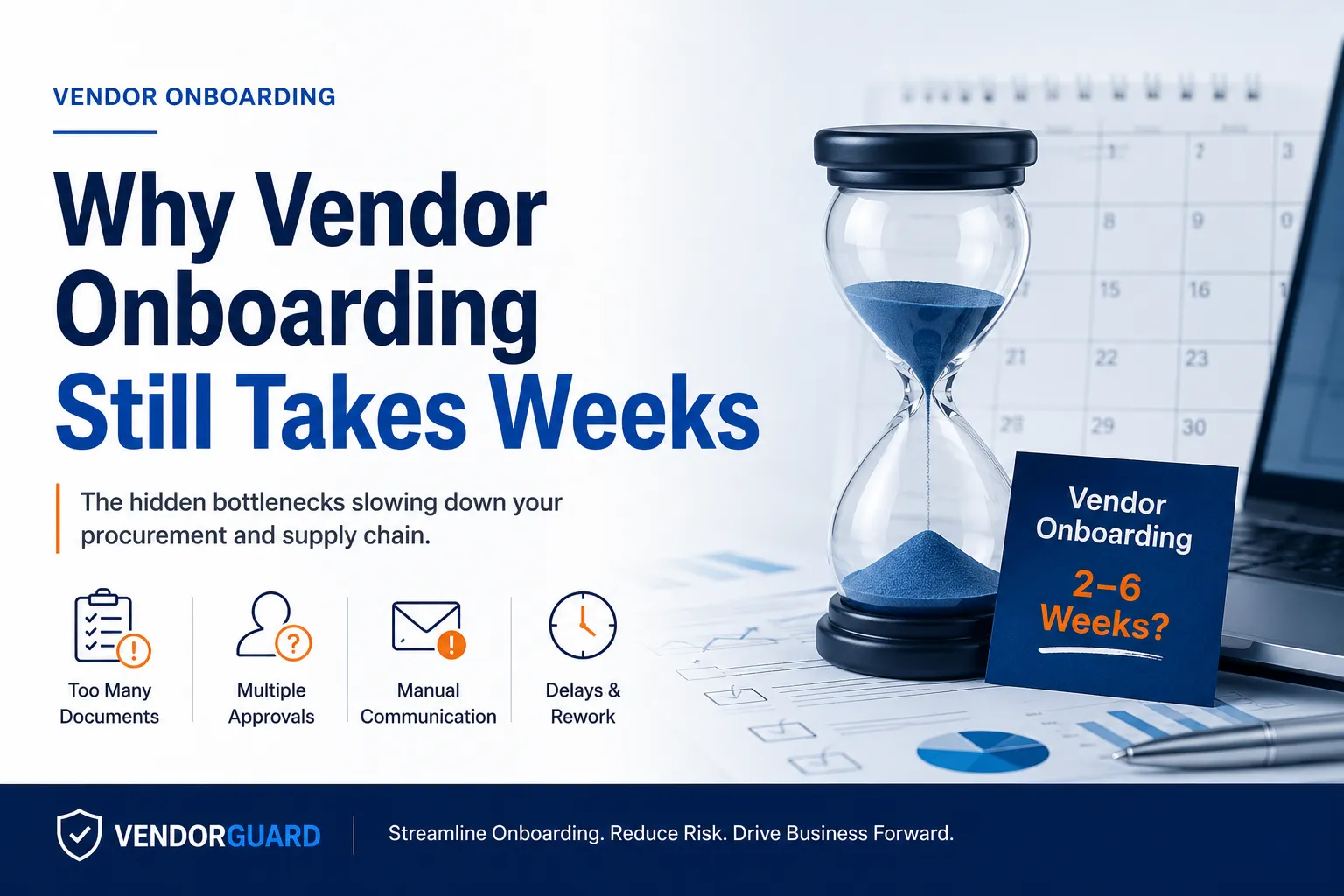
Why Vendor Onboarding Still Takes Weeks (And How to Fix It)
Vendor onboarding is one of the most important stages of the procurement process. Before a supplier or contractor can begin working with an organization, they must complete several administrative, legal, and compliance requirements.
Unfortunately, many organizations still struggle with lengthy onboarding cycles.
What should take a few days often stretches into several weeks.
The delay isn’t usually caused by vendors—it is often the result of manual processes, scattered documentation, multiple approvals, and inefficient communication.
In this guide, we’ll explore why vendor onboarding still takes weeks and discuss practical ways organizations can streamline the process without compromising compliance.
What Is Vendor Onboarding?
Vendor onboarding is the process of registering, verifying, approving, and integrating a new supplier or contractor into an organization’s procurement system.
A typical onboarding process includes:
- Vendor registration
- Business verification
- Document collection
- Compliance verification
- Contract approval
- Vendor activation
A structured onboarding process ensures vendors meet organizational, contractual, and regulatory requirements before starting work.
Why Fast Vendor Onboarding Matters
Slow onboarding affects more than procurement teams.
It can delay:
- Production schedules
- Purchase orders
- Contractor mobilization
- Project execution
- Service delivery
- Vendor payments
Efficient onboarding improves operational efficiency while creating a better experience for suppliers.
Why Vendor Onboarding Takes Weeks
Several common bottlenecks contribute to onboarding delays.
1. Manual Document Collection
Many organizations still request documents through email.
Vendors must repeatedly send:
- GST Registration Certificate
- PAN Card
- MSME Certificate
- Labour License
- Insurance Policies
- PF Registration
- ESIC Registration
Documents are often submitted one at a time, creating unnecessary delays.
How to Fix It
Provide vendors with a centralized portal where all required documents can be uploaded at once.
2. Incomplete Document Submission
One missing document can delay the entire approval process.
Procurement teams often spend days requesting additional information.
How to Fix It
Use predefined document checklists that prevent submission until all mandatory documents are uploaded.
3. Multiple Approval Levels
Vendor approvals commonly involve:
- Procurement
- Finance
- Compliance
- Legal
- Operations
When approvals are handled through email, the process becomes slow and difficult to track.
How to Fix It
Automate approval workflows with clearly defined responsibilities and notifications.
4. Manual Document Verification
Procurement teams often review every uploaded document manually.
This includes checking:
- Document type
- Expiry date
- Completeness
- Validity
- Readability
Manual verification becomes time-consuming as vendor numbers increase.
How to Fix It
Use AI-powered document validation to automatically identify document types and extract key information.
5. Poor Communication
Vendors frequently ask questions such as:
- Which documents are missing?
- Has my application been approved?
- Who is reviewing my documents?
- When can I start work?
Without visibility, both vendors and procurement teams spend time exchanging emails.
How to Fix It
Provide vendors with a self-service portal that displays real-time onboarding status.
6. Spreadsheet-Based Tracking
Many procurement teams still monitor onboarding using Excel.
Common issues include:
- Missed follow-ups
- Duplicate entries
- Version conflicts
- Limited visibility
How to Fix It
Replace spreadsheets with centralized onboarding software that tracks every vendor automatically.
7. No Standardized Process
Different procurement executives may request different documents from similar vendors.
This creates confusion and inconsistent onboarding experiences.
How to Fix It
Create standardized onboarding workflows based on vendor category.
8. Compliance Reviews Happen Too Late
Some organizations verify compliance only after vendor registration is complete.
This often leads to:
- Rejected vendors
- Missing documents
- Approval delays
How to Fix It
Integrate compliance verification directly into the onboarding process.
Common Documents Required During Vendor Onboarding
Organizations commonly collect the following documents.
Business Registration
- GST Registration Certificate
- PAN Card
- MSME Certificate
- Certificate of Incorporation
Statutory Documents
- PF Registration Certificate
- ESIC Registration Certificate
- Labour License
- Factory License
Insurance Documents
- Workmen Compensation Insurance
- Public Liability Insurance
Employee Records
- Employee List
- Attendance Register
- Wage Register
- Salary Register
Safety Documents
- Safety Training Records
- PPE Compliance Records
- Risk Assessment Reports
Manual Vendor Onboarding vs Automated Vendor Onboarding
| Manual Process | Automated Process |
|---|---|
| Email communication | Vendor self-service portal |
| Excel tracking | Centralized dashboard |
| Manual reminders | Automated notifications |
| Manual approvals | Workflow automation |
| Paper documents | Digital repository |
| Limited visibility | Real-time status tracking |
Benefits of Automating Vendor Onboarding
Faster Vendor Activation
Reduce onboarding time from weeks to days.
Better Compliance
Ensure mandatory documents are collected before approval.
Reduced Manual Work
Automate repetitive procurement activities.
Improved Vendor Experience
Provide a simple and transparent onboarding process.
Better Visibility
Track onboarding progress through dashboards and reports.
Improved Audit Readiness
Maintain complete onboarding records for future audits.
Best Practices for Vendor Onboarding
Standardize Required Documents
Create document checklists for every vendor category.
Centralize Documentation
Maintain all vendor records in one secure location.
Automate Approval Workflows
Reduce delays caused by manual approvals.
Track Document Expiry
Monitor compliance beyond onboarding.
Review Vendor Compliance Regularly
Continue monitoring vendor compliance after approval.
How AI Is Improving Vendor Onboarding
Modern AI-powered onboarding platforms help organizations:
- Automatically identify document types
- Extract expiry dates
- Detect missing information
- Validate uploaded documents
- Reduce manual verification
- Improve onboarding accuracy
AI allows procurement teams to onboard vendors faster while maintaining compliance standards.
How VendorCompliancePro Helps
VendorCompliancePro streamlines vendor onboarding through:
- Vendor self-service portal
- Centralized document repository
- Automated approval workflows
- AI-powered document validation
- Automated expiry reminders
- Compliance dashboards
- Audit-ready reporting
- Role-based access
Organizations can significantly reduce onboarding delays while ensuring vendors remain compliant from day one.
Frequently Asked Questions
Why does vendor onboarding take so long?
Vendor onboarding is often delayed due to manual document collection, multiple approval levels, spreadsheet tracking, incomplete submissions, and inefficient communication.
How can organizations reduce vendor onboarding time?
By automating document collection, approval workflows, compliance verification, and vendor communication.
What documents are required during vendor onboarding?
Common documents include GST registration, PAN card, MSME certificate, PF registration, ESIC registration, labour licenses, insurance policies, and employee records.
Can ERP systems automate vendor onboarding?
ERP systems support vendor registration but often lack specialized features such as document verification, expiry tracking, vendor portals, and compliance workflows.
What is the biggest challenge during vendor onboarding?
Collecting complete and accurate compliance documents while coordinating approvals across multiple departments.
Conclusion
Slow vendor onboarding is rarely caused by vendors alone. It is usually the result of manual processes, disconnected systems, and inefficient communication.
Organizations that standardize onboarding, automate compliance verification, and centralize document management can significantly reduce onboarding time while improving compliance and audit readiness.
Modern vendor onboarding solutions not only accelerate approvals but also create a better experience for procurement teams and suppliers alike.
Related Articles
- Vendor Onboarding Process
- What Is Vendor Compliance?
- Vendor Compliance vs Vendor Management
- Procurement Compliance Explained
- Vendor Compliance Software India