Vendor Compliance vs Vendor Management: What’s the Difference?
Many organizations use the terms Vendor Compliance and Vendor Management interchangeably.
Although they are closely related, they serve different business purposes.
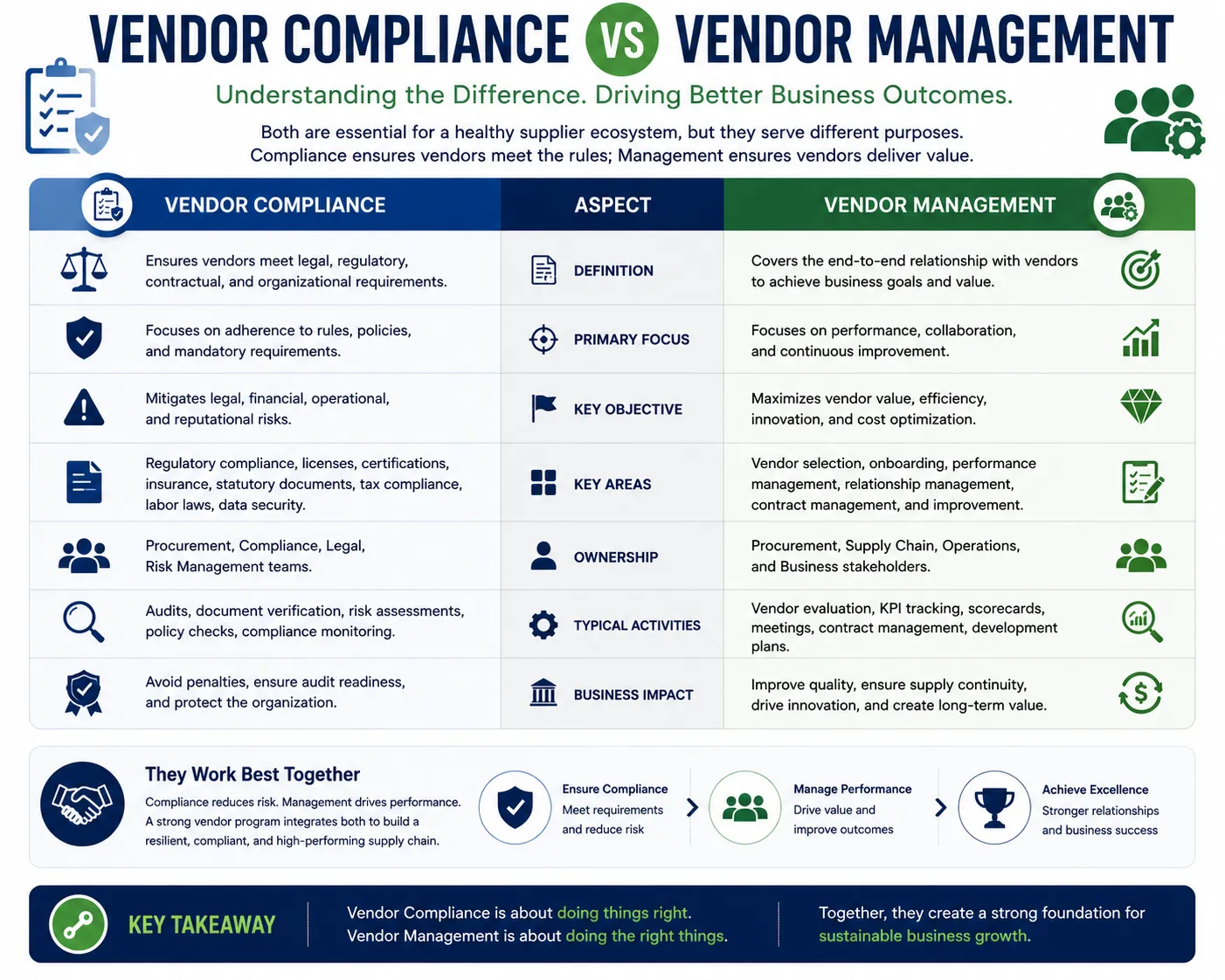
Vendor management focuses on building, evaluating, and maintaining relationships with suppliers, while vendor compliance ensures those suppliers continue meeting legal, regulatory, contractual, and organizational requirements.
Understanding the difference is essential for procurement teams, compliance managers, and business leaders looking to reduce risk while improving supplier performance.
In this guide, we’ll explain how vendor compliance differs from vendor management, why both are important, and how they work together to create a successful supplier ecosystem.
What Is Vendor Management?
Vendor management is the process of selecting, onboarding, monitoring, evaluating, and maintaining relationships with suppliers and contractors.
Its primary objective is to ensure vendors deliver products and services that meet business expectations.
Vendor management typically includes:
- Vendor selection
- Supplier qualification
- Contract management
- Vendor onboarding
- Performance evaluation
- Relationship management
- Cost optimization
- Vendor offboarding
Vendor management focuses on maximizing business value from supplier relationships.
What Is Vendor Compliance?
Vendor compliance is the process of ensuring suppliers and contractors continuously meet legal, statutory, safety, contractual, and company-specific requirements.
Vendor compliance typically includes:
- Document collection
- Document verification
- Compliance approval
- Expiry tracking
- Renewal reminders
- Regulatory monitoring
- Compliance reporting
- Audit preparation
The goal is to reduce legal, operational, and regulatory risks by ensuring vendors always maintain valid compliance records.
Vendor Compliance vs Vendor Management
Although both processes involve suppliers, they focus on different objectives.
| Vendor Management | Vendor Compliance |
|---|---|
| Builds supplier relationships | Ensures regulatory compliance |
| Manages contracts | Manages compliance documents |
| Measures vendor performance | Tracks document validity |
| Negotiates pricing | Monitors statutory requirements |
| Evaluates suppliers | Identifies compliance risks |
| Focuses on business value | Focuses on legal and audit readiness |
Both functions are equally important and should work together.
Why Organizations Need Both
Managing suppliers without monitoring compliance creates unnecessary business risks.
Similarly, tracking compliance without managing supplier relationships limits procurement efficiency.
Organizations need both to:
- Reduce operational risk
- Improve supplier performance
- Ensure regulatory compliance
- Maintain audit readiness
- Improve procurement efficiency
- Build long-term vendor relationships
Typical Vendor Management Activities
Vendor management teams commonly perform the following activities.
Vendor Selection
Identify suppliers capable of meeting business requirements.
Contract Negotiation
Define pricing, service levels, and contractual obligations.
Performance Monitoring
Measure delivery, quality, responsiveness, and service levels.
Relationship Management
Maintain effective communication with suppliers.
Vendor Evaluation
Review supplier performance regularly.
Typical Vendor Compliance Activities
Compliance teams focus on ensuring vendors continue meeting organizational and regulatory requirements.
Document Collection
Collect mandatory compliance documents.
Verification
Validate document authenticity and completeness.
Expiry Tracking
Monitor validity dates continuously.
Renewal Management
Notify vendors before documents expire.
Compliance Reporting
Provide dashboards showing vendor compliance status.
Audit Preparation
Maintain organized records for internal and external audits.
Common Vendor Compliance Documents
Organizations typically monitor:
- GST Registration Certificate
- PAN Card
- MSME Certificate
- PF Registration Certificate
- ESIC Registration Certificate
- Labour License
- Factory License
- Insurance Policies
- ISO Certifications
- Employee Registers
Many of these documents require periodic renewal.
Challenges Without Vendor Compliance
Organizations that manage vendors but ignore compliance often face:
Expired Documents
Critical certificates expire unnoticed.
Audit Findings
Missing records delay internal and external audits.
Legal Risks
Non-compliant vendors increase business exposure.
Operational Delays
Work may stop until mandatory documents are renewed.
Manual Follow-Ups
Procurement teams spend excessive time requesting updated documents.
Manual Process vs Automated Compliance
| Manual Process | Automated Compliance |
|---|---|
| Excel spreadsheets | Centralized repository |
| Email reminders | Automated notifications |
| Manual tracking | Real-time dashboards |
| Scattered documents | Organized document library |
| Time-consuming audits | Audit-ready reporting |
| Human errors | Improved accuracy |
Best Practices
Clearly Define Required Documents
Different vendor categories require different compliance records.
Centralize Vendor Documentation
Maintain all documents in one secure location.
Automate Expiry Tracking
Reduce dependency on spreadsheets and calendars.
Review Compliance Regularly
Monitor dashboards and reports every month.
Maintain Complete Audit Trails
Track uploads, approvals, renewals, and document history.
How AI Is Improving Vendor Compliance
Modern AI-powered solutions help organizations:
- Detect document types automatically
- Extract expiry dates
- Identify missing information
- Validate uploaded documents
- Reduce manual verification
- Improve compliance accuracy
AI allows procurement teams to focus on high-value work instead of repetitive document reviews.
How VendorCompliancePro Helps
VendorCompliancePro complements your vendor management process by simplifying compliance management through:
- Vendor self-service portal
- Centralized document repository
- Automated expiry reminders
- Approval workflows
- Compliance dashboards
- Audit reports
- Role-based access
- AI-powered document validation
Organizations can improve visibility, reduce manual work, and stay audit-ready throughout the year.
Frequently Asked Questions
What is the difference between vendor management and vendor compliance?
Vendor management focuses on supplier relationships, contracts, and performance, while vendor compliance ensures vendors meet legal, regulatory, and organizational requirements.
Can vendor management exist without vendor compliance?
Yes, but it increases compliance risks, audit issues, and operational disruptions.
Who is responsible for vendor compliance?
Depending on the organization, procurement teams, compliance officers, HR, finance, EHS, or internal audit teams may share responsibility.
Why is vendor compliance important?
It helps organizations reduce legal risk, improve audit readiness, and ensure vendors continuously meet regulatory requirements.
Which industries benefit from vendor compliance?
Manufacturing, logistics, warehousing, construction, engineering, healthcare, facility management, and organizations working with contractors or suppliers.
Conclusion
Vendor management and vendor compliance are two essential components of effective supplier management.
Vendor management helps organizations build productive supplier relationships, while vendor compliance ensures those relationships remain legally compliant and audit-ready.
Organizations that integrate both processes improve operational efficiency, reduce compliance risks, and build stronger, more reliable supplier ecosystems.
Related Articles
- What Is Vendor Compliance?
- Vendor Onboarding Process
- Vendor Compliance Software India
- Vendor Document Management
- Vendor Audit Readiness Checklist