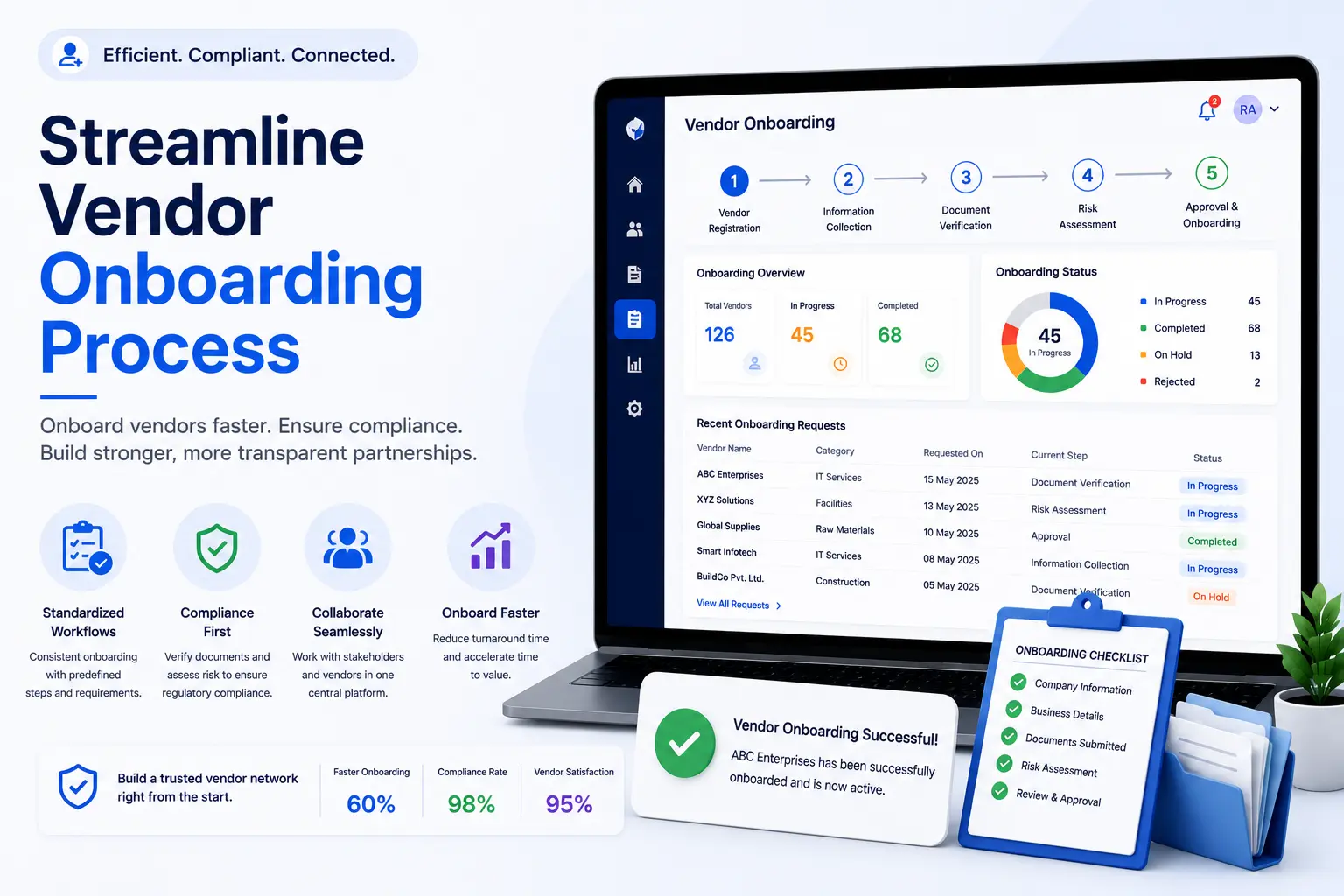
Vendor Onboarding Process: A Complete Guide for Manufacturing and Industrial Companies
Vendor onboarding is one of the most important steps in supplier and contractor management. A well-defined onboarding process helps organizations collect required documents, verify compliance, and reduce operational risks.
However, many companies still rely on emails, Excel spreadsheets, and paper files to onboard vendors. As the number of suppliers grows, manual processes become slow, inefficient, and difficult to manage.
In this guide, we’ll explain the complete vendor onboarding process and discuss best practices for maintaining an efficient and audit-ready vendor ecosystem.
What Is Vendor Onboarding?
Vendor onboarding is the process of registering, verifying, and approving suppliers or contractors before they begin providing products or services.
The onboarding process typically includes:
- Vendor registration
- Document collection
- Verification and approval
- Compliance checks
- Expiry tracking
- Audit reporting
A structured process ensures only qualified and compliant vendors are approved.
Why Vendor Onboarding Is Important
An effective onboarding process helps organizations:
- Reduce compliance risks
- Improve supplier quality
- Maintain regulatory compliance
- Increase operational efficiency
- Improve audit readiness
- Reduce manual work
Without a proper onboarding process, organizations may face delays, missing documents, and compliance violations.
Step 1: Vendor Registration
The first stage involves collecting basic information.
Typical details include:
- Company Name
- Contact Person
- Address
- Vendor Category
- GST Number
- PAN Number
- Email Address
- Phone Number
These records become part of the vendor master database.
Step 2: Collect Required Documents
Organizations generally collect:
Registration Documents
- GST Registration Certificate
- PAN Card
- MSME Certificate
Statutory Documents
- PF Registration Certificate
- ESIC Registration Certificate
- Labour License
- Contractor License
Insurance Documents
- Workmen Compensation Policy
- Public Liability Insurance
Employee Records
- Employee List
- Attendance Register
- Wage Register
Safety Documents
- Safety Training Records
- PPE Compliance Records
Step 3: Document Verification
Compliance teams verify:
- Document type
- Validity
- Expiry dates
- Completeness
- Mandatory requirements
Only verified documents should proceed to approval.
Step 4: Approval Workflow
Documents are reviewed by:
- Procurement Teams
- HR Departments
- EHS Teams
- Compliance Officers
- Plant Administrators
Approval workflows ensure accountability and transparency.
Step 5: Vendor Activation
After approval, vendors are activated and become eligible for business transactions.
This stage includes:
- Vendor code generation
- Portal access
- User creation
- Role assignment
Step 6: Ongoing Compliance Monitoring
Vendor onboarding does not end after activation.
Organizations must continuously monitor:
- Document expiry dates
- Missing documents
- Insurance validity
- Statutory compliance
Continuous monitoring helps maintain compliance.
Vendor Onboarding Workflow
Vendor Registration
↓
Document Upload
↓
Verification
↓
Approval
↓
Vendor Activation
↓
Expiry Tracking
↓
Audit Reporting
Common Challenges in Manual Onboarding
Many organizations still depend on:
- Emails
- Excel spreadsheets
- Shared drives
- Paper forms
This creates several issues.
Delayed Approvals
Manual processes slow down onboarding.
Missing Documents
Important records are often overlooked.
Human Errors
Incorrect information leads to rework.
Lack of Visibility
Teams cannot easily track onboarding progress.
Audit Difficulties
Finding records becomes time-consuming.
Manual Process vs Vendor Onboarding Software
| Manual Process | Automated Process |
|---|---|
| Emails and Excel | Centralized platform |
| Manual follow-ups | Automated workflows |
| Scattered documents | Single repository |
| Human errors | Better accuracy |
| Difficult audits | Audit-ready reports |
| Limited visibility | Real-time dashboards |
Benefits of Vendor Onboarding Software
Faster Vendor Registration
Reduce onboarding cycle times.
Better Compliance
Ensure mandatory documents are collected.
Improved Visibility
Track onboarding progress in real time.
Reduced Administrative Effort
Eliminate repetitive manual tasks.
Enhanced Audit Readiness
Maintain complete document history.
Best Practices
Standardize Document Requirements
Define requirements for each vendor category.
Centralize Documentation
Maintain a single source of truth.
Automate Approval Workflows
Reduce delays and improve transparency.
Configure Expiry Alerts
Monitor document validity continuously.
Maintain Audit Trails
Track uploads and approvals.
Industries That Benefit
Vendor onboarding processes are especially important for:
- Manufacturing Companies
- Logistics Companies
- Warehouses
- Construction Companies
- Engineering Firms
- Facility Management Companies
How AI Improves Vendor Onboarding
Modern AI-powered systems help organizations:
- Extract information from documents.
- Detect expiry dates automatically.
- Validate document types.
- Identify missing information.
- Reduce manual effort.
AI improves accuracy and speeds up onboarding.
How VendorCompliancePro Helps
VendorCompliancePro simplifies vendor onboarding through:
- Vendor self-service portal
- Centralized document repository
- Automated approval workflows
- Compliance dashboards
- Expiry reminders
- Audit reports
- Role-based access
- AI-powered document validation
Organizations can onboard vendors faster while maintaining compliance and audit readiness.
Frequently Asked Questions
What is vendor onboarding?
Vendor onboarding is the process of registering, verifying, and approving suppliers before they begin doing business.
Why is vendor onboarding important?
It helps organizations reduce compliance risks and improve operational efficiency.
Which documents are required during onboarding?
Common documents include GST registration, PAN card, PF registration, ESIC registration, labour licenses, and insurance certificates.
How long does vendor onboarding take?
It depends on document availability and approval workflows, but automation significantly reduces onboarding time.
Can Excel be used for vendor onboarding?
Yes, but automated solutions provide better visibility and scalability.
Conclusion
Vendor onboarding is the foundation of effective supplier and contractor management.
Organizations that implement a structured onboarding process can improve compliance, reduce risks, and accelerate vendor activation.
As businesses grow, automation becomes essential for maintaining a compliant and efficient vendor ecosystem.
Related Articles
- What Is Vendor Compliance?
- Vendor Compliance Checklist India
- Vendor Document Management
- Vendor Document Tracking
- Vendor Compliance Software India