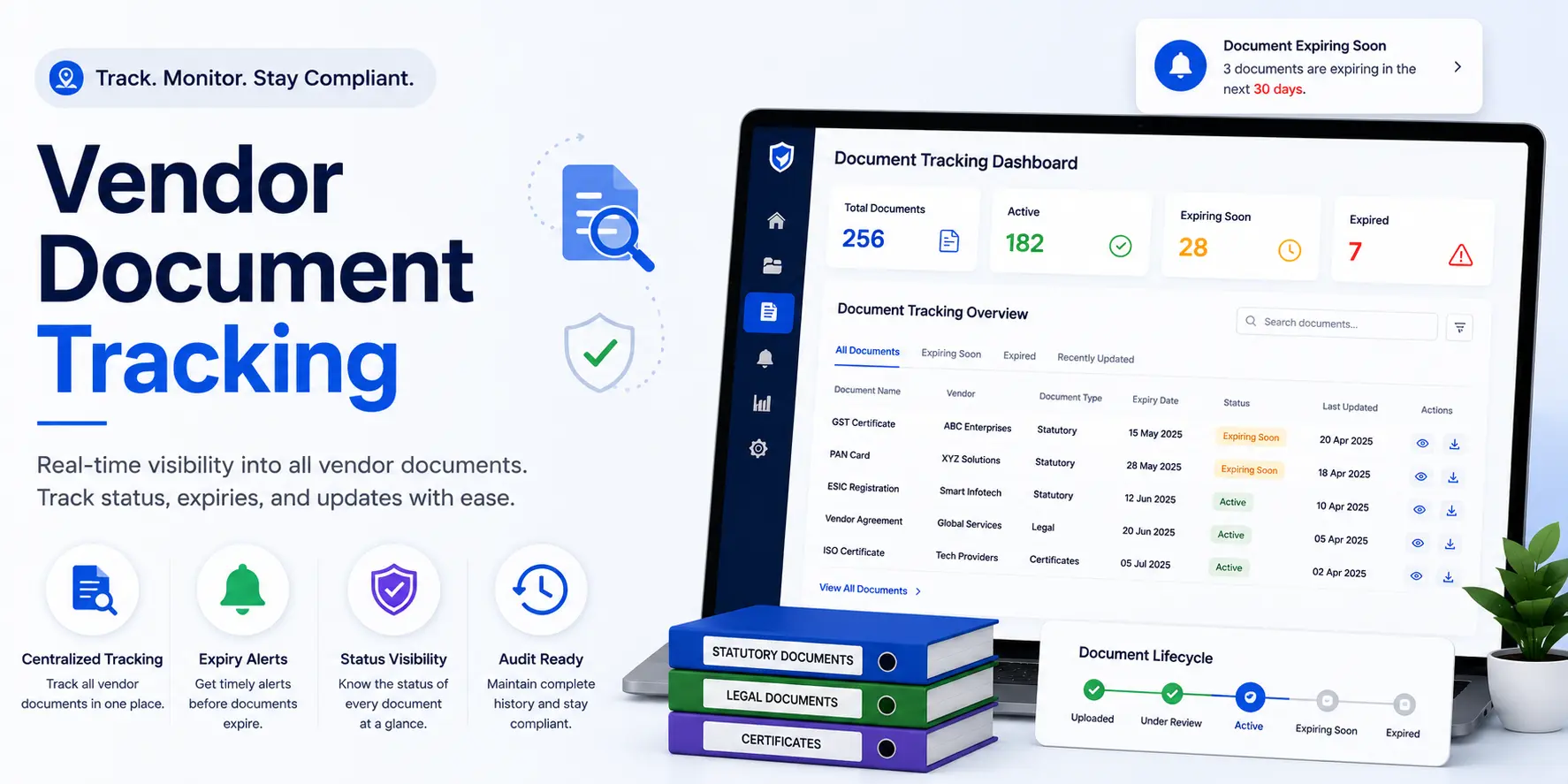
Vendor Document Tracking: A Complete Guide to Managing Supplier and Contractor Documents
Managing vendor documents effectively is essential for maintaining compliance, reducing risk, and ensuring operational continuity. However, many organizations still rely on Excel spreadsheets, email reminders, and shared folders to track important documents.
As the number of suppliers and contractors grows, manual tracking becomes increasingly difficult.
A vendor document tracking system helps organizations monitor document validity, automate reminders, and maintain complete visibility across the vendor lifecycle.
What Is Vendor Document Tracking?
Vendor document tracking is the process of monitoring supplier and contractor documents throughout their lifecycle.
This includes:
- Document collection
- Verification and approval
- Expiry tracking
- Renewal reminders
- Compliance reporting
- Audit preparation
An effective tracking process helps organizations prevent compliance gaps and avoid operational disruptions.
Why Vendor Document Tracking Is Important
Organizations depend on suppliers, contractors, transport vendors, and service providers.
Without proper tracking, companies may experience:
- Expired documents
- Regulatory penalties
- Audit observations
- Legal risks
- Service interruptions
- Increased administrative effort
Maintaining visibility over vendor records helps reduce these risks.
Documents Commonly Tracked
Organizations typically monitor the following documents.
Registration Documents
- GST Registration Certificate
- PAN Card
- MSME Certificate
Statutory Documents
- PF Registration Certificate
- ESIC Registration Certificate
- Labour License
- Contractor License
Insurance Documents
- Workmen Compensation Policy
- Public Liability Insurance
- Group Medical Insurance
Employee Records
- Attendance Register
- Wage Register
- Salary Register
- Employee List
Safety Documents
- Safety Training Records
- PPE Compliance Records
- Risk Assessment Reports
Environmental Documents
- Pollution Control Board Consent
- Factory License
- Environmental Clearance Certificates
Challenges of Manual Tracking
Many organizations still depend on:
- Excel spreadsheets
- Email reminders
- Shared drives
- Paper files
These methods create several problems.
Missed Expiry Dates
Important documents expire without notice.
Human Errors
Manual entries often lead to incorrect information.
Scattered Files
Documents become difficult to locate.
Lack of Visibility
Management teams struggle to identify compliance gaps.
Stressful Audits
Finding records during audits consumes valuable time.
Vendor Document Tracking Process
Step 1: Vendor Registration
Capture supplier information.
Step 2: Document Collection
Collect required documents from vendors.
Step 3: Verification
Review and validate submitted records.
Step 4: Approval Workflow
Approve documents before activation.
Step 5: Expiry Tracking
Monitor validity dates continuously.
Step 6: Automated Reminders
Notify vendors before documents expire.
Step 7: Renewal and Re-Submission
Replace expired documents with updated versions.
Step 8: Audit Reporting
Generate reports for internal and external audits.
Manual Tracking vs Automated Tracking
| Manual Process | Automated Process |
|---|---|
| Excel spreadsheets | Centralized platform |
| Manual reminders | Automatic alerts |
| Scattered files | Organized repository |
| Human errors | Better accuracy |
| Difficult audits | Audit-ready reports |
| Limited visibility | Real-time dashboards |
Benefits of Vendor Document Tracking
Improved Compliance
Ensure vendors maintain valid documents.
Better Visibility
Track document status in real time.
Reduced Manual Work
Eliminate repetitive follow-ups.
Faster Audits
Retrieve records instantly.
Lower Risk
Identify expiring documents before they become problems.
Increased Productivity
Allow teams to focus on higher-value activities.
Features to Look for in Vendor Document Tracking Software
Modern systems should provide:
- Centralized document repository
- Automated expiry reminders
- Vendor self-service portal
- Approval workflows
- Compliance dashboards
- Audit reports
- Role-based access
- Document history
- Audit trails
- Search capabilities
Documents That Require Expiry Tracking
| Document | Renewal Required |
|---|---|
| Labour License | Yes |
| Contractor License | Yes |
| Insurance Policies | Yes |
| Factory License | Yes |
| Pollution Control Consent | Yes |
| GST Registration | No |
| PF Registration | No |
| ESIC Registration | No |
Continuous monitoring helps maintain compliance.
Industries That Need Vendor Document Tracking
Vendor document tracking is valuable for:
Manufacturing Companies
Monitor supplier and contractor records.
Logistics Companies
Track transport vendors and service providers.
Warehouses
Maintain compliance documentation.
Construction Companies
Manage subcontractors and labour contractors.
Engineering Firms
Track statutory and safety documents.
Facility Management Companies
Handle multiple service providers efficiently.
Why Excel Is Not Enough
Excel works for a small number of vendors.
However, as organizations scale:
- Documents become scattered.
- Reminders are missed.
- Compliance gaps increase.
- Audits become stressful.
- Administrative effort rises.
Automation provides better scalability and visibility.
Best Practices
Centralize Documentation
Maintain a single source of truth.
Configure Reminder Schedules
Avoid last-minute renewals.
Define Mandatory Documents
Different vendors may require different records.
Conduct Periodic Reviews
Review compliance monthly or quarterly.
Maintain Audit Trails
Track uploads and approvals.
How AI Improves Vendor Document Tracking
Modern AI-powered solutions help organizations:
- Extract information from documents automatically.
- Detect expiry dates.
- Identify document types.
- Validate uploaded records.
- Reduce manual effort.
AI improves accuracy and efficiency.
How VendorCompliancePro Helps
VendorCompliancePro simplifies document tracking through:
- Centralized document repository
- Automated expiry reminders
- Vendor self-service portal
- Approval workflows
- Compliance dashboards
- Audit reports
- Role-based access
- AI-powered document validation
Organizations can maintain complete visibility and remain audit-ready throughout the year.
Frequently Asked Questions
What is vendor document tracking?
Vendor document tracking is the process of monitoring supplier and contractor documents throughout their lifecycle.
Why is document tracking important?
It helps organizations reduce compliance risks, improve visibility, and stay audit-ready.
Which documents should be tracked?
GST registration, PAN card, PF registration, ESIC registration, labour licenses, insurance certificates, and employee records are commonly tracked.
Can Excel be used for document tracking?
Yes, but automated systems provide better scalability and reliability.
What are the benefits of document tracking software?
Automation improves efficiency, reduces manual effort, and helps prevent compliance gaps.
Conclusion
Vendor document tracking is essential for maintaining compliance and reducing operational risks.
Organizations that continue relying on spreadsheets and email reminders often struggle with expired documents, scattered records, and stressful audits.
Implementing a modern document tracking system enables businesses to automate reminders, improve visibility, and maintain a compliant vendor ecosystem.
Related Articles
- Vendor Document Management
- Vendor Document Expiry Reminder
- Vendor Contract Expiry Reminder
- Vendor Compliance Checklist India
- Vendor Compliance Software India