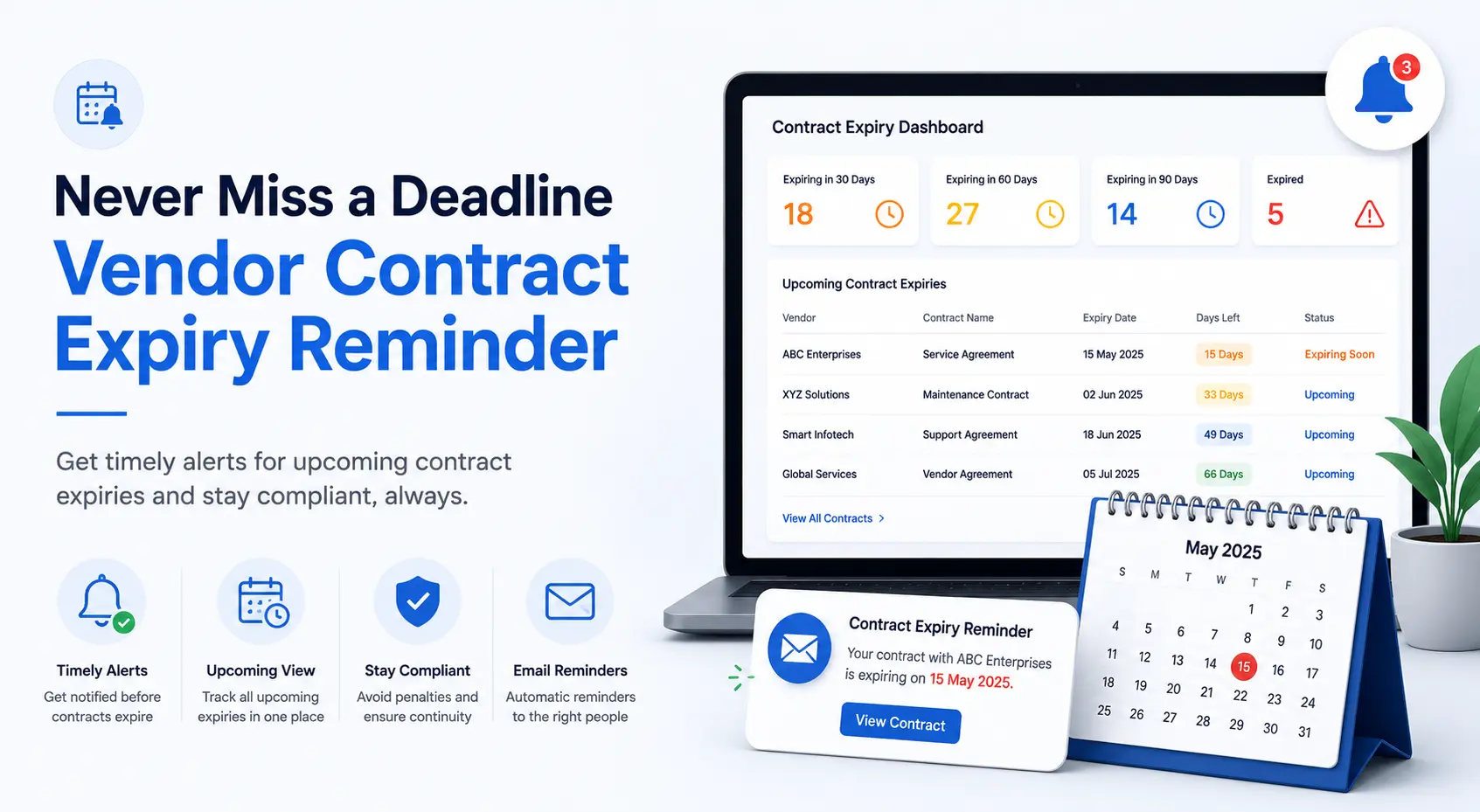
Vendor Contract Expiry Reminder: Complete Guide to Tracking Contract Renewals
How does your procurement team know which vendor contracts are approaching expiry?
Many organizations still track supplier agreements using Excel spreadsheets, email reminders, shared folders, or personal calendars. These methods can work for a small number of contracts, but they become difficult to manage as the number of vendors and agreements increases.
A vendor contract expiry reminder system helps procurement and vendor management teams monitor contract end dates, start renewal activities early, assign responsibility, and maintain better visibility across the contract lifecycle.
This guide explains:
- What a vendor contract expiry reminder is
- Why contract expiry tracking matters
- Which vendor contracts should be monitored
- How the contract renewal process works
- How to design reminder schedules
- What happens when a contract approaches expiry
- Manual vs automated contract tracking
- Best practices for contract expiry management
- Features to look for in contract management software
- How AI can support contract management
- How VendorCompliancePro helps with vendor contract tracking
What Is a Vendor Contract Expiry Reminder?
A vendor contract expiry reminder is a notification sent before a supplier or service-provider agreement reaches its contract end date.
The purpose is to give procurement and business teams enough time to:
- Review the current agreement
- Evaluate vendor performance
- Confirm whether the service is still required
- Review commercial terms
- Negotiate changes where necessary
- Obtain required approvals
- Renew, replace, or terminate the agreement
The goal is to avoid discovering that a critical contract is about to expire when there is not enough time to make an informed decision.
Why Is Vendor Contract Expiry Tracking Important?
Organizations work with many types of vendors, including:
- Maintenance contractors
- Security agencies
- Housekeeping providers
- Logistics companies
- IT service providers
- Facility management companies
- Equipment suppliers
- Engineering contractors
- Professional service providers
Each agreement may have different:
- Start dates
- End dates
- Renewal terms
- Notice periods
- Commercial conditions
- Approval requirements
Missing a contract renewal date can create:
- Service disruption risk
- Procurement delays
- Emergency purchasing
- Unplanned costs
- Legal or contractual issues
- Supplier relationship problems
- Operational uncertainty
Contract expiry tracking gives procurement teams time to act before the agreement reaches its end date.
Contract Expiry vs Contract Renewal Date
These terms are related but should not always be treated as identical.
Contract Expiry Date
The date on which the current contract term ends according to the agreement.
Renewal Date
The date or period by which the organization needs to complete a renewal process or exercise a renewal option.
A contract may also include a notice period that requires action well before the expiry date.
For example:
Contract Expiry: December 31
Notice Requirement: 90 days
In this situation, waiting until December 31 to begin the renewal process may be too late.
A good tracking process should therefore monitor not only the expiry date but also important renewal and notice dates contained in the contract.
Vendor Contract Expiry Management Process
A practical process can be organized into these stages:
| Stage | Activity | Outcome |
|---|---|---|
| 1 | Contract creation | Agreement finalized |
| 2 | Contract storage | Signed agreement organized |
| 3 | Key date recording | Expiry and notice dates captured |
| 4 | Reminder setup | Renewal schedule configured |
| 5 | Contract review | Business and commercial review |
| 6 | Vendor evaluation | Performance considered |
| 7 | Renewal decision | Renew, renegotiate, replace, or terminate |
| 8 | Approval | Required internal approval |
| 9 | Renewal execution | New agreement completed |
| 10 | New dates recorded | Next renewal cycle begins |
The exact process should be adapted to the organization’s procurement policy and contract terms.
Contracts That Should Be Monitored
Organizations may want to track expiry and renewal dates for agreements such as:
| Contract Type | Example |
|---|---|
| AMC | Equipment maintenance |
| Facility Management | Facility services |
| Security | Security services |
| Housekeeping | Cleaning services |
| Transport | Logistics and transportation |
| IT Services | Managed IT services |
| Software | Software or SaaS agreements |
| Engineering | Engineering services |
| Consulting | Professional services |
| Manpower | Staffing or contract labour services |
Not every contract requires the same renewal process.
Critical contracts may need earlier review and escalation than low-risk agreements.
Key Contract Information to Track
A contract expiry reminder system should ideally capture more than just the expiry date.
Useful fields may include:
- Vendor name
- Contract ID
- Contract type
- Contract owner
- Business unit
- Start date
- End date
- Renewal date
- Notice period
- Renewal terms
- Contract value
- Payment terms
- Service category
- Contract status
- Responsible procurement contact
- Approval status
- Document location
- Renewal decision
The exact fields should reflect the organization’s contract management process.
Vendor Contract Statuses
A consistent status model helps teams understand the current state of each agreement.
Possible statuses include:
- Draft
- Under Review
- Pending Approval
- Active
- Renewal Upcoming
- Renewal In Progress
- Renewed
- Expiring Soon
- Expired
- Terminated
- Archived
Status names can be customized to match the organization’s workflow.
How a Vendor Contract Expiry Reminder System Works
A typical workflow looks like:
Contract Uploaded
↓
Contract End Date Recorded
↓
Notice Period Identified
↓
Reminder Schedule Configured
↓
Renewal Review Started
↓
Vendor Performance / Commercial Review
↓
Renew / Renegotiate / Replace / Terminate
↓
Approval
↓
New Contract Executed
↓
New Expiry Date Recorded
↓
Next Renewal Cycle
This creates a repeatable contract renewal process.
How to Design a Contract Expiry Reminder Schedule
There is no single reminder schedule that works for every contract.
The appropriate timing depends on:
- Contract value
- Vendor criticality
- Contract complexity
- Notice requirements
- Negotiation time
- Internal approval time
- Vendor availability
- Procurement cycle
For example, an organization might use:
| Reminder | Example Timing |
|---|---|
| Early planning | 180 days before expiry |
| Renewal review | 120 days before expiry |
| Procurement follow-up | 90 days before expiry |
| Negotiation reminder | 60 days before expiry |
| Final preparation | 30 days before expiry |
| Urgent follow-up | 15 days before expiry |
These are examples, not universal requirements.
A critical contract with a long notice period may require an earlier reminder.
Example: Annual Maintenance Contract Renewal
Consider an annual maintenance contract for production equipment.
180 Days Before Expiry
Procurement receives an early reminder.
The team checks whether the contract is still required.
120 Days Before Expiry
The business reviews vendor performance and service history.
90 Days Before Expiry
Procurement starts commercial discussions.
60 Days Before Expiry
The organization reviews pricing and contract terms.
30 Days Before Expiry
Required approvals and documentation are completed.
Renewal
The renewed agreement is signed.
New Contract Date
The new expiry and relevant notice dates are recorded.
The next renewal cycle is then scheduled.
What Should Be Reviewed Before Renewing a Vendor Contract?
Contract renewal should not be based only on the expiry date.
Procurement teams may review:
Vendor Performance
- Delivery performance
- Service quality
- Response time
- Issue resolution
- Previous performance reviews
Commercial Terms
- Contract price
- Payment terms
- Price increases
- Discounts
- Renewal terms
Business Need
- Is the service still required?
- Has the scope changed?
- Has the business grown or changed?
Risk and Compliance
- Required vendor documents
- Insurance
- Licenses
- Compliance status
- Risk classification
Contract Terms
- Notice period
- Renewal clause
- Termination clause
- Service-level requirements
- Liability provisions
- Other important contractual conditions
The exact review should be based on the organization’s procurement, legal, and risk processes.
Manual Contract Tracking vs Automated Tracking
| Manual Process | Automated Tracking |
|---|---|
| Excel expiry dates | Centralized contract records |
| Personal calendar reminders | Configurable notifications |
| Scattered contracts | Organized contract repository |
| Manual date checking | Automated monitoring |
| Email follow-ups | Workflow-based tasks |
| Limited visibility | Contract dashboards |
| Difficult history | Activity and approval history |
| Last-minute renewals | Proactive renewal planning |
Automation can reduce repetitive tracking, but procurement and legal review are still important for contract decisions.
Benefits of Vendor Contract Expiry Reminders
Earlier Renewal Planning
Teams can start reviewing agreements before they become urgent.
Reduced Service Disruption Risk
Critical supplier and service agreements can be reviewed before expiry.
Better Procurement Negotiation
More lead time can provide an opportunity to review pricing, scope, and terms.
Improved Visibility
Procurement teams can see upcoming renewals in one place.
Reduced Manual Work
Automated reminders reduce the need to manually check spreadsheets and calendars.
Better Accountability
Contract owners can be assigned to renewal activities.
Improved Audit Readiness
Contract records, approvals, and renewal history can be easier to retrieve.
Common Problems With Manual Contract Expiry Tracking
Missed Renewal Dates
A contract expiry date may be recorded but not actively monitored.
Incorrect Dates
Manual entry can result in incorrect contract dates.
Notice Periods Are Ignored
Teams may track the final expiry date without considering the notice period.
Contracts Are Scattered
Signed agreements may be stored in different folders or email accounts.
No Clear Contract Owner
It may be unclear who is responsible for renewal.
Last-Minute Negotiations
If procurement starts too late, there may be limited time for negotiation.
Limited Management Visibility
Leadership may not have a current view of upcoming high-value or critical renewals.
Vendor Contract Expiry Checklist
Before a contract reaches its expiry date, review:
- Contract record exists
- Signed agreement is accessible
- Contract start date is recorded
- Contract expiry date is recorded
- Notice period is recorded
- Renewal terms are understood
- Contract owner is assigned
- Vendor performance is reviewed
- Commercial terms are reviewed
- Vendor compliance status is checked
- Business need is confirmed
- Renewal decision is recorded
- Required approvals are completed
- Renewal agreement is signed where applicable
- New contract dates are recorded
- Previous contract history is retained according to policy
Best Practices for Vendor Contract Expiry Management
1. Record Contract Dates Centrally
Maintain contract start, expiry, renewal, and notice dates in a centralized system.
2. Track Notice Periods
Do not rely only on the final contract expiry date.
3. Assign Contract Owners
Every important contract should have a responsible owner.
4. Use Multiple Reminders
Give procurement and business teams enough time to review and act.
5. Review Vendor Performance
Use performance information when making renewal decisions.
6. Review Compliance Before Renewal
Confirm that the vendor continues to meet applicable compliance requirements.
7. Maintain Contract History
Keep previous agreements and important renewal decisions according to the organization’s retention policy.
8. Monitor Critical Contracts Closely
High-value or business-critical contracts may require earlier reminders and escalation.
9. Connect Contracts With Vendor Records
Associate the contract with the correct vendor master record.
10. Integrate Contract and Compliance Processes
A useful vendor management workflow is:
Vendor Registration → Vendor Master → Vendor Documents → Vendor Compliance → Contract Management → Renewal → Ongoing Monitoring
Features to Look for in Vendor Contract Expiry Reminder Software
When evaluating contract expiry reminder software, consider:
- Centralized contract repository
- Contract expiry tracking
- Notice-period tracking
- Configurable reminder schedules
- Email notifications
- Renewal workflow
- Contract owner assignment
- Approval workflows
- Contract status management
- Search and filtering
- Contract dashboards
- Renewal reports
- Audit trails
- Document history
- Role-based access
- Vendor document integration
- Compliance status integration
- API integration
- ERP or procurement integration
- AI-assisted contract data extraction
The right feature set depends on contract volume, contract complexity, procurement processes, and existing systems.
Why Excel and Calendar Reminders Are Not Always Enough
Excel and calendar reminders can be useful for small contract portfolios.
However, larger contract programs may encounter:
- Manual date updates
- Missed notice periods
- Scattered contract files
- Unclear ownership
- Difficult renewal reporting
- Limited audit history
- Last-minute negotiations
The challenge is not that Excel is always unsuitable.
For a small portfolio, it may be sufficient.
The challenge is that spreadsheets and personal calendars do not automatically connect:
Contract → Vendor → Notice Date → Expiry Date → Owner → Renewal Workflow → Approval → New Contract
A dedicated contract tracking system can bring these activities together.
How AI Can Support Vendor Contract Management
AI and document-processing technologies can support parts of contract management.
Depending on the implementation, AI can help:
- Extract contract dates
- Identify renewal clauses
- Identify notice periods
- Extract vendor names
- Extract contract values
- Identify key contractual information
- Reduce manual data entry
- Flag contracts for human review
AI should support contract review rather than replace legal or procurement judgment.
Important contractual decisions should remain subject to appropriate human review.
Industries That Benefit From Vendor Contract Expiry Tracking
Manufacturing
Track maintenance, engineering, raw-material, service, and facility contracts.
Logistics
Manage transport, warehouse, fleet, and logistics service agreements.
Warehousing
Track facility, maintenance, security, and service contracts.
Construction
Manage contractor, subcontractor, equipment, and service agreements.
Engineering
Track engineering services, maintenance, and supplier contracts.
Facility Management
Monitor housekeeping, security, maintenance, and manpower agreements.
IT and Software
Track software subscriptions, support agreements, managed services, and other technology contracts.
How VendorCompliancePro Helps With Vendor Contract Expiry
VendorCompliancePro can help organizations connect vendor compliance information with contract-related tracking.
Capabilities include:
- Centralized vendor records
- Vendor document repository
- Vendor self-service portal
- Document expiry reminders
- Compliance dashboards
- Approval workflows
- Audit trails
- Reports and analytics
Where contract tracking is part of the organization’s vendor management process, these capabilities can help teams keep vendor information, compliance records, and important dates organized.
VendorCompliancePro can complement an existing ERP, procurement, or contract-management system by focusing on vendor information, documents, compliance status, expiry monitoring, and audit readiness.
Frequently Asked Questions
What is a vendor contract expiry reminder?
A vendor contract expiry reminder is an alert sent before a supplier or service-provider agreement reaches its end date so procurement teams have time to review and take action.
Why is vendor contract expiry tracking important?
It helps organizations identify upcoming renewals, reduce last-minute decisions, improve procurement planning, and reduce the risk of service disruption.
Which vendor contracts should be tracked?
Organizations may track maintenance, facility management, security, housekeeping, transport, IT, engineering, manpower, software, and other supplier or service agreements.
How far in advance should a contract renewal reminder be sent?
There is no universal schedule. Organizations may use reminders such as 180, 120, 90, 60, 30, and 15 days before expiry depending on contract value, complexity, notice period, and business criticality.
What is the difference between contract expiry and renewal date?
The expiry date is when the current contract term ends. A renewal date or renewal deadline may occur earlier depending on the agreement and required notice period.
Can Excel be used for contract expiry tracking?
Yes. Excel can be suitable for smaller contract portfolios.
Larger programs may benefit from centralized contract records, automated reminders, owner assignment, workflows, dashboards, and audit trails.
What should be reviewed before renewing a vendor contract?
Organizations may review vendor performance, commercial terms, business need, compliance status, risk, notice requirements, and important contractual conditions.
Can vendor contract expiry reminders be automated?
Yes. Software can automate reminders, notifications, renewal workflows, reporting, and some contract-data extraction tasks.
Human review is still important for procurement, legal, financial, and business decisions.
Conclusion
Vendor contract expiry management is an important part of procurement and supplier management.
A strong process connects:
Contract Storage → Key Date Tracking → Notice Period → Reminder → Contract Review → Renewal Decision → Approval → New Contract
Organizations that rely entirely on spreadsheets and personal calendar reminders may find it increasingly difficult to manage contract renewals as the number of vendors and agreements grows.
A structured vendor contract expiry reminder process gives procurement teams more time to review vendor performance, negotiate terms, complete approvals, and avoid last-minute renewal decisions.
The goal is simple:
Know which contracts are approaching expiry, understand when action is required, and start the renewal process early.
Related Articles
- Vendor Document Expiry Reminder
- Vendor Document Tracking
- Vendor Document Management
- Vendor Registration Process
- Vendor Master Data Management
- Supplier Risk Assessment Process
- Vendor Audit Readiness Checklist
- Vendor Compliance Checklist India
- Vendor Compliance Software India
- What Is Vendor Compliance?