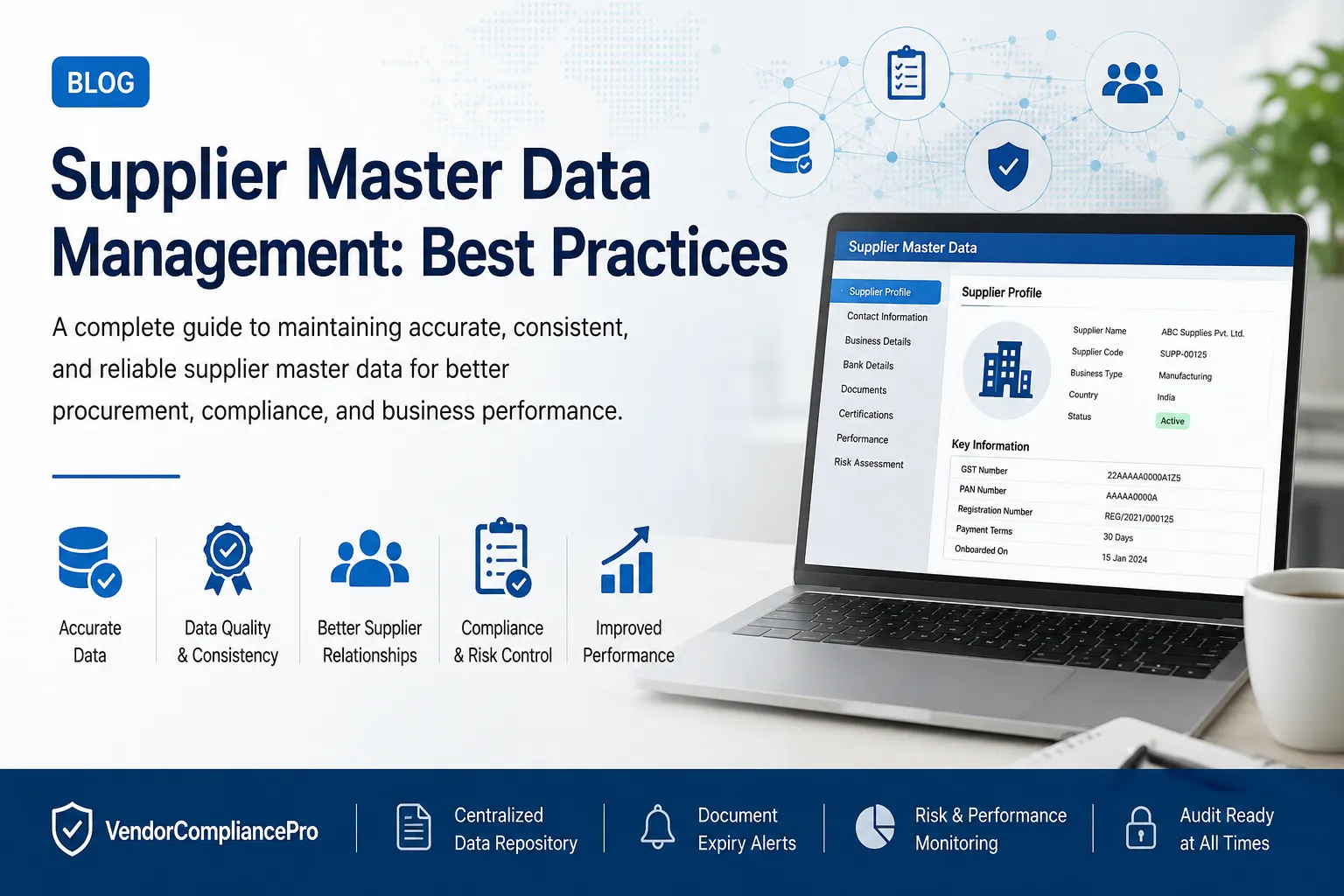
Supplier Master Data Management: Best Practices for Procurement Teams
How confident are you that your procurement team is always working with the correct supplier information?
Supplier names, GST numbers, PAN numbers, addresses, contact details, banking information, compliance documents, and other supplier records are often maintained across spreadsheets, ERP systems, procurement applications, emails, and shared folders.
As the supplier base grows, maintaining accurate and consistent information becomes increasingly difficult.
Poor supplier master data can result in:
- Duplicate supplier records
- Incomplete supplier information
- Incorrect purchase orders
- Payment and invoice problems
- Procurement delays
- Compliance risks
- Poor supplier reporting
- Difficult audits
- Increased manual work
This is where supplier master data management (Supplier MDM) becomes important.
Supplier master data management is the process of creating, maintaining, validating, updating, and governing the core information associated with suppliers.
In this guide, we will explain:
- What supplier master data management means
- What supplier master data contains
- Supplier MDM vs vendor master data
- Why supplier master data matters
- Common supplier data problems
- 12 best practices for managing supplier master data
- How to measure supplier data quality
- How supplier MDM supports supplier risk and compliance
- When to consider supplier data management software
- A practical supplier master data checklist
What Is Supplier Master Data Management?
Supplier Master Data Management (Supplier MDM) is the process of creating, maintaining, validating, updating, and governing the core information about suppliers.
The objective is to maintain a single, reliable, and trusted view of every supplier.
Supplier master data can include:
- Supplier legal name
- Trade name
- Registered address
- Billing address
- Shipping address
- Contact information
- GST registration details
- PAN information
- MSME status
- Bank and payment information
- Tax information
- Supplier category
- Products or services supplied
- Supplier locations
- Contract information
- Risk classification
- Compliance status
- Required certificates and documents
Good supplier master data allows procurement, finance, compliance, operations, and management teams to work with consistent supplier information.
Supplier Master Data vs Vendor Master Data
The terms supplier master data and vendor master data are often used interchangeably.
In many organizations, a supplier is the company or individual providing goods or services, while a vendor is commonly used in procurement and ERP systems to refer to the same business relationship.
For example, an organization may maintain a:
Supplier Master
or
Vendor Master
Both may contain information such as:
- Legal supplier name
- Tax identification numbers
- Address
- Contact details
- Banking information
- Supplier category
- Payment information
- Supplier status
- Compliance information
The exact terminology depends on the organization’s procurement, ERP, or finance processes.
For procurement teams searching for vendor master data management best practices, the underlying objective is the same:
Maintain accurate, complete, consistent, current, and trusted information about every supplier or vendor.
Supplier Master Data Management at a Glance
A strong supplier master data process should cover the following areas:
| Area | Best Practice | Objective |
|---|---|---|
| Supplier data model | Define standard fields | Create consistent records |
| Supplier onboarding | Use a controlled process | Prevent incomplete records |
| Data entry | Standardize formats | Improve consistency |
| Duplicate prevention | Check existing suppliers | Avoid duplicate records |
| Validation | Verify critical information | Improve data accuracy |
| Ownership | Assign responsibility | Establish accountability |
| Approval workflow | Review supplier creation and changes | Control supplier records |
| Audit trail | Track changes | Improve traceability |
| Data review | Periodically review records | Keep information current |
| Supplier status | Define clear statuses | Understand supplier lifecycle |
| Security | Use role-based access | Protect sensitive information |
| Documents | Connect records with documents | Improve supplier visibility |
These practices work together rather than operating as isolated activities.
Why Supplier Master Data Matters
Supplier information is used by many departments across an organization.
Procurement may use supplier data to manage sourcing, purchasing, and supplier relationships.
Finance may use it for invoices, payments, and financial records.
Compliance teams may use it to verify registrations, certificates, and other supplier requirements.
Operations may use supplier information to understand which suppliers provide specific products or services.
When supplier information is inaccurate or incomplete, the impact can spread across the organization.
Poor supplier master data can cause:
- Duplicate supplier records
- Incorrect purchase orders
- Payment delays
- Invoice mismatches
- Incorrect tax information
- Procurement delays
- Compliance issues
- Difficulty contacting suppliers
- Increased fraud risk
- Poor supplier reporting
- Audit difficulties
For organizations managing hundreds or thousands of suppliers, these problems can become increasingly difficult to manage manually.
Common Supplier Master Data Problems
1. Duplicate Supplier Records
One of the most common supplier master data problems is having the same supplier recorded multiple times.
For example:
- ABC Engineering Pvt Ltd
- ABC Engineering Private Limited
- ABC Engineering
- A.B.C. Engineering Pvt. Ltd.
These records may all represent the same organization.
Duplicate records can result in:
- Incorrect supplier counts
- Duplicate payments
- Confusing procurement reports
- Inaccurate spend analysis
- Difficulty assessing supplier risk
A standardized supplier creation process and duplicate check can significantly reduce this problem.
2. Incomplete Supplier Information
Supplier records are sometimes created with only the information required to create a purchase order.
Important information may be missing later.
Examples include:
- Missing GST information
- Missing PAN
- Missing contact person
- Missing bank information
- Missing business address
- Missing compliance documents
- Missing supplier category
- Missing risk classification
A supplier master should define the minimum information required before a supplier becomes active.
3. Outdated Supplier Information
Supplier information changes over time.
A supplier may:
- Change its address
- Change its contact person
- Update its bank account
- Change its legal name
- Renew a registration
- Obtain MSME registration
- Change its products or services
- Change its business category
If these changes are not captured, employees may continue using outdated information.
Regular supplier data reviews help identify and correct outdated records.
4. Supplier Data Stored in Multiple Places
Organizations often maintain supplier information in:
- Excel spreadsheets
- ERP systems
- Procurement applications
- Shared folders
- Local files
- Accounting software
When different systems contain different information, employees may not know which record is correct.
A clear system of record and defined ownership are therefore important.
5. No Standard Naming Convention
Supplier names should be stored consistently.
Without a naming convention, the same supplier can appear under different names.
For example:
ABC Engineering Pvt Ltd
could also appear as:
ABC Engineering Private Limited
or:
ABC Engineering Pvt. Ltd.
A supplier naming convention should define how legal names and entity types are recorded.
6. Missing or Invalid Tax Information
Tax information is particularly important for procurement and finance teams.
Depending on the organization’s country and requirements, supplier records may contain:
- Tax identification numbers
- GST registration
- PAN
- VAT number
- Sales tax information
- Other statutory registrations
Organizations should establish appropriate validation rules for the information they collect.
Supplier Master Data vs Supplier Compliance
Supplier master data and supplier compliance are closely related, but they are not the same thing.
Supplier Master Data
Supplier MDM focuses on:
- Who the supplier is
- Where the supplier is located
- How the supplier is identified
- How the supplier is categorized
- How the supplier is contacted
- How the supplier is paid
- Core supplier information
Supplier Compliance
Supplier compliance focuses on:
- Whether required documents have been submitted
- Whether documents are valid
- Whether certificates have expired
- Whether statutory requirements are satisfied
- Whether required approvals are complete
- Whether the supplier remains compliant over time
A supplier can have accurate master data but still have expired compliance documents.
For example:
A supplier’s name, GST number, and address may be completely correct while its insurance certificate or labour license has expired.
This is why supplier master data management and supplier compliance management should work together.
12 Best Practices for Supplier Master Data Management
1. Define a Standard Supplier Data Model
Before collecting supplier information, define exactly what data should be maintained.
Create standard fields for:
- Legal name
- Supplier type
- Address
- Contact details
- Tax information
- Banking information
- Products or services
- Supplier category
- Risk classification
- Compliance status
Required fields should be clearly documented.
This gives procurement teams a consistent structure for supplier records.
2. Establish a Standard Supplier Onboarding Process
Supplier master data should be created through a controlled onboarding process.
A typical process can be:
- Supplier submits information
- Procurement reviews the information
- Required documents are collected
- Supplier data is validated
- Compliance requirements are checked
- Internal approvals are completed
- Supplier record is created
- Supplier becomes active
This prevents incomplete supplier records from entering the supplier master.
3. Use Standard Data Entry Rules
Define rules for how supplier information should be entered.
For example:
- Standardize supplier names
- Standardize phone number formats
- Standardize addresses
- Use consistent supplier categories
- Validate tax identification numbers
- Avoid unnecessary abbreviations
- Define mandatory fields
Standardization makes supplier searching, reporting, and analysis much easier.
4. Prevent Duplicate Suppliers
Duplicate prevention should happen before a new supplier record is created.
Potential duplicate checks can use:
- Supplier legal name
- Tax identification number
- GST number
- PAN
- Email domain
- Bank account information
- Registered address
If a potential duplicate is detected, it should be reviewed before creating another supplier record.
5. Validate Supplier Information
Supplier information should not simply be accepted without validation.
Validation can include:
- Format validation
- Mandatory field validation
- Tax information validation
- Document validation
- Approval checks
- Duplicate checks
For critical supplier information, organizations should establish appropriate verification procedures.
6. Assign Clear Ownership
Someone should be responsible for maintaining supplier master data.
Depending on the organization, ownership may involve:
- Procurement
- Master Data Management
- Finance
- Compliance
- Vendor Management
The important point is that responsibility should be clearly defined.
A good ownership model should answer:
- Who creates the supplier?
- Who validates the information?
- Who approves the supplier?
- Who updates the record?
- Who reviews changes?
- Who deactivates inactive suppliers?
Without clear ownership, supplier master data can gradually become inaccurate.
7. Maintain an Approval Workflow
Supplier creation and important supplier changes should follow an approval workflow.
For example:
Supplier Submission
↓
Procurement Review
↓
Data Validation
↓
Compliance Review
↓
Management Approval
↓
Supplier Activation
A controlled workflow reduces uncontrolled changes and improves accountability.
8. Keep an Audit Trail
Supplier information changes over time.
Organizations should be able to determine:
- What changed?
- When did it change?
- Who changed it?
- Who approved the change?
- What was the previous value?
An audit trail is particularly important for sensitive supplier information and organizations operating in highly controlled environments.
9. Regularly Review Supplier Data
Supplier master data should not be treated as a one-time activity.
Schedule periodic reviews to identify:
- Duplicate suppliers
- Inactive suppliers
- Missing information
- Outdated contacts
- Incorrect classifications
- Invalid records
- Missing compliance information
Review frequency can depend on supplier risk and business requirements.
Higher-risk suppliers may require more frequent reviews.
10. Define Supplier Statuses
Use clear supplier statuses to represent the supplier lifecycle.
For example:
- Pending
- Under Review
- Approved
- Active
- Suspended
- Blocked
- Inactive
Clear statuses help procurement teams understand the current state of every supplier.
11. Protect Sensitive Supplier Information
Supplier records can contain sensitive business information.
Access should be based on user roles and responsibilities.
For example:
- Procurement users may manage supplier information
- Finance users may access payment-related information
- Compliance users may review compliance documents
- Auditors may have read-only access
Role-based access helps reduce unnecessary exposure of sensitive information.
12. Connect Supplier Master Data With Supplier Documents
Supplier master data and supplier documents serve different purposes, but they should work together.
The master record may contain:
Supplier Name: ABC Engineering Pvt Ltd
The connected document repository may contain:
- GST certificate
- PAN card
- MSME certificate
- Insurance certificate
- Labour license
- PF registration
- ESI registration
Keeping these connected but logically organized makes supplier management easier.
This is especially important when procurement teams need to verify supplier information during audits or compliance reviews.
Supplier Master Data Quality Framework
A useful way to evaluate supplier master data quality is to measure five key dimensions.
Accuracy
Is the supplier information correct?
For example:
- Is the legal name correct?
- Is the GST information correct?
- Is the address current?
Completeness
Are all required fields populated?
A supplier record should not be considered complete if critical information is missing.
Consistency
Is the same supplier represented consistently across systems?
The supplier name, identifiers, category, and other important information should not conflict between systems.
Timeliness
Is the supplier information current?
Old contact information or outdated registrations can reduce the usefulness of the supplier master.
Uniqueness
Does each supplier have one trusted master record?
Duplicate records can affect reporting, payments, spend analysis, and supplier risk assessment.
These five dimensions provide a useful foundation for a supplier data quality program.
Supplier Master Data Management for Growing Organizations
A small organization may manage supplier information using spreadsheets.
That can work when the supplier base is small and changes are limited.
As the organization grows, the number of suppliers, users, documents, transactions, and compliance requirements also increases.
For example:
50 suppliers
may be manageable manually.
But:
500 suppliers
or:
2,000 suppliers
can make spreadsheet-based management increasingly difficult.
At that point, organizations may need stronger:
- Data governance
- Validation
- Workflows
- Access controls
- Reporting
- Duplicate detection
- Audit trails
- Supplier document management
The goal is not simply to replace Excel.
The goal is to create a reliable supplier management process.
How Supplier Master Data Supports Supplier Risk Management
Accurate supplier master data provides an important foundation for supplier risk assessment.
Risk teams need reliable information about:
- Supplier identity
- Supplier location
- Products and services
- Business category
- Compliance status
- Supplier history
- Risk classification
If the underlying supplier information is incomplete or incorrect, the resulting risk assessment may also be unreliable.
This creates a connection between:
Supplier Master Data
↓
Supplier Risk Assessment
↓
Supplier Compliance
↓
Supplier Monitoring
Good supplier data therefore supports better supplier visibility and risk management.
How Supplier Master Data Supports Vendor Compliance
Supplier master data tells you:
Who the supplier is.
Vendor compliance tells you:
Whether the supplier continues to meet your requirements.
For example, a procurement team may maintain:
ABC Engineering Pvt Ltd
GST: XXXXX
Category: Engineering Supplier
Location: Bangalore
The compliance process may additionally track:
- GST certificate
- PAN
- MSME certificate
- Insurance
- Labour license
- PF registration
- ESI registration
- Other required documents
The supplier record and compliance information should therefore work together.
A reliable supplier master can provide the identity and context required to manage the supplier’s ongoing compliance requirements.
Supplier Master Data vs Vendor Compliance Management
These two processes solve different problems.
| Supplier Master Data Management | Vendor Compliance Management |
|---|---|
| Supplier identity | Compliance documents |
| Supplier legal information | Document validity |
| Supplier address | Document expiry |
| Supplier category | Renewal tracking |
| Supplier contact information | Compliance status |
| Banking information | Compliance reminders |
| Supplier status | Audit readiness |
| Supplier data quality | Compliance history |
An organization may already have an ERP, procurement platform, or supplier management system for supplier master data.
A dedicated vendor compliance solution can complement those systems by focusing specifically on the ongoing collection, validation, expiry tracking, and monitoring of supplier compliance documents.
When Should You Consider Supplier Data Management Software?
Supplier data management software can become useful when:
- You have hundreds of suppliers
- Multiple departments manage suppliers
- Supplier information changes frequently
- Duplicate records are common
- Procurement relies heavily on spreadsheets
- Supplier information is stored across multiple systems
- Supplier documents are stored in emails or shared folders
- Approvals are handled manually
- Audits require significant preparation
- Compliance documents need regular monitoring
The right solution should simplify supplier management rather than create another complicated process.
A Practical Supplier Master Data Checklist
Before activating a supplier, procurement teams can check:
- Legal supplier name verified
- Supplier category selected
- Registered address captured
- Contact information captured
- Tax information collected
- Required banking information collected
- Duplicate supplier check completed
- Required documents collected
- Compliance requirements reviewed
- Risk classification assigned
- Required approvals completed
- Supplier status activated
This checklist can be adapted according to the organization’s industry, supplier risk level, and business requirements.
How VendorCompliancePro Fits Into the Supplier Management Process
Supplier master data management and vendor compliance management solve different parts of the supplier lifecycle.
VendorCompliancePro focuses specifically on the compliance side of supplier management.
It helps organizations:
- Centralize vendor documents
- Collect documents through a vendor portal
- Track document expiry dates
- Send automated reminders
- Validate documents
- Manage approvals
- Maintain audit history
This can complement an organization’s existing ERP, procurement, or supplier management processes.
The overall supplier lifecycle can look like:
Supplier Onboarding
↓
Supplier Master Data
↓
Supplier Risk Assessment
↓
Supplier Compliance
↓
Ongoing Supplier Monitoring
The objective is simple:
Keep supplier compliance information organized, current, and ready when it is needed.
Frequently Asked Questions
What is supplier master data management?
Supplier master data management is the process of creating, maintaining, validating, updating, and governing the core information associated with suppliers.
It helps organizations maintain accurate, complete, consistent, current, and trusted supplier records.
What is vendor master data management?
Vendor master data management is the process of managing the core information associated with vendors in an organization’s procurement or ERP environment.
The term is often used interchangeably with supplier master data management.
Why is supplier master data important?
Accurate supplier master data helps procurement, finance, compliance, and operations teams work with reliable supplier information.
It can also reduce duplicate, incomplete, inconsistent, and outdated supplier records.
What information is included in supplier master data?
Supplier master data can include:
- Supplier legal name
- Address
- Contact details
- Tax information
- Banking information
- Supplier category
- Products or services
- Supplier status
- Risk classification
- Other information required by the organization
What is the difference between supplier MDM and vendor compliance?
Supplier MDM manages the core information about a supplier.
Vendor compliance focuses on whether required supplier documents, certificates, approvals, and other requirements remain valid and up to date.
Can Excel be used for supplier master data management?
Excel can work for smaller supplier bases, particularly when the number of suppliers and changes is limited.
However, managing hundreds or thousands of suppliers can become difficult because of duplicates, inconsistent updates, manual errors, limited workflows, and audit challenges.
How can organizations prevent duplicate supplier records?
Organizations can use:
- Standardized supplier names
- Mandatory identifiers
- GST or tax information
- Duplicate checks
- Standardized onboarding
- Approval workflows
Potential duplicates should be reviewed before activating a new supplier record.
How often should supplier master data be reviewed?
The appropriate frequency depends on the organization’s supplier base, risk level, and business requirements.
Higher-risk suppliers or supplier information that changes frequently may require more frequent reviews.
What are the five dimensions of supplier data quality?
Five commonly useful dimensions are:
- Accuracy
- Completeness
- Consistency
- Timeliness
- Uniqueness
These dimensions provide a practical framework for evaluating supplier master data quality.
When should a company consider supplier management software?
Software can become useful when supplier volumes increase, multiple departments manage supplier information, duplicate records become common, supplier documents are difficult to track, or manual processes make audits and supplier reviews difficult.
Conclusion
Supplier master data is the foundation of effective supplier management.
When supplier information is accurate, complete, consistent, unique, and current, procurement teams can make better decisions and other departments can work with greater confidence.
However, supplier master data management should not be treated as a one-time data entry exercise.
It requires:
- Standardized supplier onboarding
- Data validation
- Duplicate prevention
- Clear ownership
- Approval workflows
- Regular data reviews
- Audit trails
- Appropriate access controls
- Integration with the broader supplier lifecycle
Most importantly, supplier master data should connect with the processes that happen before and after supplier creation.
Supplier Onboarding → Supplier Master Data → Supplier Risk → Supplier Compliance → Ongoing Monitoring
When these processes work together, organizations can improve supplier visibility, reduce manual work, strengthen data quality, and maintain better control over their supplier network.
Related Articles
- Supplier Risk Assessment Process
- Vendor Onboarding Process: Complete Checklist
- What Is Vendor Compliance?
- Vendor Compliance Checklist India
- Vendor Document Management Best Practices
- Vendor Audit Readiness Checklist
- Why Vendor Onboarding Still Takes Weeks in 2026
- How AI Can Reduce Vendor Onboarding Time
- Vendor Compliance Software India