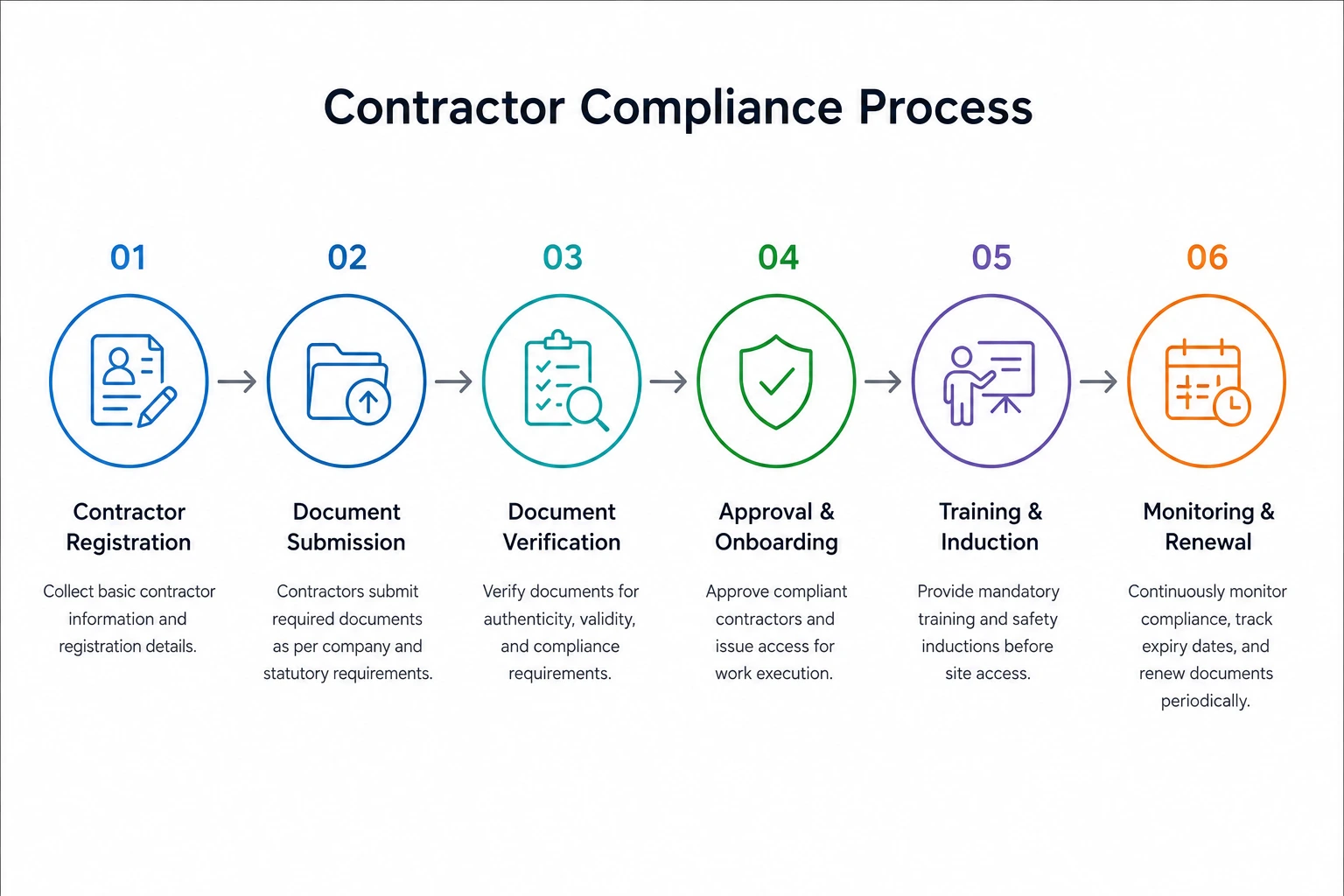
Contractor Compliance Process: Step-by-Step Guide for Manufacturing and Industrial Companies
Managing contractors efficiently is essential for ensuring regulatory compliance, workplace safety, and smooth business operations. Whether you work with manpower suppliers, maintenance agencies, housekeeping vendors, security providers, or transport contractors, maintaining proper contractor compliance is critical.
Without a structured contractor compliance process, organizations may face compliance violations, safety risks, audit observations, and operational disruptions.
In this guide, we’ll explain the contractor compliance process step by step and discuss best practices for building an efficient and audit-ready contractor management system.
What Is Contractor Compliance?
Contractor compliance refers to ensuring that contractors and service providers maintain valid documents and meet statutory, legal, and organizational requirements.
The process includes:
- Contractor onboarding
- Document collection
- Document verification
- Approval workflows
- Expiry tracking
- Renewal reminders
- Compliance reporting
- Audit preparation
A structured process helps organizations reduce risk and maintain regulatory compliance.
Why Contractor Compliance Is Important
Contractors often work inside factories, warehouses, offices, and industrial facilities.
Missing or expired documents can result in:
- Regulatory penalties
- Safety risks
- Legal liabilities
- Failed audits
- Contractor access restrictions
- Operational delays
A well-defined compliance process ensures that only compliant contractors are allowed to work.
Step 1: Contractor Registration
The first stage involves registering the contractor.
Typical information collected includes:
- Company name
- Contact details
- Vendor category
- Address
- GST number
- PAN number
This information becomes the foundation of the contractor management system.
Step 2: Define Required Documents
Different contractor categories require different documents.
Common requirements include:
Statutory Documents
- GST Registration Certificate
- PAN Card
- PF Registration
- ESIC Registration
- Labour License
- Contractor License
Insurance Documents
- Workmen Compensation Policy
- Public Liability Insurance
Employee Documents
- Employee List
- Attendance Register
- Salary Register
Safety Documents
- Safety Training Records
- PPE Compliance Records
- Risk Assessment Reports
Clearly defining requirements improves compliance consistency.
Step 3: Document Submission
Contractors upload required documents for review.
Documents may be submitted through:
- Shared drives
- Vendor portals
- Compliance software
Centralized uploads improve visibility and reduce document loss.
Step 4: Document Verification
Compliance teams verify:
- Document type
- Validity
- Expiry date
- Mandatory information
- Completeness
Only verified documents should be approved.
Step 5: Approval Workflow
After verification, documents move through approval workflows.
Typical stakeholders include:
- Procurement teams
- HR departments
- EHS teams
- Compliance officers
- Plant administrators
Approval workflows ensure accountability and maintain audit trails.
Step 6: Expiry Tracking
Many contractor documents have expiry dates.
Examples include:
- Labour License
- Contractor License
- Insurance Certificates
- Pollution Control Documents
Continuous monitoring is essential to prevent compliance gaps.
Step 7: Automated Reminder Notifications
Organizations should send notifications before expiry.
Typical reminder intervals include:
- 90 days before expiry
- 60 days before expiry
- 30 days before expiry
- 15 days before expiry
- 7 days before expiry
Early reminders help contractors renew documents on time.
Step 8: Renewal and Re-Submission
Expired documents must be replaced with updated versions.
The process includes:
- Contractor renews the document.
- Updated document is uploaded.
- Compliance team verifies the new document.
- Approval workflow is completed.
This cycle continues throughout the contractor relationship.
Step 9: Compliance Reporting
Reports help organizations monitor:
- Expiring documents
- Non-compliant contractors
- Missing documents
- Pending approvals
- Overall compliance status
Dashboards improve decision-making and visibility.
Step 10: Audit Readiness
Organizations should maintain:
- Complete document history
- Approval records
- Expiry logs
- Audit trails
Being audit-ready reduces stress during inspections and external audits.
Manual Process vs Automated Contractor Compliance Process
| Manual Process | Automated Process |
|---|---|
| Excel spreadsheets | Centralized platform |
| Manual reminders | Automatic alerts |
| Scattered documents | Single repository |
| Human errors | Better accuracy |
| Time-consuming audits | Audit-ready reports |
| Limited visibility | Real-time dashboards |
Common Challenges
Many organizations face:
Missed Expiry Dates
Important documents expire without notice.
Lack of Visibility
Teams struggle to identify non-compliant contractors.
Human Errors
Manual tracking increases mistakes.
Multiple Locations
Managing contractors across plants and warehouses becomes difficult.
Audit Pressure
Finding documents during audits consumes valuable time.
Best Practices for Contractor Compliance
Centralize Documents
Store everything in one place.
Automate Expiry Tracking
Avoid manual reminders.
Define Mandatory Requirements
Different contractor categories may require different documents.
Maintain Audit Trails
Track uploads, approvals, and renewals.
Conduct Regular Reviews
Periodic reviews help identify compliance gaps.
Industries That Benefit
Contractor compliance processes are especially important for:
- Manufacturing Companies
- Logistics Companies
- Warehouses
- Construction Companies
- Engineering Firms
- Facility Management Companies
- Industrial Plants
How AI Improves Contractor Compliance
Modern systems use AI to:
- Extract information from documents.
- Detect expiry dates automatically.
- Validate document types.
- Identify missing information.
- Reduce manual effort.
AI-driven compliance management improves efficiency and accuracy.
How VendorCompliancePro Helps
VendorCompliancePro simplifies contractor compliance through:
- Contractor self-service portal
- Centralized document repository
- Automated expiry reminders
- Approval workflows
- Compliance dashboards
- Audit reports
- Role-based access
- AI-powered document validation
Organizations can maintain contractor compliance while reducing administrative effort.
Frequently Asked Questions
What is the contractor compliance process?
The contractor compliance process includes contractor onboarding, document collection, verification, expiry tracking, approval workflows, and audit reporting.
Why is contractor compliance important?
It helps organizations reduce legal, regulatory, and operational risks.
Which documents are commonly required?
GST registration, PAN card, PF registration, ESIC registration, labour licenses, insurance certificates, and employee records.
How often should documents be reviewed?
Most organizations conduct monthly or quarterly reviews.
Can Excel be used for contractor compliance?
Yes, but manual tracking becomes difficult as the number of contractors increases.
Conclusion
Contractor compliance is a continuous process rather than a one-time activity. Organizations that implement a structured process can reduce compliance risks, improve visibility, and remain audit-ready.
As businesses grow, automation becomes essential for managing contractors efficiently and maintaining regulatory compliance.
Related Articles
- Contractor Compliance Management
- Vendor Document Tracking
- Vendor Audit Readiness Checklist
- PF and ESIC Vendor Compliance Guide
- What Is Vendor Compliance?