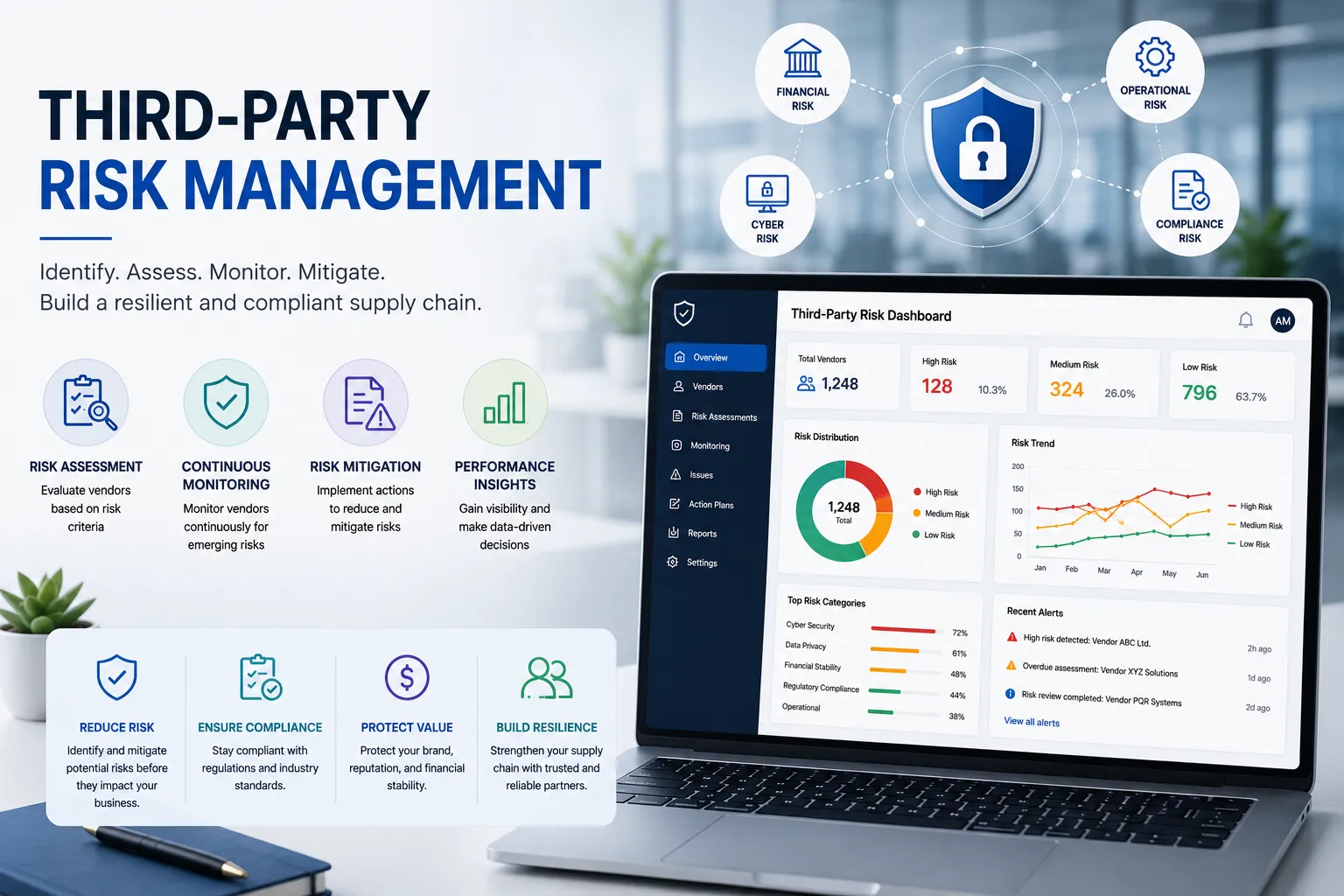
Third-Party Risk Management: Complete Guide for Manufacturing Companies (2026)
Every business depends on third parties such as suppliers, contractors, transporters, consultants, and service providers. While these partnerships improve efficiency, they also introduce compliance, operational, financial, and cybersecurity risks.
Third-Party Risk Management (TPRM) is the process of identifying, assessing, monitoring, and reducing these risks throughout the relationship with external vendors.
For manufacturing companies, logistics providers, warehouses, and engineering organizations, a structured TPRM program protects operations, ensures compliance, and improves business continuity.
What is Third-Party Risk Management?
Third-Party Risk Management is a structured framework for evaluating and monitoring risks associated with external vendors before onboarding and throughout the vendor lifecycle.
A good TPRM program helps organizations ensure vendors meet legal, regulatory, security, quality, and operational requirements.
Why is TPRM Important?
Without proper monitoring, organizations may face:
- Expired compliance documents
- Regulatory penalties
- Supply chain disruptions
- Financial losses
- Poor-quality deliveries
- Contractor safety issues
- Data security risks
- Failed audits
A centralized TPRM process helps reduce these risks before they impact the business.
| Without TPRM | With TPRM |
|---|---|
| Manual tracking | Centralized monitoring |
| Reactive decisions | Proactive risk assessment |
| Email follow-ups | Automated reminders |
| Limited visibility | Real-time risk dashboards |
| Difficult audits | Audit-ready records |
| Scattered vendor data | Centralized vendor repository |
| Manual reporting | Automated compliance reports |
Who Should Implement TPRM?
| Industry | Recommended |
|---|---|
| Manufacturing | ✅ |
| Logistics | ✅ |
| Warehousing | ✅ |
| Food Processing | ✅ |
| Automotive | ✅ |
| Engineering | ✅ |
| Construction | ✅ |
| Healthcare | ✅ |
| Pharmaceutical | ✅ |
| Financial Services | ✅ |
Types of Third-Party Risks
Compliance Risk
Missing or expired statutory documents.
Operational Risk
Vendor failure affecting production or services.
Financial Risk
Financial instability or bankruptcy of suppliers.
Cybersecurity Risk
Unauthorized access or data breaches.
Quality Risk
Poor product quality or inconsistent deliveries.
Reputational Risk
Vendor misconduct affecting your organization’s reputation.
Key Benefits
- Better vendor visibility
- Early risk identification
- Faster compliance reviews
- Improved audit readiness
- Reduced manual work
- Stronger supplier governance
- Better procurement decisions
Essential Features
Look for software that includes:
- Vendor onboarding
- Risk assessment questionnaires
- Document management
- Expiry reminders
- Vendor risk scoring
- Approval workflows
- Audit trail
- Compliance dashboard
- Reports and analytics
- AI/OCR document validation
Real Manufacturing Example
A manufacturing company works with 300 suppliers and contractors. Before onboarding, vendors must submit GST registration, PAN, insurance certificates, labour licenses, PF and ESIC registrations.
Instead of reviewing these documents manually every few months, the company uses a centralized TPRM platform to validate documents, assign vendor risk scores, track expiries, and receive automated alerts before compliance issues occur.
Third-Party Risk Management Process
- Identify third parties
- Collect vendor information
- Assess vendor risks
- Verify compliance documents
- Approve onboarding
- Monitor risks continuously
- Review vendor performance
- Renew documents
- Offboard vendors when required
Buying Checklist
Before selecting a TPRM solution, ensure it provides:
- Vendor portal
- Risk scoring
- Compliance tracking
- Document repository
- Approval workflows
- Automated reminders
- Audit trail
- Reports and dashboards
- AI/OCR validation
- API integration
Common Mistakes
- Assessing risk only during onboarding
- Ignoring document expiry
- No vendor risk scoring
- Manual spreadsheet tracking
- No audit history
- Poor reporting
- No workflow automation
- Infrequent vendor reviews
Best Practices
- Categorize vendors by risk level.
- Define mandatory compliance documents.
- Review high-risk vendors regularly.
- Automate expiry reminders.
- Conduct periodic compliance audits.
- Maintain complete vendor history.
Why VendorCompliancePro?
VendorCompliancePro helps manufacturing companies strengthen Third-Party Risk Management through:
- Vendor onboarding
- Vendor Self-Service Portal
- Compliance document management
- AI-powered document validation
- OCR processing
- Vendor risk monitoring
- Approval workflows
- Automated expiry reminders
- Audit trails
- Compliance dashboards
The platform simplifies vendor governance and helps organizations remain audit-ready while reducing compliance risk.
Frequently Asked Questions
What is Third-Party Risk Management?
It is the process of identifying, assessing, monitoring, and reducing risks associated with external vendors and suppliers.
Why is TPRM important?
It helps organizations reduce compliance, operational, financial, and supply chain risks.
Is TPRM only for large enterprises?
No. Small and medium-sized businesses also benefit from structured vendor risk management.
How often should vendor risks be reviewed?
High-risk vendors should be reviewed regularly, while all vendors should undergo periodic compliance checks.
How does VendorCompliancePro help?
VendorCompliancePro automates vendor onboarding, compliance tracking, document validation, reminders, and risk monitoring from one centralized platform.
Conclusion
Third-Party Risk Management is essential for organizations that rely on suppliers, contractors, and service providers. By replacing manual tracking with automated workflows, businesses can identify risks earlier, improve compliance, and build a more resilient supply chain.