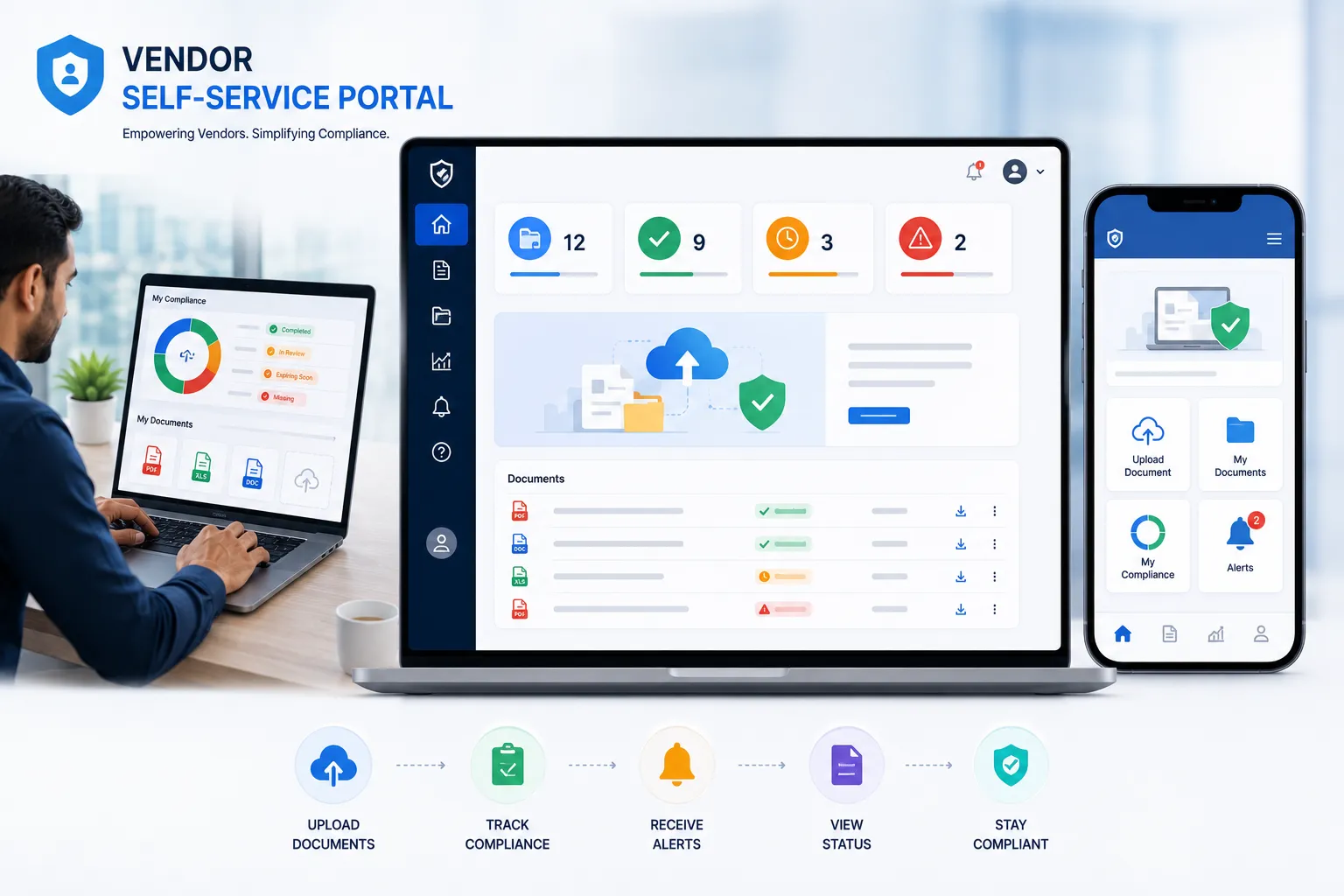
Vendor Self-Service Portal: Complete Guide to Features, Benefits and Buying
Managing suppliers and contractors through email, Excel spreadsheets, phone calls, and shared folders can become difficult as the vendor network grows.
Procurement and compliance teams may need to collect company information, request documents, review submissions, follow up on missing records, track approvals, and request renewed documents.
A vendor self-service portal gives suppliers and contractors a secure online place to perform many of these activities themselves.
Vendors can potentially:
- Register online
- Complete their company profile
- Upload required documents
- Respond to document requests
- Update permitted information
- Track submission or approval status
- Respond to renewal requests
- Receive notifications
Meanwhile, internal teams can manage vendor submissions, approvals, compliance status, and document history through a centralized system.
This guide explains what a vendor self-service portal is, how it works, which features to look for, how to implement one, and how it can support vendor onboarding and compliance.
What Is a Vendor Self-Service Portal?
A vendor self-service portal is a secure online interface that allows suppliers, contractors, and other third parties to interact directly with an organization’s vendor-management process.
Instead of sending every document and update through email, vendors can complete permitted activities themselves.
Typical activities include:
- Vendor registration
- Company profile completion
- Document upload
- Document resubmission
- Information updates
- Approval-status tracking
- Renewal responses
- Communication related to vendor requirements
The organization retains control over requirements, approvals, permissions, and compliance workflows.
The exact capabilities vary by software product.
Vendor Self-Service Portal vs Vendor Portal
The terms vendor portal and vendor self-service portal are closely related.
A vendor portal is the broader platform used to interact with suppliers and contractors.
A vendor self-service portal emphasizes the activities vendors can perform independently.
For example:
| Activity | Vendor Self-Service |
|---|---|
| Vendor registration | Yes |
| Profile updates | Yes, where permitted |
| Document upload | Yes |
| Document resubmission | Yes |
| Approval tracking | Often |
| Renewal response | Often |
| Internal approval | No — handled by authorized users |
For a broader overview of vendor portals, see Vendor Portal Software.
Why Do Companies Need a Vendor Self-Service Portal?
Organizations may work with:
- Suppliers
- Contractors
- Manpower agencies
- Transport vendors
- Maintenance providers
- Security agencies
- Facility-management companies
- Engineering service providers
As the number of vendors grows, manual communication can create significant administrative work.
Repeated Email Follow-Ups
Procurement teams may repeatedly ask vendors for the same documents.
Missing Information
Vendors may submit incomplete registration information.
Scattered Documents
Files can be distributed across emails, shared drives, and local folders.
Slow Onboarding
A vendor may take several rounds of communication to complete registration.
Poor Status Visibility
Internal teams may not know which vendors have completed their submissions.
Difficult Renewals
Vendors may need to be contacted manually when documents approach expiry.
A self-service portal creates a structured channel for these interactions.
Traditional Process vs Vendor Self-Service Portal
| Traditional Process | Vendor Self-Service Portal |
|---|---|
| Email registration forms | Online registration |
| Email attachments | Secure document upload |
| Excel tracking | Centralized status |
| Manual follow-up | Notifications and reminders |
| Phone calls for status | Portal-based status tracking |
| Shared folders | Centralized vendor records |
| Manual updates | Vendor-managed permitted information |
A portal does not eliminate every internal task. It moves appropriate activities to a structured self-service workflow.
Who Should Use a Vendor Self-Service Portal?
A self-service portal can be useful for organizations with recurring vendor onboarding or document-collection activities.
Common industries include:
| Industry | Example Use |
|---|---|
| Manufacturing | Supplier and contractor onboarding |
| Logistics | Transport and service vendors |
| Warehousing | Facility and operational contractors |
| Construction | Contractor and subcontractor records |
| Engineering | Project and maintenance vendors |
| Facility Management | Housekeeping, security, and maintenance |
| Automotive | Supplier and contractor documentation |
| Food Processing | Supplier and service-provider records |
There is no universal vendor-count threshold at which a portal becomes necessary.
The business case depends on:
- Vendor volume
- Number of documents
- Number of locations
- Frequency of updates
- Internal administrative effort
- Compliance requirements
- Vendor onboarding complexity
Key Features of a Vendor Self-Service Portal
1. Vendor Self-Registration
Vendors should be able to register through a structured form.
The process may collect:
- Legal company name
- Address
- Contact information
- Vendor category
- Products or services
- Tax information
- Registration information
2. Vendor Profile Management
Vendors should be able to update permitted information themselves.
Important master-data changes should remain subject to appropriate internal controls and approval.
3. Secure Document Upload
Vendors should have a clear way to upload requested documents.
Depending on the organization’s requirements, examples may include:
- GST registration information
- PAN
- MSME/Udyam information where applicable
- Insurance documents
- Licenses
- Certificates
- Labour-related records
- PF and ESIC records where applicable
- Contracts
The exact document list should be defined by vendor category and applicable requirements.
4. Configurable Document Requirements
Not every vendor needs the same documents.
A useful portal should support requirements based on:
- Vendor type
- Service category
- Location
- Risk
- Work type
- Contract
This avoids unnecessary document requests and makes onboarding clearer for vendors.
5. Document Resubmission
If a document is rejected or requires correction, the vendor should be able to upload a replacement without restarting the entire onboarding process.
Useful statuses include:
- Submitted
- Under Review
- Approved
- Rejected
- Resubmission Required
6. Approval Workflows
Internal users should be able to review submissions through controlled workflows.
Depending on the organization, approval may involve:
- Procurement
- Compliance
- Finance
- HR
- EHS
- Management
The workflow should retain appropriate approval history.
7. Approval Status Tracking
Vendors should be able to see the status of their submission where the organization chooses to expose it.
This can reduce questions such as:
“Has my vendor registration been approved?”
8. Expiry and Renewal Tracking
For documents with validity periods, the system should track:
- Issue date
- Expiry date
- Renewal status
- Submission status
Vendors can then be asked to submit updated records before expiry.
See Vendor Document Expiry Reminder.
9. Automated Notifications
Notifications can be used for:
- Registration invitations
- Missing documents
- Rejected submissions
- Pending approvals
- Upcoming expiries
- Renewal requests
Reminder schedules should be configurable according to the organization’s process.
10. Compliance Dashboard
Internal teams should be able to identify:
- Vendors awaiting registration
- Missing documents
- Pending approvals
- Expiring documents
- Expired documents
- Open compliance issues
A useful dashboard should help teams decide what needs action.
11. Audit Trail
The portal should retain important activity history such as:
- Registration
- Document uploads
- Rejections
- Approvals
- Updates
- Status changes
- User activity
This can support audit preparation and internal reviews.
12. Role-Based Access
A portal can have separate access for:
- Vendors
- Procurement users
- Compliance users
- Administrators
- Auditors
Users should only receive the permissions appropriate to their role.
13. Search and Reporting
Internal teams may need to filter by:
- Vendor
- Vendor category
- Location
- Status
- Document type
- Expiry date
- Compliance status
Reports can support management reviews and audits.
14. API Integration
Organizations may need the portal to integrate with:
- ERP systems
- Procurement systems
- Finance systems
- HR systems
- Identity providers
- Internal applications
Integration requirements should be defined before implementation.
15. AI and OCR Support
AI and OCR can assist with:
- Document classification
- Information extraction
- Date extraction
- Registration-number extraction
- Document validation
- Potential missing-information detection
AI should support human review rather than automatically making important legal or compliance decisions.
Vendor Self-Service Onboarding Workflow
A typical process can be:
Step 1: Vendor Invitation
The organization invites the supplier or contractor to register.
Step 2: Online Registration
The vendor creates a profile and submits basic information.
Step 3: Requirement Assignment
The system determines which documents and information are required.
Step 4: Document Upload
The vendor submits the requested records.
Step 5: Validation
Documents and information are checked.
Step 6: Internal Review
Procurement or compliance users review the submission.
Step 7: Approval or Resubmission
The vendor is approved or asked to correct or replace information.
Step 8: Vendor Activation
The vendor becomes active according to the organization’s process.
Step 9: Ongoing Updates
The vendor responds to future document requests and updates.
Benefits of a Vendor Self-Service Portal
Faster Vendor Onboarding
Vendors can submit their information directly instead of exchanging multiple emails.
Reduced Administrative Work
Internal teams spend less time collecting routine information.
Better Vendor Experience
Vendors have a clear place to register, submit documents, and respond to requests.
Better Data Quality
Structured forms can reduce incomplete and inconsistent submissions.
Improved Compliance Visibility
Internal users can identify missing, pending, expiring, and expired records.
Faster Follow-Up
Automated notifications can reduce manual chasing.
Better Audit Readiness
Documents, approvals, and activity history can be organized in one system.
Scalable Vendor Management
A self-service workflow can support a growing vendor network without increasing manual communication at the same rate.
Vendor Self-Service Portal vs Email and Excel
Email and Excel are not automatically unsuitable.
For a small number of vendors and simple processes, they may still be sufficient.
However, organizations with more complex vendor workflows may need:
| Requirement | Email + Excel | Self-Service Portal |
|---|---|---|
| Vendor registration | Manual | Structured |
| Document submission | Email attachments | Online upload |
| Status tracking | Manual | Centralized |
| Automated reminders | Limited | Supported |
| Approval workflow | Manual | Workflow-based |
| Vendor self-service | No | Yes |
| Audit history | Limited | Centralized |
| Reporting | Manual | Dashboard/reporting |
The right choice depends on process complexity, workload, risk, and expected growth.
How to Choose a Vendor Self-Service Portal
Before selecting a solution, evaluate:
Vendor Experience
Can a new supplier understand and complete registration without extensive assistance?
Document Requirements
Can requirements vary by vendor type?
Workflow
Can the system match your actual approval process?
Notifications
Can the organization configure reminders and follow-ups?
Compliance
Can users identify missing, expiring, and expired documents?
Security
Evaluate:
- Authentication
- Authorization
- Role-based access
- Audit logs
- Data protection
- Backup and recovery
Integration
Can the portal connect with existing ERP, procurement, HR, or finance systems?
Reporting
Can users generate the reports required for management and audits?
Scalability
Consider expected growth in:
- Vendors
- Documents
- Users
- Locations
Total Cost
Consider:
- Subscription
- Implementation
- Data migration
- Integration
- Support
- User licensing
- Vendor licensing where applicable
Vendor Self-Service Portal Buying Checklist
Before selecting a platform:
- Vendor self-registration
- Vendor profile management
- Secure document upload
- Configurable document requirements
- Document resubmission
- Approval workflows
- Approval status tracking
- Expiry tracking
- Automated notifications
- Compliance dashboard
- Audit trail
- Search and filtering
- Reports and exports
- Role-based access
- API integration
- AI/OCR support if required
- Mobile-friendly experience
- Appropriate security controls
Common Implementation Mistakes
Making Registration Too Complicated
Long forms can reduce vendor completion rates.
Requesting Too Many Documents
Not every vendor needs every document.
Requirements should be based on vendor category and applicable needs.
Ignoring Vendor Experience
A portal that is difficult to use may simply move the workload back to procurement teams.
No Resubmission Workflow
Rejected documents should have a clear correction and resubmission process.
No Ownership
Internal teams should know who is responsible for reviewing and approving submissions.
No Expiry Tracking
Collecting a document once does not ensure it remains current.
Weak Reporting
Without dashboards and reports, teams may still struggle to identify compliance gaps.
Poor Integration Planning
A portal can create duplicate work if it does not fit the organization’s existing systems.
Best Practices for Implementing a Vendor Self-Service Portal
1. Map the Vendor Journey
Define the process from invitation through registration, approval, and ongoing updates.
2. Standardize Requirements
Create document and information requirements by vendor category.
3. Keep Registration Simple
Ask for the information needed at each stage rather than overwhelming vendors with a long form.
4. Clean Existing Vendor Data
Before migration, identify:
- Duplicate vendors
- Inactive vendors
- Missing information
- Outdated documents
5. Define Ownership
Assign responsibility for:
- Vendor registration
- Document review
- Approval
- Renewal
- Escalation
6. Pilot the Portal
Start with a manageable vendor group and improve the process before broader rollout.
7. Measure Adoption
Track:
- Registration completion rate
- Average onboarding time
- Missing-document rate
- Approval turnaround time
- Renewal completion rate
- Portal adoption rate
How a Vendor Self-Service Portal Supports Compliance
The real value of a self-service portal is not just document upload.
It can connect:
Vendor Registration
↓
Requirement Definition
↓
Document Collection
↓
Verification
↓
Approval
↓
Vendor Activation
↓
Expiry Monitoring
↓
Renewal
↓
Periodic Review
↓
Audit Readiness
This connects onboarding with ongoing vendor compliance.
How AI Can Support a Vendor Self-Service Portal
AI and OCR can help reduce manual work during document processing.
Depending on the implementation, they can:
- Identify document types
- Extract vendor information
- Extract dates
- Extract registration numbers
- Compare uploaded documents with expected types
- Flag potential issues
- Reduce manual data entry
Human review remains important for significant compliance, legal, financial, safety, and operational decisions.
How VendorCompliancePro Helps
VendorCompliancePro combines a vendor self-service portal with vendor document and compliance management.
Organizations can use it for:
- Vendor registration
- Vendor self-service
- Company-profile management
- Configurable document requirements
- Secure document upload
- Document resubmission
- AI-powered document validation
- OCR processing
- Approval workflows
- Document expiry tracking
- Automated expiry reminders
- Compliance dashboards
- Audit trails
- Reports and analytics
The workflow connects:
Vendor → Registration → Requirements → Documents → Verification → Approval → Expiry → Renewal → Compliance Status
VendorCompliancePro can complement an existing ERP or procurement system by focusing on vendor onboarding, document collection, compliance monitoring, expiry tracking, renewal reminders, and audit readiness.
Frequently Asked Questions
What is a vendor self-service portal?
A vendor self-service portal is an online platform where suppliers and contractors can register, submit information, upload documents, respond to requests, and track permitted vendor activities themselves.
What is the difference between a vendor portal and a vendor self-service portal?
A vendor portal is the broader platform for vendor interaction. A self-service portal emphasizes activities that vendors can complete independently, such as registration, document submission, updates, and renewal responses.
Can vendors upload their own documents?
Yes. A self-service portal can allow vendors to securely upload and update requested documents.
Can vendors update their company information?
Many portals allow vendors to update permitted information. Important master-data changes can remain subject to internal review and approval.
Can a vendor self-service portal automate onboarding?
Yes. A portal can automate invitations, registration, document requests, notifications, approvals, and status tracking.
Does a vendor portal replace an ERP?
Usually not.
An ERP may manage purchasing, finance, inventory, and other core processes, while a vendor portal can focus on vendor interaction, onboarding, document collection, and compliance workflows.
Is a vendor self-service portal suitable for SMEs?
Yes. Suitability depends on vendor volume, document complexity, internal workload, and process requirements rather than a fixed number of vendors.
Can a vendor portal improve audit readiness?
Yes. Centralized documents, submission history, approvals, and audit trails can make it easier to retrieve evidence during audits and reviews.
Conclusion
A vendor self-service portal can transform supplier and contractor interaction from repeated emails and spreadsheets into a structured digital workflow.
The strongest implementations connect:
Vendor Registration → Information Collection → Document Submission → Verification → Approval → Compliance Monitoring → Renewal → Audit Readiness
The objective is not simply to give vendors a place to upload files.
The portal should help answer:
Which vendors have completed onboarding, which documents are missing or expiring, what action is required, and who is responsible for it?
For manufacturing, logistics, warehousing, engineering, construction, automotive, and facility-management organizations, a well-designed vendor self-service portal can reduce administrative effort, improve vendor experience, and strengthen compliance visibility.
Related Articles
- Vendor Portal Software
- Vendor Onboarding Process
- Vendor Compliance Software India
- Vendor Compliance Checklist India
- Vendor Document Management
- Vendor Document Tracking
- Vendor Document Expiry Reminder
- Vendor Contract Expiry Reminder
- Vendor Master Data Management
- Contractor Compliance Management
- PF and ESIC Vendor Compliance Guide
- Vendor Audit Readiness Checklist