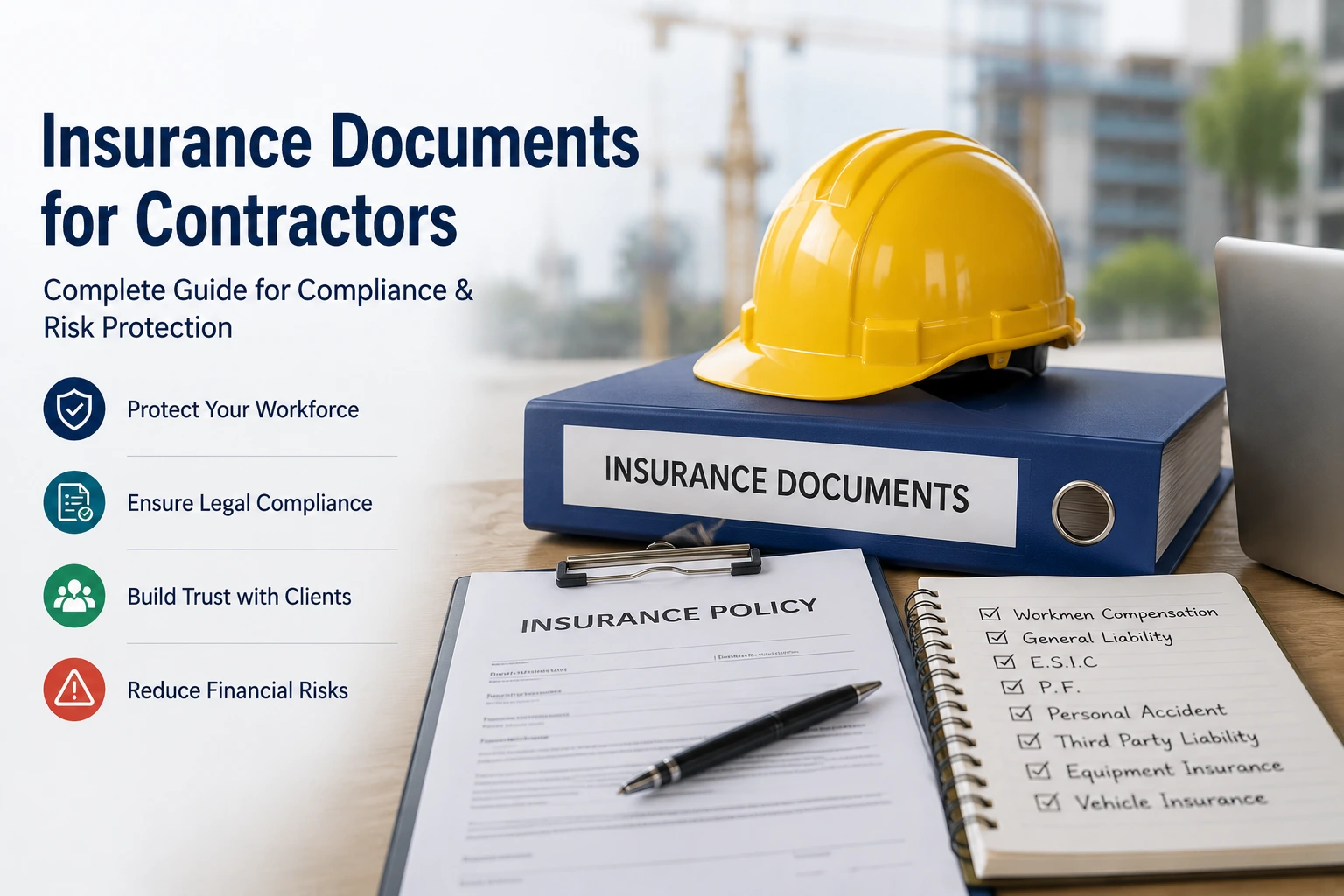
Insurance Documents Required for Contractors: Complete Guide for Vendor Compliance
Insurance documents are among the most important compliance records organizations request from contractors during vendor onboarding. They help protect both the hiring organization and the contractor from financial losses arising from workplace accidents, property damage, or third-party claims.
Manufacturing companies, logistics providers, warehouses, engineering firms, construction companies, and facility management organizations commonly require contractors to maintain valid insurance coverage before work begins.
In this guide, we’ll explain which insurance documents contractors should provide, why they are important, and how organizations can manage contractor insurance as part of a structured vendor compliance program.
Why Are Insurance Documents Important?
Contractors often perform work involving machinery, equipment, vehicles, hazardous materials, or large workforces. Even with proper safety measures, unexpected incidents can occur.
Valid insurance policies help organizations:
- Reduce financial risk
- Meet contractual obligations
- Protect workers
- Support workplace safety
- Improve audit readiness
- Demonstrate regulatory compliance
Insurance verification has become a standard requirement during contractor onboarding.
Common Insurance Documents Required from Contractors
The exact insurance requirements depend on the nature of work, industry, and contractual obligations. However, most organizations request the following documents.
Workmen Compensation Insurance Policy
This policy provides financial protection if a contractor’s employee suffers injury or death while performing work.
Why it is important
- Employee protection
- Labour law compliance
- Reduced employer liability
- Contract compliance
Many manufacturing companies make this a mandatory requirement before contractor deployment.
Public Liability Insurance
Public Liability Insurance protects against claims made by third parties for injury or property damage resulting from contractor activities.
Commonly required for
- Construction projects
- Engineering services
- Industrial maintenance
- Facility management
- Warehousing operations
General Liability Insurance
General Liability Insurance provides broader protection against legal claims arising from contractor operations.
Organizations often request this policy when contractors work inside manufacturing plants or customer facilities.
Professional Indemnity Insurance
Professional Indemnity Insurance is generally requested from contractors providing professional or consulting services.
Examples include:
- Engineering consultants
- Design consultants
- IT service providers
- Architects
- Project management consultants
Vehicle Insurance
Contractors operating commercial vehicles may be required to submit valid vehicle insurance documents.
Common examples include:
- Transport contractors
- Logistics companies
- Delivery service providers
Contractor All Risk (CAR) Insurance
For construction and infrastructure projects, organizations often require Contractor All Risk (CAR) Insurance to cover accidental losses during project execution.
What Should Procurement Teams Verify?
Before approving insurance documents, organizations should verify the following details.
Policy Holder Name
Ensure the insurance policy belongs to the contractor being onboarded.
Policy Number
Verify that the policy number is complete and valid.
Coverage Period
Confirm that the insurance policy remains valid throughout the contract duration.
Coverage Amount
Review whether the insured amount satisfies contractual requirements.
Nature of Coverage
Ensure the insurance policy covers the work being performed.
Insurance Company Details
Verify the insurer information and policy documentation.
Common Challenges in Managing Insurance Documents
Managing contractor insurance manually often creates several problems.
Expired Insurance Policies
Policies expire during active contracts without timely renewal.
Missing Insurance Documents
Contractors fail to submit required policies before work begins.
Manual Tracking
Expiry dates are tracked in Excel spreadsheets.
Multiple Contractors
Managing hundreds of policies across different contractors becomes difficult.
Audit Preparation
Locating insurance records during compliance audits consumes valuable time.
Best Practices for Managing Contractor Insurance
Organizations can improve contractor compliance by following these best practices.
Define Insurance Requirements
Specify mandatory insurance documents before vendor onboarding.
Verify Coverage Before Approval
Review policy validity and coverage before allowing contractors to begin work.
Monitor Policy Expiry Dates
Track expiry dates continuously and initiate renewal reminders well in advance.
Maintain Centralized Records
Store insurance documents securely within a centralized vendor compliance system.
Conduct Periodic Reviews
Review contractor insurance policies regularly to ensure continuous compliance.
Manual Process vs Automated Insurance Management
| Manual Process | Automated Process |
|---|---|
| Excel tracking | Centralized repository |
| Email reminders | Automated expiry alerts |
| Shared folders | Secure document storage |
| Manual follow-up | Vendor self-service uploads |
| Difficult audits | Audit-ready reports |
| Limited visibility | Compliance dashboards |
How VendorCompliancePro Helps
VendorCompliancePro simplifies contractor insurance management by providing:
- Vendor self-service document uploads
- Centralized insurance document repository
- Automated expiry reminders
- Approval workflows
- Compliance dashboards
- Audit-ready reports
- Document history
- AI-powered document validation
Organizations can manage insurance documents together with GST Registration Certificates, PAN Cards, PF Registration Certificates, ESIC Registration Certificates, Labour Licences, and other statutory compliance records from a single platform.
Frequently Asked Questions
Which insurance documents should contractors submit?
The required insurance documents depend on the nature of work. Common requirements include Workmen Compensation Insurance, Public Liability Insurance, General Liability Insurance, Professional Indemnity Insurance, Vehicle Insurance, and Contractor All Risk Insurance.
Why do organizations request insurance documents during vendor onboarding?
Insurance documents help verify that contractors have adequate financial protection and meet contractual and compliance requirements before work begins.
How often should contractor insurance be reviewed?
Organizations should monitor insurance policy validity continuously and ensure policies remain active throughout the contract period.
Can vendor compliance software manage insurance documents?
Yes. Vendor compliance software centralizes insurance records, tracks policy expiry dates, automates reminders, supports approval workflows, and improves audit readiness.
Conclusion
Insurance documents are a critical component of contractor and vendor compliance. Verifying insurance coverage before contractor deployment helps organizations reduce financial risks, improve statutory compliance, and strengthen workplace safety.
Rather than relying on spreadsheets and manual reminders, organizations can simplify contractor insurance management through a centralized vendor compliance platform that provides secure document storage, automated expiry tracking, and complete compliance visibility.