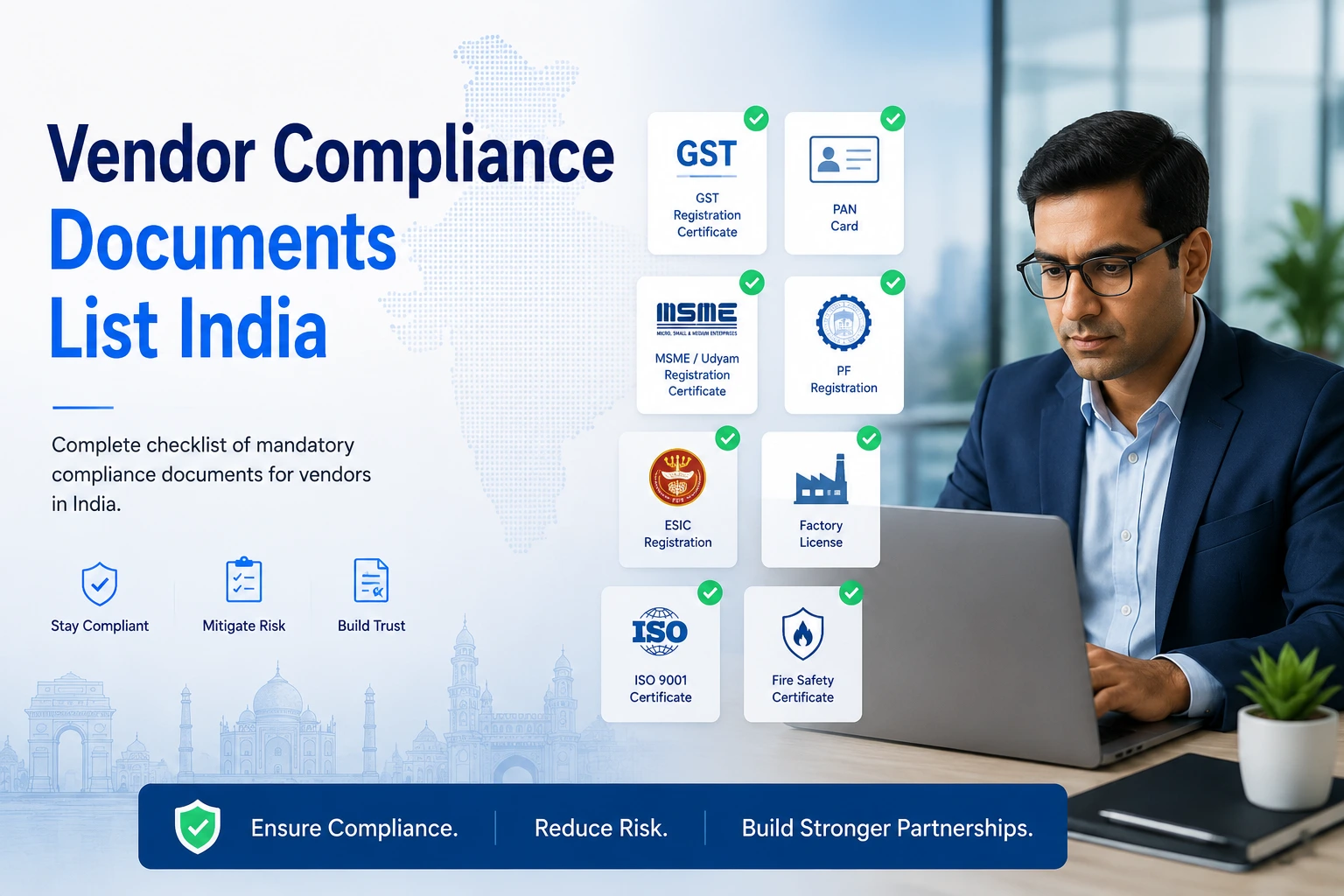
Complete Vendor Compliance Documents List in India (2026 Guide)
Managing vendor compliance requires more than collecting a few registration certificates. Organizations must ensure that suppliers, contractors, and service providers submit valid statutory, tax, labour, insurance, and safety documents before they begin work and throughout the business relationship.
Missing or expired compliance documents can lead to audit observations, regulatory penalties, legal liabilities, project delays, and operational risks.
In this guide, we’ll explain the complete vendor compliance documents list commonly required by manufacturing companies, logistics providers, warehouses, engineering firms, construction companies, and other industrial organizations in India.
Why Vendor Compliance Documents Matter
Vendor compliance documents help organizations verify that vendors meet legal and regulatory requirements before providing goods or services.
Maintaining updated vendor records helps organizations:
- Reduce compliance risks
- Improve audit readiness
- Verify statutory registrations
- Ensure contractor compliance
- Protect workplace safety
- Reduce legal liabilities
- Maintain uninterrupted business operations
A centralized document management process also reduces manual follow-up and improves visibility across procurement and compliance teams.
Vendor Compliance Documents Checklist
Vendor compliance requirements vary by industry, company policy, and type of vendor. However, most organizations collect documents from the following categories.
- Registration Documents
- Tax Documents
- Labour Law Documents
- Insurance Documents
- Employee Records
- Safety Documents
- Environmental Compliance Documents
- Monthly Compliance Documents
- Annual Compliance Documents
Registration Documents
These documents establish the legal identity of the vendor.
GST Registration Certificate
The GST Registration Certificate verifies that the vendor is registered under the Goods and Services Tax (GST) Act.
Why it is required
- GST compliance
- Vendor verification
- Tax invoice validation
Renewal
Generally permanent unless cancelled or amended.
PAN Card
The Permanent Account Number (PAN) identifies the business for income tax purposes.
Why it is required
- Vendor identification
- Tax compliance
- Financial transactions
MSME / Udyam Registration Certificate
This certificate confirms whether the vendor is registered as a Micro, Small, or Medium Enterprise.
Benefits
- MSME compliance
- Procurement benefits
- Government incentives
Certificate of Incorporation
Applicable for companies registered under the Companies Act.
Used to verify:
- Company registration
- Legal entity
- CIN number
Partnership Deed / LLP Registration
Applicable for partnership firms and LLPs.
Labour Law Compliance Documents
Organizations engaging contractors typically collect the following documents.
PF Registration Certificate
Required to verify Employees’ Provident Fund registration.
ESIC Registration Certificate
Confirms Employees’ State Insurance registration.
Labour License
Required for contractors employing workers under applicable labour laws.
Contractor License
Many organizations require contractors to submit a valid contractor licence where applicable.
Professional Tax Registration
Required in states where Professional Tax is applicable.
Insurance Documents
Insurance protects both the vendor and the hiring organization against financial and operational risks.
Common insurance documents include:
- Workmen Compensation Policy
- Public Liability Insurance
- General Liability Insurance
- Employee Accident Insurance
- Professional Indemnity Insurance (where applicable)
Organizations should monitor policy expiry dates and renewal status.
Employee Compliance Documents
Many organizations request employee-related records from contractors.
Examples include:
- Employee List
- Attendance Register
- Wage Register
- Salary Register
- Identity Cards
- Skill Certificates
- Police Verification (where required)
These documents help demonstrate compliance during labour inspections and audits.
Safety Compliance Documents
Safety documentation is particularly important for manufacturing plants, warehouses, construction sites, and engineering companies.
Common safety documents include:
- Safety Training Records
- PPE Compliance Records
- Toolbox Talk Records
- Medical Fitness Certificates
- Risk Assessment Reports
- Emergency Contact Details
Regular review of these records helps reduce workplace incidents and supports safety audits.
Environmental Compliance Documents
Depending on the industry, vendors may also need to provide environmental compliance records such as:
- Pollution Control Board Consent
- Hazardous Waste Authorization
- Environmental Clearance
- Waste Disposal Agreement
These documents are particularly relevant for manufacturing and industrial operations.
Monthly Compliance Documents
Many organizations collect recurring compliance documents every month.
Examples include:
- PF Challan
- ESIC Challan
- Salary Register
- Attendance Register
- Wage Register
- Employee Contribution Records
Tracking monthly submissions manually often becomes difficult as the number of vendors grows.
Annual Compliance Documents
Annual compliance documents may include:
- Insurance Renewals
- ISO Certificates
- Factory License Renewal
- Labour License Renewal
- Professional Tax Renewal (where applicable)
Organizations should schedule reminders well before expiry dates.
Common Challenges in Managing Vendor Documents
Many organizations still rely on:
- Excel spreadsheets
- Email reminders
- Shared folders
- Paper files
These manual methods often result in:
- Missing documents
- Expired certificates
- Duplicate records
- Delayed approvals
- Difficult audits
- Increased administrative effort
Best Practices for Managing Vendor Compliance Documents
Organizations can improve compliance management by following these practices.
Create a Standard Document Checklist
Different vendor categories may require different compliance documents.
Centralize Document Storage
Store all vendor records in one secure location.
Track Expiry Dates
Monitor document validity continuously instead of relying on manual reminders.
Automate Renewal Notifications
Notify vendors before documents expire to reduce compliance gaps.
Maintain Audit History
Track document uploads, approvals, renewals, and changes.
How VendorCompliancePro Helps
VendorCompliancePro simplifies vendor document management by providing:
- Centralized document repository
- Vendor self-service portal
- Automated expiry reminders
- Approval workflows
- Compliance dashboards
- Audit-ready reports
- Role-based access
- AI-powered document validation
Organizations can replace spreadsheets with an automated compliance management process while improving visibility and reducing administrative effort.
Frequently Asked Questions
Which documents should every vendor submit?
The exact requirements depend on the vendor type and industry, but GST Registration, PAN Card, MSME Registration (if applicable), PF Registration, ESIC Registration, Labour License, insurance documents, and employee records are among the most commonly requested.
Are compliance documents the same for every industry?
No. Manufacturing, logistics, construction, healthcare, engineering, and facility management organizations often require different compliance documents based on regulatory requirements.
How often should vendor documents be reviewed?
Organizations should review compliance documents regularly and monitor expiry dates throughout the year. Monthly and quarterly compliance reviews are common best practices.
Can vendor compliance software automate document tracking?
Yes. Modern vendor compliance software centralizes document management, tracks expiry dates, sends automated reminders, supports approval workflows, and generates audit-ready reports.
Conclusion
Maintaining a complete and up-to-date vendor compliance document repository is essential for reducing operational and regulatory risks.
By replacing manual spreadsheets with an automated compliance management process, organizations can improve visibility, simplify audits, and ensure vendors continue to meet statutory and organizational requirements.