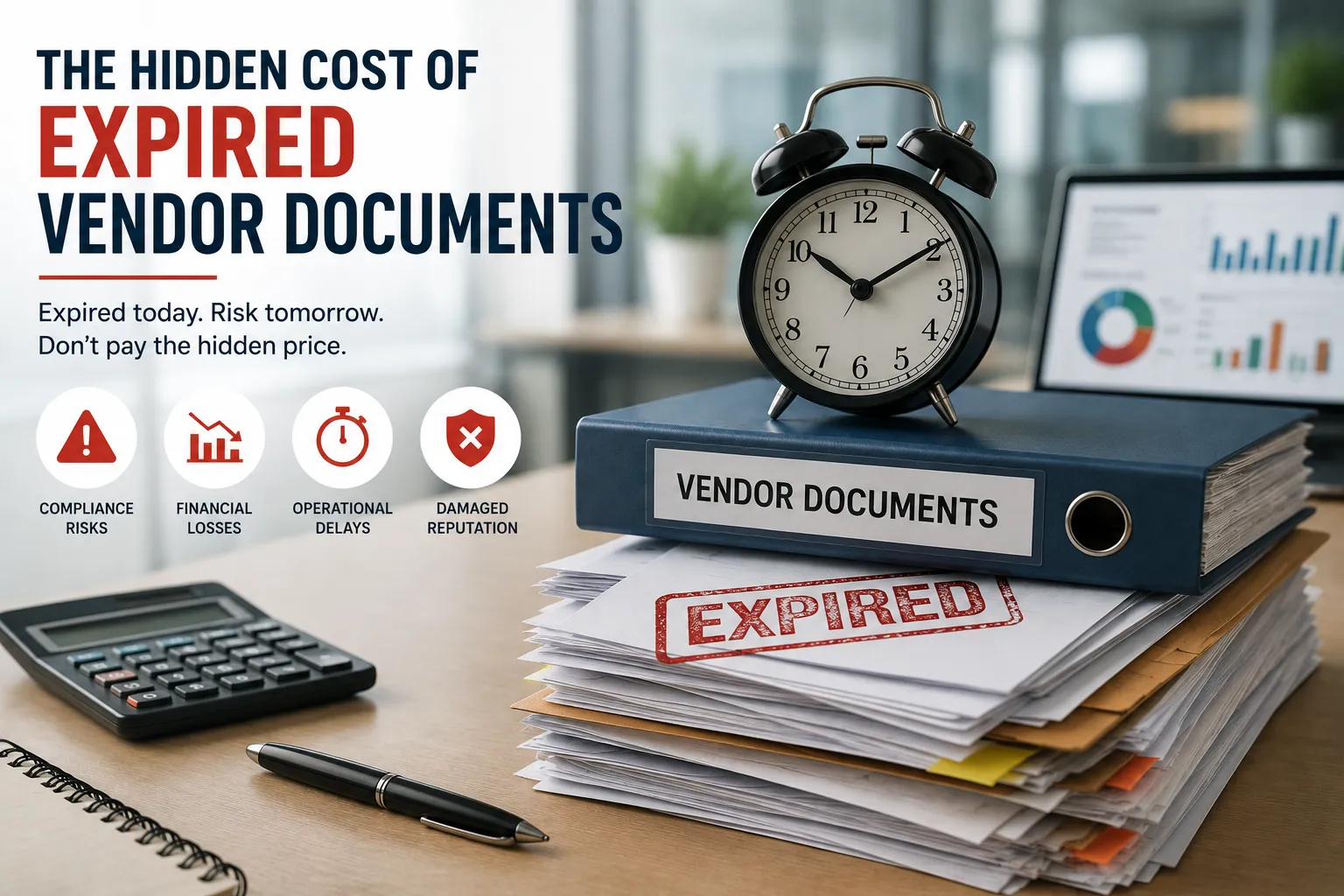
The Hidden Cost of Expired Vendor Documents (And How to Prevent It)
Most organizations don’t realize there’s a problem until it’s too late.
A vendor arrives at your factory.
Security asks for their compliance documents.
Someone discovers the contractor’s insurance certificate expired last month.
The vendor cannot enter the premises.
Work stops.
Procurement starts making frantic phone calls.
What could have been prevented with a simple reminder now becomes an expensive operational issue.
Expired vendor documents are far more than an administrative inconvenience—they can disrupt operations, delay payments, create audit findings, and expose organizations to significant compliance risks.
In this article, we’ll explore the hidden costs of expired vendor documents and how modern organizations prevent these problems before they happen.
Why Vendor Documents Expire
Every vendor is required to maintain various compliance documents.
These commonly include:
- GST Registration Certificate
- PAN Card
- MSME Certificate
- PF Registration
- ESIC Registration
- Labour License
- Insurance Policies
- Factory Licenses
- Professional Tax Registration
- ISO Certifications
Many of these documents require periodic renewal.
Without proper tracking, it’s easy for expiry dates to be overlooked.
The Hidden Costs of Expired Vendor Documents
Many organizations only think about document expiry during audits.
In reality, the impact is much broader.
1. Audit Findings and Compliance Failures
Auditors expect organizations to maintain valid vendor compliance records.
If an expired document is presented during an audit, it raises questions about your compliance processes.
Common consequences include:
- Non-conformance reports
- Audit observations
- Corrective action requests
- Additional audit scrutiny
Even one expired document can affect your audit outcome.
2. Delayed Vendor Payments
Many finance teams verify vendor compliance before releasing payments.
If required documents have expired:
- Invoice processing may stop
- Payments are delayed
- Vendors become frustrated
- Procurement receives unnecessary escalations
A simple renewal delay can damage supplier relationships.
3. Operational Disruptions
Imagine a contractor arriving on-site with an expired labour license or insurance policy.
The organization may deny site access until updated documents are provided.
This can lead to:
- Project delays
- Production downtime
- Missed delivery schedules
- Increased operational costs
4. Increased Legal and Regulatory Risk
Certain vendor documents are legally required.
Using vendors with expired registrations or licenses may expose organizations to:
- Regulatory penalties
- Legal disputes
- Contract violations
- Increased compliance risk
Prevention is always less expensive than resolving compliance issues later.
5. Loss of Customer Confidence
Many customers conduct supplier audits before awarding contracts.
Finding expired vendor documents creates doubt about your internal controls.
Customers expect organizations to demonstrate:
- Strong governance
- Reliable compliance processes
- Effective vendor management
Expired documentation can weaken that confidence.
6. Reduced Procurement Productivity
When expiry dates aren’t tracked automatically, procurement teams spend valuable time:
- Searching spreadsheets
- Sending reminder emails
- Calling vendors
- Following up repeatedly
- Updating manual trackers
Instead of focusing on strategic sourcing, teams become document chasers.
7. Reputational Damage
Compliance failures rarely remain internal.
Repeated vendor compliance issues can affect your organization’s reputation with:
- Customers
- Auditors
- Regulatory authorities
- Business partners
Maintaining valid vendor documentation reflects a mature and reliable procurement process.
Why Manual Tracking Often Fails
Many organizations still rely on:
- Excel spreadsheets
- Calendar reminders
- Email follow-ups
- Shared folders
These methods work for a handful of vendors.
As the vendor base grows, manual tracking becomes increasingly difficult.
Common problems include:
- Missed reminder dates
- Human error
- Duplicate spreadsheets
- Lack of ownership
- No visibility into document status
Eventually, expired documents become inevitable.
How Modern Organizations Prevent Document Expiry
Leading organizations replace manual tracking with automated vendor compliance management.
Modern platforms provide:
Automated Expiry Notifications
Receive reminders well before documents expire, allowing vendors enough time to renew them.
Centralized Document Repository
Store every vendor document securely in one searchable location.
Vendor Self-Service Portal
Allow vendors to upload renewed documents directly without lengthy email exchanges.
Approval Workflows
Ensure updated documents are reviewed and approved before becoming active.
Compliance Dashboards
Provide a real-time overview of upcoming expiries and overdue renewals.
Complete Audit Trail
Track who uploaded, reviewed, approved, or replaced every document.
Warning Signs Your Organization Is at Risk
You may already have a document expiry problem if:
- Expired documents are discovered during audits.
- Procurement maintains multiple Excel trackers.
- Vendors submit documents by email.
- Teams manually send renewal reminders.
- Nobody knows which documents expire next month.
- Different departments maintain separate records.
If these situations sound familiar, your organization may benefit from automating vendor document management.
How VendorCompliancePro Helps
VendorCompliancePro helps organizations stay ahead of document expiry by centralizing vendor compliance management.
Key capabilities include:
- Automated expiry reminders
- Centralized document repository
- Vendor self-service portal
- AI-powered document validation
- Approval workflows
- Compliance dashboards
- Audit-ready reporting
- Complete document history
Instead of reacting to expired documents, your team can proactively prevent them.
Frequently Asked Questions
Why are expired vendor documents a compliance risk?
Expired documents indicate that vendors may no longer meet regulatory or contractual requirements, increasing legal, operational, and audit risks.
Which vendor documents commonly expire?
Insurance certificates, labour licenses, PF registrations, ESIC registrations, ISO certifications, contractor licenses, and various statutory registrations typically require periodic renewal.
How can organizations prevent expired vendor documents?
Using automated expiry reminders, centralized document management, approval workflows, and vendor self-service portals significantly reduces the risk of missed renewals.
Why is Excel not sufficient for tracking document expiry?
Excel relies on manual updates and reminders, making it difficult to manage hundreds of vendors accurately as organizations grow.
What is the benefit of automated vendor compliance software?
Automation improves visibility, reduces manual work, prevents compliance gaps, and keeps organizations audit-ready throughout the year.
Conclusion
Expired vendor documents rarely cause problems on their own.
The real cost comes from delayed operations, failed audits, payment holds, regulatory risk, and countless hours spent resolving issues that could have been prevented.
Organizations that automate vendor document management gain better visibility, reduce compliance risk, and ensure every vendor remains audit-ready throughout the year.
The best time to renew a document is before it expires—not after it creates a problem.