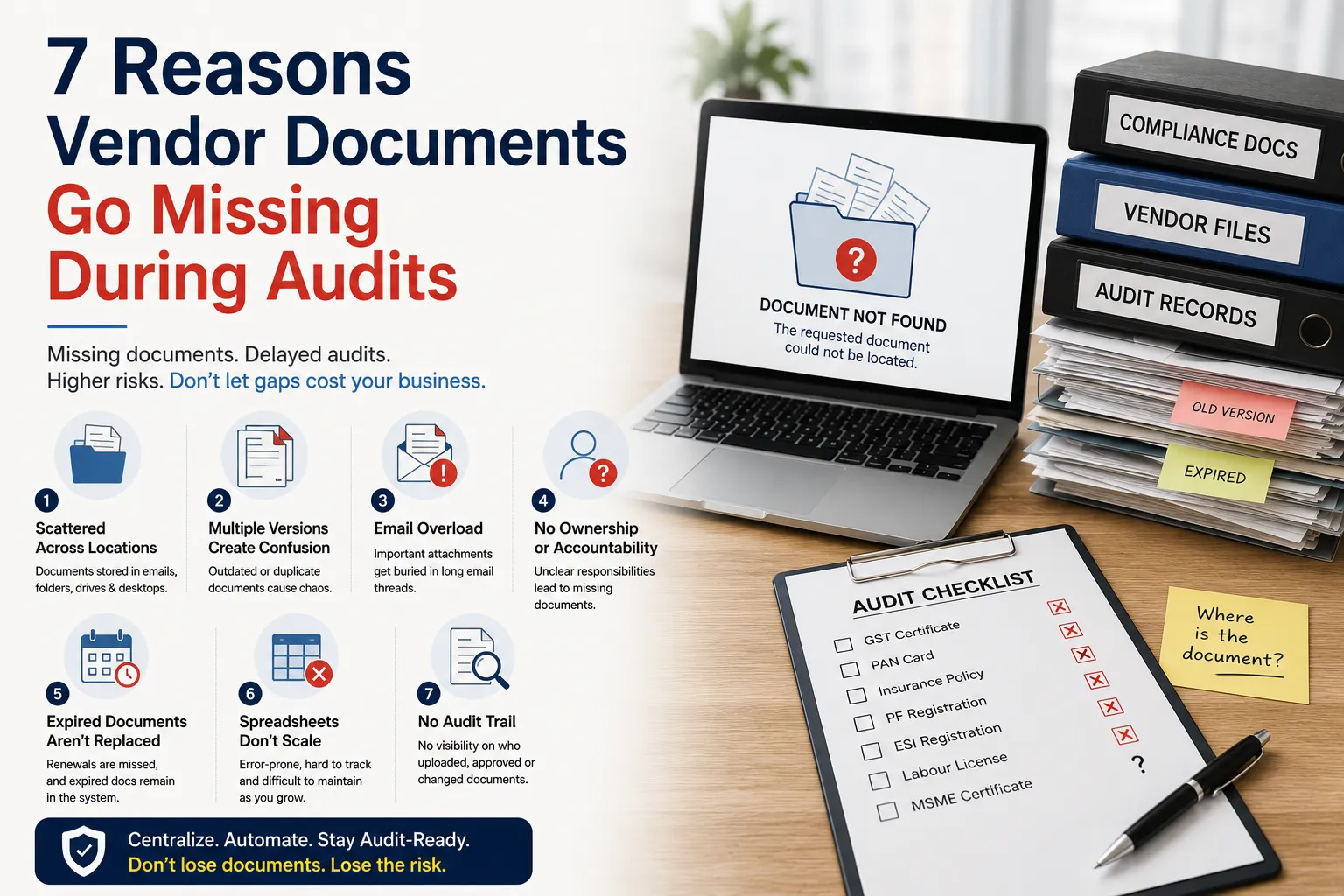
7 Reasons Vendor Documents Go Missing During Audits (And How to Prevent It)
Nothing creates more stress during an audit than hearing the question:
“Can you show the vendor’s compliance documents?”
What should take a few seconds often turns into hours of searching through emails, shared folders, spreadsheets, and personal computers.
Missing vendor documents not only delay audits but can also lead to compliance findings, financial penalties, and damaged business relationships.
In this article, we’ll explore the seven most common reasons vendor documents go missing during audits and how organizations can eliminate these issues with a modern document management process.
Why Missing Documents Are a Serious Problem
Vendor documents prove that suppliers meet your organization’s legal, regulatory, and contractual requirements.
Missing documents can result in:
- Failed compliance audits
- Delayed customer audits
- Procurement delays
- Regulatory penalties
- Increased operational risk
- Loss of customer confidence
The larger your vendor network becomes, the harder manual document management becomes.
1. Documents Are Scattered Across Multiple Locations
One of the biggest reasons documents go missing is that they are stored in different places.
Examples include:
- Email inboxes
- Shared drives
- OneDrive folders
- Google Drive
- Local desktops
- USB drives
When an auditor requests a document, nobody knows where the latest version exists.
A centralized repository solves this problem by storing every vendor document in one secure location.
2. Multiple Versions Create Confusion
Vendors often submit updated documents throughout the year.
Without version control, teams may have:
- Old GST certificates
- Expired insurance policies
- Previous labour licenses
- Duplicate PAN cards
Instead of one trusted copy, several versions exist.
This creates confusion during audits and increases the risk of presenting outdated documents.
3. Email Is Used as a Document Management System
Many organizations still rely on email to collect vendor documents.
The typical process looks like this:
- Procurement requests documents.
- Vendor sends attachments.
- Someone downloads them.
- Another employee forwards them.
- Months later, nobody remembers where the files were saved.
Important attachments become buried in long email conversations.
Email is excellent for communication—but not for document management.
4. No Ownership or Accountability
Who is responsible for maintaining vendor documents?
In many organizations, the answer isn’t clear.
Procurement assumes Compliance is responsible.
Compliance expects vendors to upload documents.
Finance believes Procurement is handling everything.
Without clear ownership, documents slowly disappear over time.
Assigning document owners and approval responsibilities significantly improves accountability.
5. Expired Documents Aren’t Replaced
Many audits fail because organizations still retain expired documents.
Examples include:
- Expired insurance certificates
- Old GST registrations
- Outdated PF registrations
- Expired labour licenses
If renewal reminders aren’t automated, expired documents remain in the system while valid versions are never collected.
6. Spreadsheets Can’t Manage Growing Vendor Data
Excel works well for a small number of vendors.
But as organizations grow, spreadsheets become difficult to maintain.
Common problems include:
- Broken file links
- Duplicate entries
- Missing document references
- Incorrect status updates
- Human errors
Eventually, teams spend more time maintaining spreadsheets than managing compliance.
7. No Audit Trail Exists
During an audit, it’s important to know:
- Who uploaded the document?
- When was it approved?
- Who reviewed it?
- Has it been modified?
- Is this the latest version?
Without an audit trail, it’s impossible to answer these questions confidently.
Modern vendor compliance platforms automatically record every document activity, creating complete transparency.
The Real Cost of Missing Vendor Documents
The impact extends far beyond the audit room.
Organizations may experience:
- Delayed audits
- Customer dissatisfaction
- Increased procurement workload
- Higher compliance risks
- Lost productivity
- Reputational damage
Even a single missing document can trigger days of unnecessary work.
How Modern Organizations Prevent Missing Documents
Leading organizations are replacing manual document management with centralized digital platforms.
These systems provide:
Centralized Document Repository
Store every vendor document in one secure location with instant search capabilities.
Vendor Self-Service Portal
Allow vendors to upload and update documents directly without endless email exchanges.
Automated Expiry Tracking
Receive notifications before documents expire so renewals happen on time.
Version Control
Maintain only the latest approved document while preserving document history.
Role-Based Access
Ensure authorized users can access documents quickly while maintaining security.
Audit Trails
Track every upload, approval, rejection, and document update automatically.
Signs Your Organization Is at Risk
- Auditors frequently request missing documents.
- Teams spend hours searching for files.
- Vendor documents are stored across multiple systems.
- Expired certificates are discovered during audits.
- Procurement relies heavily on spreadsheets.
- Employees ask, “Who has the latest version?”
How VendorCompliancePro Helps
VendorCompliancePro centralizes vendor document management with a secure repository, vendor portal, automated expiry reminders, AI-powered validation, approval workflows, role-based access, audit dashboards, and complete document history.
Frequently Asked Questions
Why do vendor documents go missing?
The most common reasons include decentralized storage, email-based document collection, poor ownership, spreadsheet tracking, and lack of version control.
Why is centralized document management important?
It ensures every vendor document is stored securely in one location, making retrieval fast during audits.
Can automation reduce missing documents?
Yes. Automated reminders, approval workflows, and vendor self-service portals significantly reduce manual errors and missing documentation.
What documents are commonly requested during vendor audits?
GST Registration, PAN Card, MSME Certificate, PF Registration, ESIC Registration, Insurance Policies, Labour Licenses, and other compliance certificates.
How can organizations become audit-ready?
By maintaining a centralized repository, tracking expiry dates, automating approvals, and keeping a complete audit trail.
Conclusion
Missing vendor documents are rarely caused by careless employees—they’re usually the result of outdated processes.
By implementing centralized document management, automated workflows, and audit-ready compliance software, organizations can eliminate document chaos, reduce audit preparation time, and improve overall compliance.
The next time an auditor asks for a vendor document, your team should be able to find it in seconds—not hours.
Related Articles
- Vendor Document Management Best Practices
- Vendor Compliance Checklist India
- Vendor Audit Readiness Checklist
- What Is Vendor Compliance?
- Vendor Compliance Software India
- How to Choose Vendor Compliance Software
- Why Vendor Onboarding Still Takes Weeks in 2026
- How AI Can Reduce Vendor Onboarding Time
- 10 Features Every Vendor Compliance Software Should Have