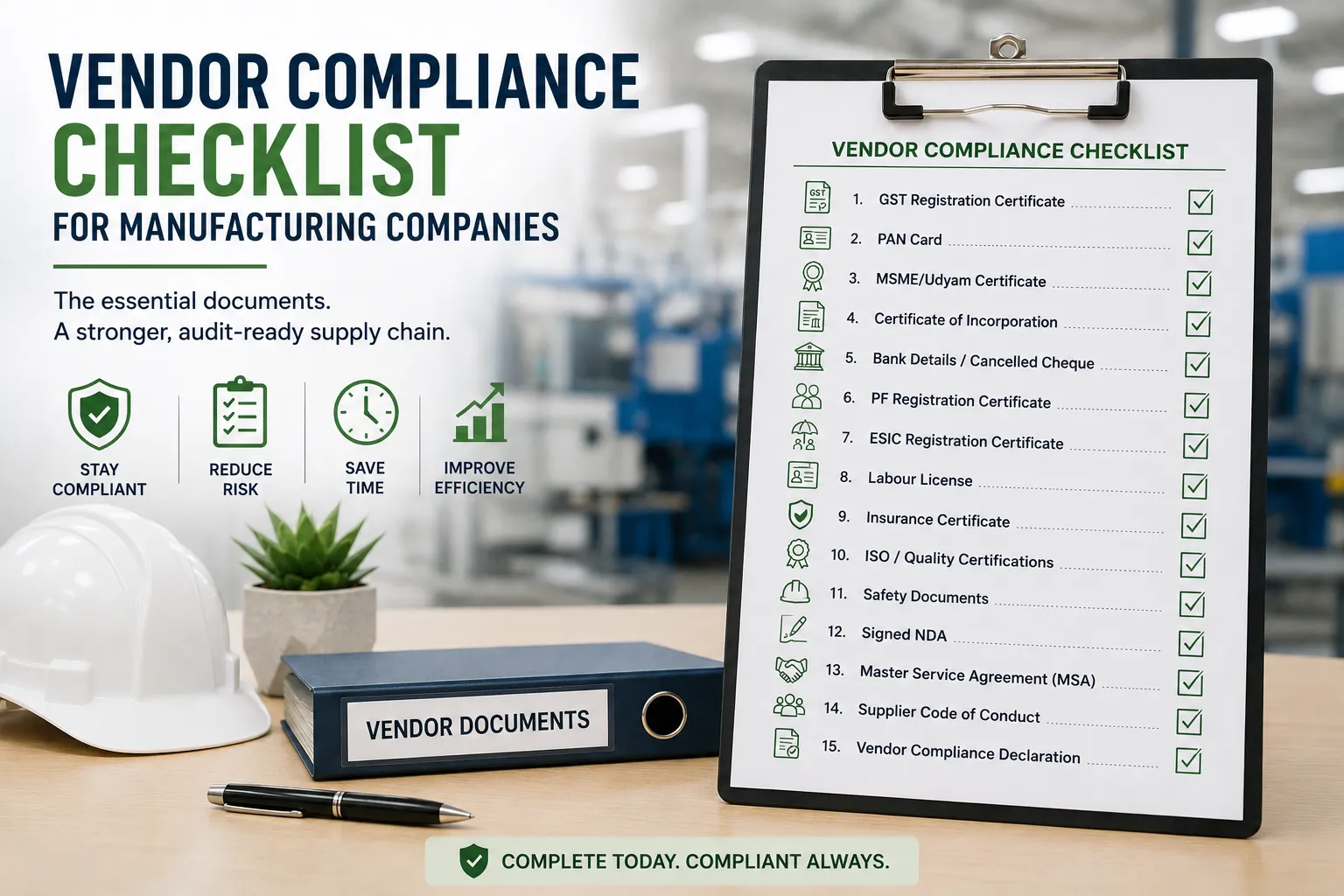
Vendor Compliance Checklist for Manufacturing Companies
For manufacturing companies, choosing the right vendor is only half the job.
The other half is ensuring every vendor remains compliant throughout the business relationship.
A supplier with expired registrations, missing statutory documents, or invalid insurance can expose your organization to operational delays, audit findings, legal issues, and financial penalties.
That’s why leading manufacturers follow a structured vendor compliance checklist before approving and working with any supplier.
In this article, we’ll walk through the essential vendor compliance checklist that every manufacturing company should follow.
Why Vendor Compliance Matters in Manufacturing
Manufacturing companies work with a wide variety of vendors, including:
- Raw material suppliers
- Packaging vendors
- Logistics providers
- Labour contractors
- Equipment suppliers
- Maintenance contractors
- Engineering service providers
- Security agencies
- Housekeeping contractors
Each vendor introduces a different level of operational and compliance risk.
Without a proper compliance process, organizations may unknowingly work with vendors that fail to meet regulatory or contractual requirements.
Vendor Compliance Checklist
Before approving a new vendor, verify the following areas.
1. Basic Business Information
Start by collecting essential business details.
Typical information includes:
- Company Name
- Registered Address
- Contact Details
- GST Number
- PAN Number
- CIN (if applicable)
- MSME Registration
- Bank Account Details
This information forms the foundation of your vendor master.
2. Legal Registration Documents
Verify that the vendor is legally authorized to operate.
Common documents include:
- GST Registration Certificate
- PAN Card
- Certificate of Incorporation
- MSME Certificate
- Shop & Establishment Registration
- Trade License (where applicable)
Always verify that these documents are current and valid.
3. Statutory Compliance Documents
Depending on the nature of the vendor, additional statutory registrations may be required.
Examples include:
- PF Registration
- ESIC Registration
- Professional Tax Registration
- Labour License
- Contractor License
- Factory License
These documents are especially important for contractors working at manufacturing facilities.
4. Insurance Documents
Many organizations require vendors to maintain valid insurance coverage.
Common examples include:
- Workmen Compensation Insurance
- Public Liability Insurance
- Professional Indemnity Insurance
- General Liability Insurance
Always verify the expiry date and coverage period.
5. Financial Information
Financial verification helps reduce business risk.
Organizations may request:
- Cancelled Cheque
- Bank Verification Letter
- GST Returns
- Financial Statements
- Credit Information
The level of verification often depends on vendor criticality.
6. Quality Certifications
Manufacturing companies frequently work with suppliers that maintain quality management systems.
Examples include:
- ISO 9001
- ISO 14001
- ISO 45001
- IATF 16949
- GMP Certifications
These certifications demonstrate process maturity and quality standards.
7. Safety and Environmental Compliance
For contractors working on-site, safety documentation is often mandatory.
Examples include:
- Safety Policy
- Employee Training Records
- PPE Compliance
- Environmental Compliance Certificates
- Hazardous Material Handling Certifications
These documents help reduce workplace risk.
8. Vendor Agreements
Ensure all commercial documents are signed before vendor activation.
Typical agreements include:
- Master Service Agreement (MSA)
- Non-Disclosure Agreement (NDA)
- Purchase Terms & Conditions
- Code of Conduct
- Supplier Compliance Declaration
Maintaining signed agreements protects both parties.
9. Risk Assessment
Not every vendor requires the same level of review.
Consider factors such as:
- Business criticality
- Operational impact
- Regulatory exposure
- Site access
- Data access
- Financial dependency
Higher-risk vendors should undergo additional verification.
10. Document Expiry Tracking
Collecting documents once is not enough.
Organizations should continuously monitor:
- Expiry dates
- Upcoming renewals
- Missing documents
- Updated certificates
Automated reminders help prevent compliance gaps.
Best Practices for Manufacturing Companies
Successful procurement teams follow a few simple principles.
Centralize Vendor Documents
Store all vendor documents in one secure repository instead of multiple email inboxes and shared folders.
Standardize Document Requirements
Create predefined checklists for different vendor categories such as contractors, suppliers, logistics providers, and consultants.
Automate Document Collection
Allow vendors to upload documents through a secure self-service portal instead of sending endless email attachments.
Review Documents Before Approval
Every uploaded document should be reviewed and approved before the vendor becomes active.
Monitor Compliance Continuously
Vendor compliance is an ongoing process—not a one-time activity.
Track renewals and compliance status throughout the vendor relationship.
Common Mistakes to Avoid
Many manufacturing companies unknowingly create compliance risks by:
- Maintaining vendor documents in Excel
- Collecting incomplete documentation
- Missing document expiry dates
- Using outdated document versions
- Having no approval workflow
- Waiting until audits to verify compliance
Addressing these issues early significantly reduces operational risk.
Signs Your Vendor Compliance Process Needs Improvement
You may need a better compliance process if:
- Audits regularly uncover missing documents.
- Procurement spends hours chasing vendors.
- Vendor documents are stored across multiple systems.
- Expired certificates are discovered too late.
- Different departments maintain separate vendor records.
- Onboarding takes several weeks.
These are common indicators that manual processes are no longer sufficient.
How VendorCompliancePro Helps
VendorCompliancePro simplifies vendor compliance management for manufacturing companies by providing:
- Vendor self-service onboarding
- Centralized document repository
- Configurable compliance checklists
- AI-powered document validation
- Approval workflows
- Automated expiry reminders
- Compliance dashboards
- Audit-ready reporting
- Complete document history
Instead of relying on spreadsheets and manual reminders, procurement teams gain complete visibility into vendor compliance from a single platform.
Frequently Asked Questions
What is a vendor compliance checklist?
A vendor compliance checklist is a standardized list of documents and verification steps used to ensure suppliers meet legal, regulatory, contractual, and organizational requirements.
Why is vendor compliance important for manufacturing companies?
Manufacturing companies rely on compliant suppliers to avoid production delays, audit findings, legal penalties, and operational risks.
Which documents are most commonly collected?
GST Registration, PAN Card, MSME Certificate, PF Registration, ESIC Registration, Labour License, Insurance Certificates, Bank Details, and quality certifications.
How often should vendor documents be reviewed?
Organizations should monitor vendor documents continuously and renew them before their expiry dates.
Can vendor compliance be automated?
Yes. Modern vendor compliance software automates document collection, expiry tracking, approval workflows, and compliance reporting.
Conclusion
Vendor compliance is more than collecting documents during onboarding.
It requires a structured process, continuous monitoring, and clear accountability throughout the vendor lifecycle.
By following a standardized vendor compliance checklist, manufacturing companies can reduce compliance risks, improve audit readiness, strengthen supplier relationships, and keep procurement operations running smoothly.
The most successful organizations don’t wait for an audit to discover missing documents—they build compliance into every stage of vendor management.
Related Articles
- The Hidden Cost of Expired Vendor Documents
- Why “Email + Excel” Still Dominates Vendor Onboarding
- How Risk-Based Vendor Onboarding Saves Time and Reduces Compliance Risk
- 7 Reasons Vendor Documents Go Missing During Audits
- Why Every Vendor Should Have a Single Business Owner
- 10 Features Every Vendor Compliance Software Should Have