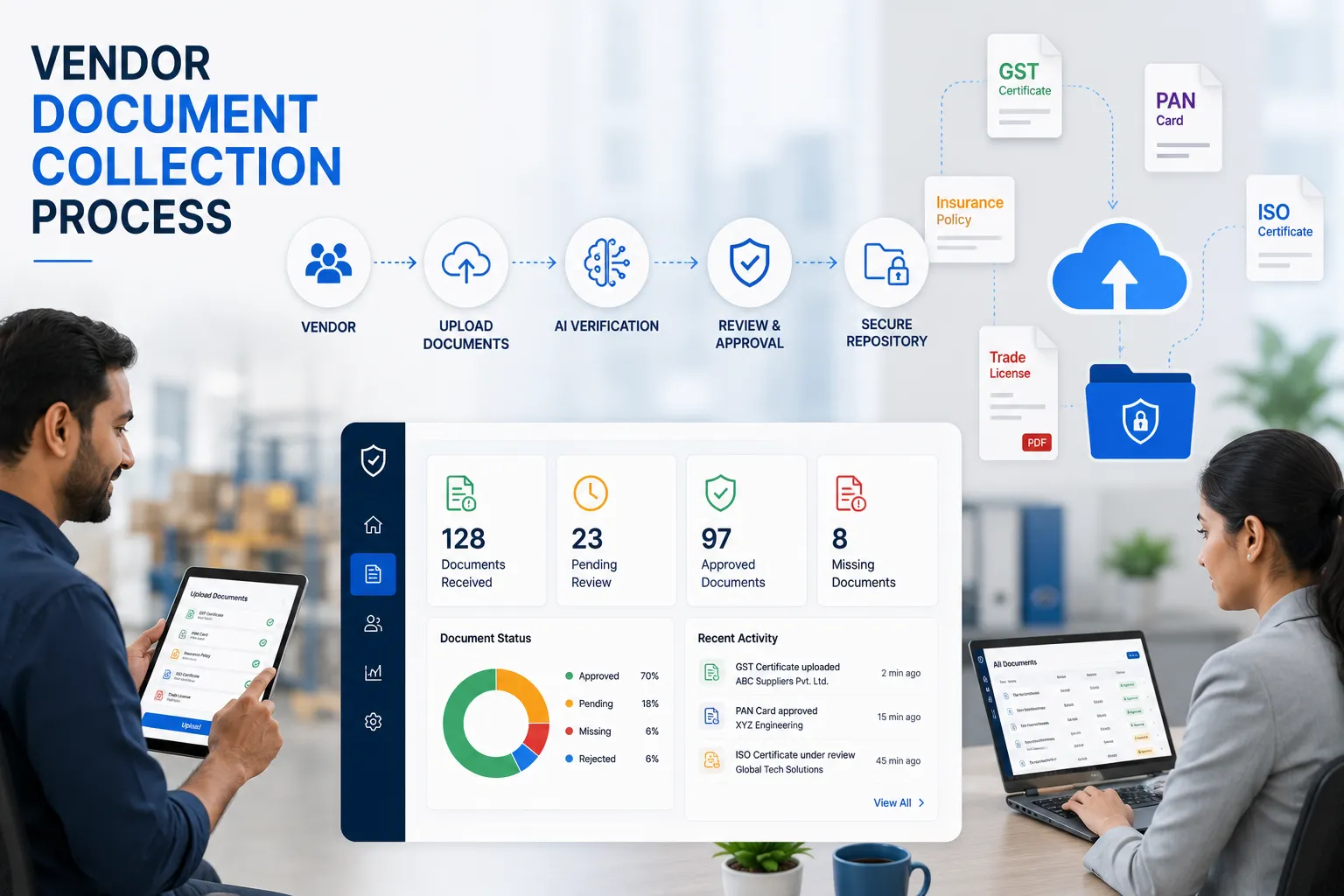
Vendor Document Collection Process: Complete Guide for Manufacturing Companies (2026)
Collecting vendor documents is one of the most important steps in vendor onboarding. Unfortunately, many organizations still rely on emails, WhatsApp messages, spreadsheets, and shared folders to request and track compliance documents. This often results in missing files, delayed approvals, duplicate records, and audit challenges.
A well-defined Vendor Document Collection Process standardizes how vendors submit documents, how procurement teams verify them, and how organizations monitor renewals throughout the vendor lifecycle.
For manufacturing companies, logistics providers, warehouses, engineering firms, and food processing businesses, an efficient document collection process reduces manual work and improves compliance.
What is the Vendor Document Collection Process?
The Vendor Document Collection Process is the workflow used to request, receive, verify, approve, store, and renew documents required before and during a vendor relationship.
Instead of collecting documents manually, organizations use a centralized system that tracks document status, expiry dates, and approvals.
Why is a Structured Process Important?
Without a defined process, organizations often experience:
- Missing compliance documents
- Delayed vendor onboarding
- Expired licenses
- Repeated follow-up emails
- Audit findings
- Duplicate document storage
- Poor visibility into vendor compliance
| Manual Collection | Automated Collection |
|---|---|
| Email attachments | Secure vendor portal |
| Shared folders | Central document repository |
| Manual reminders | Automated notifications |
| Spreadsheet tracking | Real-time dashboard |
| Reactive audits | Continuous compliance |
Who Should Implement It?
| Industry | Recommended |
|---|---|
| Manufacturing | ✅ |
| Logistics | ✅ |
| Warehousing | ✅ |
| Food Processing | ✅ |
| Automotive | ✅ |
| Engineering | ✅ |
| Construction | ✅ |
Organizations working with contractors, suppliers, distributors, or service providers benefit from a standardized document collection process.
Documents Commonly Collected
Typical vendor documents include:
- GST Registration Certificate
- PAN Card
- MSME Certificate
- PF Registration
- ESIC Registration
- Labour License
- Factory License (where applicable)
- Insurance Certificate
- Bank Details
- Cancelled Cheque
- ISO Certificates
- Company Registration Certificate
Vendor Document Collection Workflow
- Invite vendor
- Vendor completes registration
- Upload mandatory documents
- Validate document type and completeness
- Review compliance requirements
- Approve or reject documents
- Store documents securely
- Track expiry dates
- Send renewal reminders automatically
Key Benefits
- Faster vendor onboarding
- Reduced manual follow-ups
- Better compliance visibility
- Secure document repository
- Improved audit readiness
- Automated expiry tracking
- Standardized approval process
Essential Features
Choose software that provides:
- Vendor Self-Service Portal
- Secure document upload
- OCR document extraction
- AI-powered document validation
- Document expiry tracking
- Approval workflows
- Compliance dashboard
- Audit trail
- Reports and analytics
- Role-based access
Real Manufacturing Example
A manufacturing company works with 220 suppliers and contractors. Earlier, vendors emailed GST certificates, insurance policies, labour licenses, and bank documents to multiple employees. Finding the latest version during an audit was difficult.
After implementing a centralized document collection process, vendors uploaded documents through a self-service portal. Procurement teams reviewed submissions from a dashboard, while automated reminders ensured documents were renewed before expiry.
Buying Checklist
Before selecting vendor document management software, ensure it includes:
- Vendor portal
- Document checklist
- Approval workflow
- AI/OCR validation
- Expiry reminders
- Compliance dashboard
- Audit trail
- Reports
- Mobile access
- API integration
Common Mistakes
- Accepting documents through multiple channels
- No standardized checklist
- Not validating uploaded documents
- Ignoring expiry dates
- Manual spreadsheet tracking
- No approval history
- Poor folder organization
- Missing audit trail
Best Practices
- Define mandatory documents by vendor type.
- Use a standardized document checklist.
- Validate every uploaded document.
- Automate renewal reminders.
- Store all files in a central repository.
- Review compliance status monthly.
Why VendorCompliancePro?
VendorCompliancePro simplifies the entire Vendor Document Collection Process through:
- Vendor Self-Service Portal
- Secure document repository
- AI-powered document validation
- OCR document processing
- Automated expiry reminders
- Approval workflows
- Compliance dashboards
- Audit trails
- Reports and analytics
This enables procurement teams to collect, validate, monitor, and manage vendor documents from one centralized platform.
Frequently Asked Questions
What is the Vendor Document Collection Process?
It is the process of requesting, verifying, approving, storing, and renewing vendor compliance documents throughout the vendor lifecycle.
Which documents should vendors submit?
Requirements vary, but commonly include GST, PAN, MSME, PF, ESIC, insurance, bank details, and applicable licenses.
Can document collection be automated?
Yes. Modern vendor compliance software automates document requests, reminders, validation, and expiry tracking.
Why is document expiry tracking important?
Expired documents can create compliance risks, delay procurement, and affect audit readiness.
Does VendorCompliancePro help with document collection?
Yes. VendorCompliancePro provides a vendor portal, document repository, AI validation, OCR processing, approval workflows, reminders, dashboards, and reporting.
Conclusion
A structured Vendor Document Collection Process ensures every supplier submits complete and valid compliance documents before doing business. By replacing manual emails and spreadsheets with automated workflows, organizations improve onboarding speed, reduce compliance risks, and stay audit-ready throughout the vendor lifecycle.