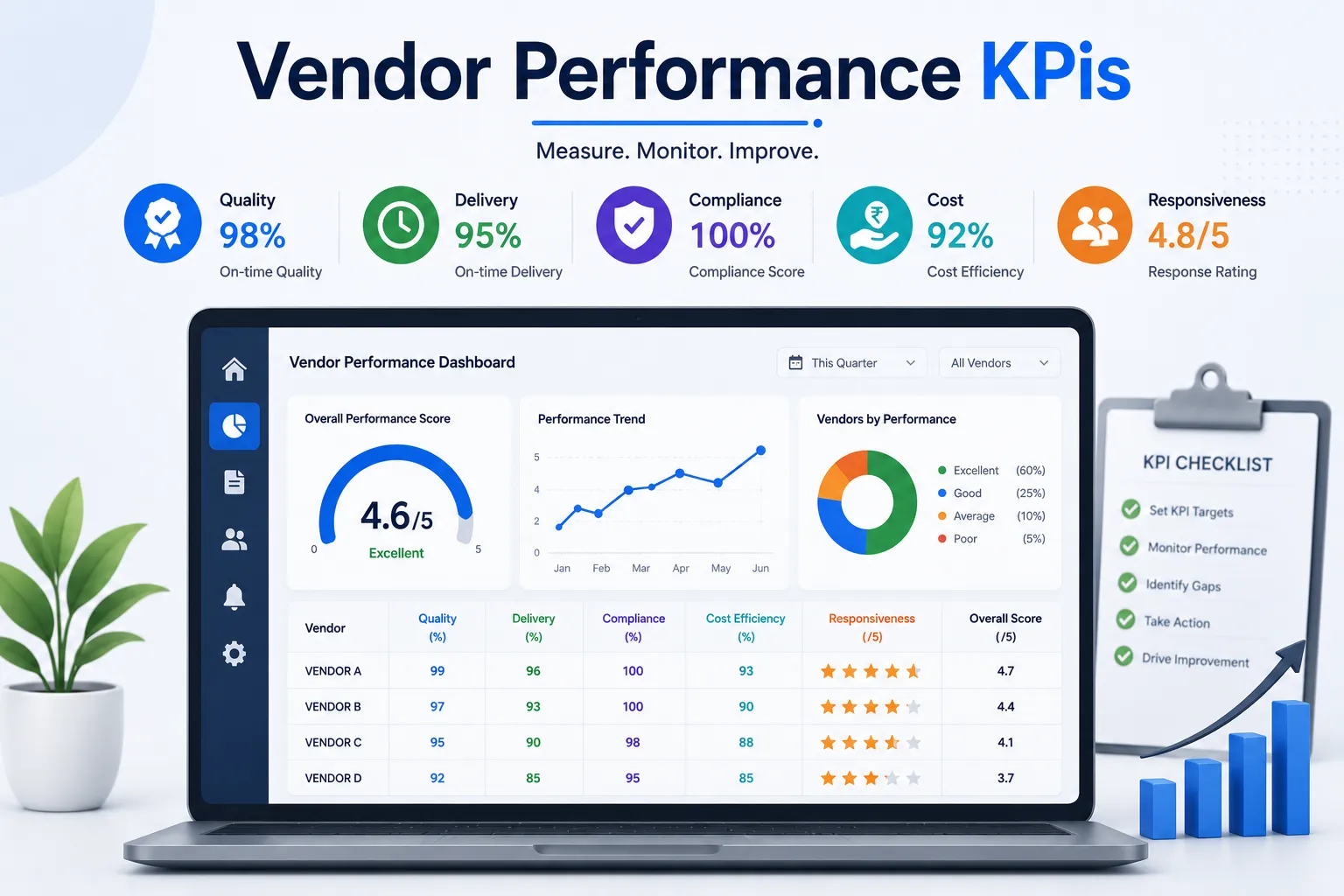
Vendor Performance KPIs: Complete Guide for Manufacturing Companies (2026)
Choosing the right supplier is only the first step. To build a reliable supply chain, organizations need measurable indicators that show whether vendors consistently deliver quality products, meet deadlines, maintain compliance, and support business goals.
Vendor Performance KPIs (Key Performance Indicators) help procurement teams measure supplier performance objectively instead of relying on assumptions or occasional reviews.
For manufacturing companies, logistics providers, warehouses, engineering firms, and food processing businesses, tracking the right KPIs improves supplier relationships, reduces operational risks, and supports better purchasing decisions.
What are Vendor Performance KPIs?
Vendor Performance KPIs are measurable metrics used to evaluate supplier performance over time. They provide a consistent way to compare vendors, identify improvement opportunities, and support renewal or sourcing decisions.
Why Measure Vendor Performance?
Without KPIs, organizations often face:
- Inconsistent supplier quality
- Late deliveries
- Expired compliance documents
- Poor communication
- Rising procurement costs
- Difficult supplier comparisons
- Reactive decision-making
| Without KPIs | With KPIs |
|---|---|
| Subjective reviews | Data-driven decisions |
| Manual spreadsheets | Central dashboards |
| Limited visibility | Performance trends |
| Reactive actions | Continuous improvement |
| Difficult audits | Measurable compliance |
Who Should Track Vendor KPIs?
| Industry | Recommended |
|---|---|
| Manufacturing | ✅ |
| Logistics | ✅ |
| Warehousing | ✅ |
| Food Processing | ✅ |
| Automotive | ✅ |
| Engineering | ✅ |
| Construction | ✅ |
Essential Vendor Performance KPIs
1. On-Time Delivery Rate
Measures how consistently a vendor delivers on or before the committed date.
2. Product Quality
Tracks defects, rejection rates, and quality issues.
3. Compliance Score
Measures document validity, regulatory compliance, and audit readiness.
4. Response Time
Measures how quickly vendors respond to requests or issues.
5. Order Accuracy
Tracks whether delivered quantities and specifications match purchase orders.
6. Issue Resolution Time
Measures how quickly vendors resolve complaints or corrective actions.
7. Cost Competitiveness
Compares pricing against market expectations while maintaining quality.
8. Contract Compliance
Tracks adherence to agreed contractual terms and service levels.
Example KPI Dashboard
| KPI | Target | Actual |
|---|---|---|
| On-Time Delivery | 95% | 97% |
| Product Quality | 98% | 96% |
| Compliance Score | 100% | 100% |
| Response Time | <24 hrs | 18 hrs |
| Order Accuracy | 99% | 98% |
Key Benefits
- Objective supplier evaluation
- Better sourcing decisions
- Improved vendor accountability
- Continuous supplier improvement
- Better compliance visibility
- Reduced procurement risk
- Stronger audit readiness
Essential Software Features
Look for software that includes:
- KPI dashboards
- Vendor scorecards
- Compliance monitoring
- Document expiry tracking
- Automated reminders
- Performance reports
- Audit trail
- Vendor risk indicators
- AI-powered document validation
- Role-based access
Real Manufacturing Example
A manufacturing company reviews 200 suppliers every quarter. By tracking delivery performance, quality, compliance, and responsiveness through a centralized dashboard, procurement managers identify underperforming vendors early and work with them on improvement plans before production is affected.
KPI Review Process
- Define KPIs
- Set target values
- Collect supplier data
- Measure performance
- Compare against targets
- Identify improvement areas
- Review with vendors
- Repeat monthly or quarterly
Buying Checklist
Before choosing KPI management software, ensure it offers:
- KPI dashboards
- Vendor scorecards
- Compliance tracking
- Automated reporting
- Risk monitoring
- Audit trail
- Workflow automation
- API integration
- Mobile access
- Historical trend analysis
Common Mistakes
- Measuring only cost
- Ignoring compliance metrics
- Using inconsistent KPIs
- Reviewing vendors infrequently
- Not sharing feedback with suppliers
- No historical reporting
- Manual spreadsheet tracking
- No improvement plans
Best Practices
- Standardize KPIs across vendors.
- Review strategic suppliers monthly.
- Combine quality and compliance metrics.
- Share scorecards with suppliers.
- Track trends over time.
- Continuously refine KPI targets.
Why VendorCompliancePro?
VendorCompliancePro helps organizations track vendor performance and compliance from one platform.
Features include:
- Vendor performance dashboards
- Compliance monitoring
- Vendor scorecards
- Document expiry reminders
- AI-powered document validation
- OCR processing
- Audit trails
- Reports and analytics
- Vendor Self-Service Portal
This enables procurement teams to measure supplier performance while maintaining continuous compliance.
Frequently Asked Questions
What are Vendor Performance KPIs?
They are measurable indicators used to evaluate supplier quality, delivery, compliance, responsiveness, and overall performance.
How often should KPIs be reviewed?
Most organizations review KPIs monthly or quarterly depending on supplier criticality.
Which KPI is most important?
There is no single KPI. Delivery, quality, compliance, and responsiveness should all be measured together.
Why include compliance as a KPI?
Compliance directly affects audit readiness and operational risk, making it an essential performance metric.
Does VendorCompliancePro support KPI tracking?
Yes. VendorCompliancePro provides dashboards, compliance tracking, reminders, reporting, and vendor performance visibility.
Conclusion
Vendor Performance KPIs help procurement teams measure supplier performance using objective, consistent metrics. By combining delivery, quality, compliance, and service indicators, organizations can strengthen supplier relationships, reduce risk, and make informed procurement decisions.