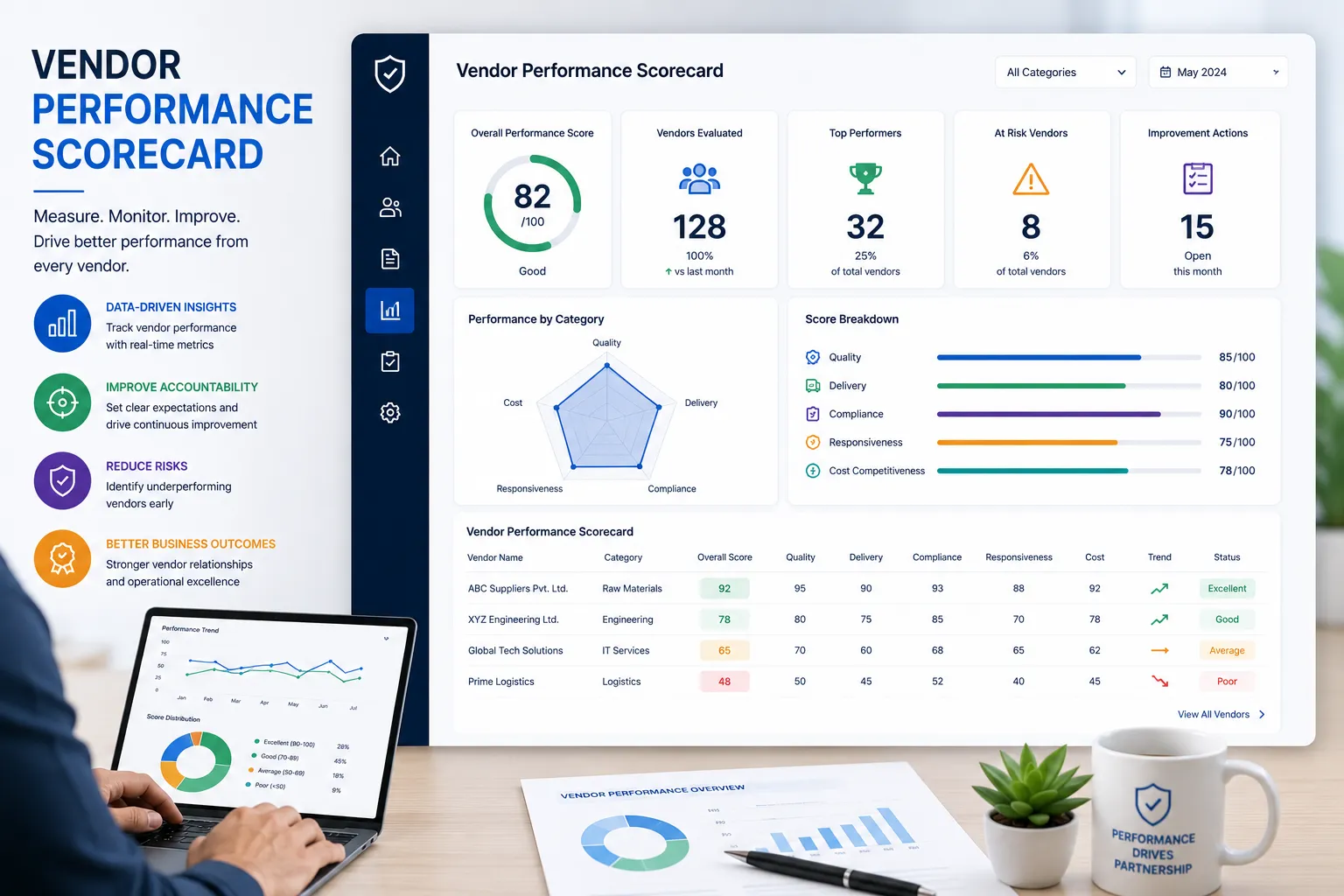
Vendor Performance Scorecard: KPIs, Scoring, Examples and Best Practices (2026)
Selecting a supplier is only the beginning of supplier management.
Once a vendor is approved, procurement teams need a consistent way to understand whether the supplier is meeting expectations for delivery, quality, responsiveness, compliance, cost, and service.
A vendor performance scorecard provides a structured framework for measuring supplier performance using defined KPIs and scoring rules.
For manufacturing companies, logistics providers, warehouses, engineering firms, construction companies, and other organizations that depend on external suppliers and contractors, a scorecard can support better supplier reviews and more informed procurement decisions.
This guide explains vendor performance scorecards, common KPIs, scoring methods, review workflows, implementation best practices, and software features.
What Is a Vendor Performance Scorecard?
A vendor performance scorecard is a structured method for evaluating a supplier against predefined performance indicators over a specific period.
Instead of relying only on subjective opinions, procurement teams can use measurable data such as:
- On-time delivery
- Product or service quality
- Order accuracy
- Responsiveness
- Issue resolution
- Compliance status
- Contract performance
- Cost performance
- Service-level performance
The scorecard can combine these KPIs into an overall supplier performance score.
The exact KPIs and weights should reflect the organization’s business priorities and the type of supplier being evaluated.
Why Use a Vendor Performance Scorecard?
Without a consistent scoring process, supplier reviews can become subjective.
Common challenges include:
- Inconsistent supplier evaluations
- Late deliveries
- Quality problems
- Poor communication
- Repeated service issues
- Compliance gaps
- Limited historical performance data
- Difficulty comparing suppliers
- No structured improvement process
A scorecard creates a common framework for reviewing supplier performance.
| Without a Scorecard | With a Scorecard |
|---|---|
| Subjective reviews | KPI-based evaluation |
| Spreadsheet-based tracking | Centralized performance records |
| Manual reporting | Structured reports |
| Limited historical visibility | Performance trends |
| Reactive supplier discussions | Data-driven reviews |
| Inconsistent evaluation | Standardized scoring |
Who Should Use a Vendor Performance Scorecard?
Vendor performance scorecards can be useful for organizations that depend on suppliers, contractors, and service providers.
Common industries include:
| Industry | Example Use |
|---|---|
| Manufacturing | Supplier quality and delivery |
| Logistics | Transport and service performance |
| Warehousing | Facility and operational vendors |
| Automotive | Supplier quality and delivery |
| Engineering | Project and service suppliers |
| Construction | Contractor performance |
| Food Processing | Supplier quality and service |
| Facility Management | Service-provider performance |
Not every vendor needs the same scorecard.
A critical production supplier may require more detailed KPIs than a low-risk office-services vendor.
Key Vendor Performance KPIs
The right KPIs depend on the supplier relationship.
1. On-Time Delivery
Measures how consistently the supplier delivers by the agreed date.
A simple calculation is:
On-Time Delivery Rate = On-Time Deliveries ÷ Total Deliveries × 100
For example, if 95 of 100 deliveries arrive on time:
95 ÷ 100 × 100 = 95%
2. Quality Performance
Possible quality measures include:
- Defect rate
- Rejection rate
- Customer complaints
- Non-conformances
- Corrective actions
- First-pass acceptance
Manufacturing organizations may place greater weight on quality for critical production suppliers.
3. Order Accuracy
Measure whether the supplier delivers the correct:
- Quantity
- Product
- Specification
- Packaging
- Documentation
Order accuracy can help identify recurring fulfillment problems.
4. Responsiveness
Measure how quickly the supplier responds to:
- Requests
- Queries
- Escalations
- Corrective-action requests
- Delivery issues
5. Issue Resolution
Track how effectively the supplier resolves problems.
Possible measures include:
- Average resolution time
- Percentage of issues closed on time
- Repeat issue rate
- Corrective-action completion
6. Compliance Performance
Where applicable, monitor:
- Required document availability
- Document validity
- Submission timeliness
- Corrective actions
- Contract compliance
A supplier can have excellent delivery performance while still creating compliance risk, so compliance may need to be evaluated separately.
7. Cost Performance
Depending on the procurement model, organizations may consider:
- Agreed-price compliance
- Cost variance
- Invoice accuracy
- Total cost of ownership
- Commercial competitiveness
Price should not necessarily dominate the scorecard if quality, continuity, safety, or compliance are more important.
8. Contract and Service-Level Performance
For service providers, consider:
- SLA compliance
- Contract adherence
- Service availability
- Response times
- Escalation handling
Example Vendor Performance Scorecard
A simple scorecard might use the following weighting:
| KPI | Weight | Score |
|---|---|---|
| Delivery Performance | 30% | 28 |
| Quality | 25% | 23 |
| Compliance | 20% | 18 |
| Responsiveness | 15% | 14 |
| Cost Performance | 10% | 8 |
| Total | 100% | 91/100 |
This is only an example. Organizations should define weights based on supplier category, business criticality, and procurement objectives.
How to Calculate a Vendor Performance Score
A weighted score can be calculated as:
Overall Score = Σ (KPI Score × KPI Weight)
For example:
- Delivery = 28/30
- Quality = 23/25
- Compliance = 18/20
- Responsiveness = 14/15
- Cost = 8/10
Total:
91/100
The organization can then map the score to an internal rating.
For example:
| Score | Example Rating |
|---|---|
| 90–100 | Excellent |
| 75–89 | Good |
| 60–74 | Needs Improvement |
| Below 60 | Poor |
These thresholds are examples and should be customized to the organization’s supplier-management policy.
Vendor Performance Review Process
A practical scorecard process can follow these steps.
Step 1: Define Supplier Categories
Group suppliers by factors such as:
- Product or service
- Business criticality
- Risk
- Spend
- Location
Step 2: Define KPIs
Choose KPIs relevant to each supplier category.
Step 3: Assign KPI Weights
Give greater weight to the metrics that matter most.
Step 4: Collect Performance Data
Use appropriate data sources such as:
- Purchase orders
- Goods-receipt records
- Quality records
- Service tickets
- Compliance records
- Contract information
- Procurement data
Step 5: Calculate Scores
Apply the defined scoring method.
Step 6: Review Results
Identify:
- High performers
- Stable performers
- Underperformers
- Significant trends
Step 7: Discuss Improvement Actions
Agree on corrective or improvement actions with underperforming suppliers.
Step 8: Monitor Progress
Track whether performance improves over subsequent review periods.
Monthly vs Quarterly Vendor Reviews
Review frequency should depend on supplier criticality and risk.
| Vendor Type | Possible Review Frequency |
|---|---|
| Critical / High Risk | Monthly or more frequently |
| Important Supplier | Monthly or Quarterly |
| Standard Supplier | Quarterly |
| Low-Risk Supplier | Semi-annually or annually |
These are example frequencies, not universal requirements.
A risk-based review schedule is usually more practical than evaluating every supplier with exactly the same frequency.
Vendor Performance Scorecard vs Vendor Risk Score
These concepts are related but serve different purposes.
Vendor Performance Scorecard
Focuses primarily on how well the supplier is performing.
Examples:
- Delivery
- Quality
- Responsiveness
- Service
- Cost
Vendor Risk Score
Focuses primarily on the level of risk associated with the supplier.
Examples:
- Compliance risk
- Operational risk
- Business continuity risk
- Contract risk
- Supplier criticality
A procurement team can use both.
Performance Scorecard + Risk Assessment = Better Supplier Oversight
Benefits of Vendor Performance Scorecards
Objective Supplier Evaluation
Defined KPIs make supplier reviews more consistent.
Better Procurement Decisions
Performance history can support sourcing, renewal, and supplier-development decisions.
Early Problem Detection
Declining delivery or quality performance can be identified earlier.
Improved Supplier Accountability
Suppliers can see the areas where improvement is required.
Stronger Supplier Relationships
Regular, data-based reviews create a clearer basis for supplier discussions.
Better Risk Visibility
Performance information can contribute to broader vendor risk reviews.
Continuous Improvement
Organizations can track whether corrective actions actually improve performance.
Common Vendor Performance Scorecard Mistakes
Measuring Only Cost
Lowest price does not always mean lowest total business risk.
Using Too Many KPIs
A scorecard with dozens of metrics can become difficult to maintain.
Using the Same KPIs for Every Vendor
A transport provider and a raw-material supplier may require very different measurements.
No Defined Weights
Without weights, teams may disagree about the relative importance of KPIs.
Subjective Scoring
Scores should be supported by measurable evidence wherever possible.
Reviewing Vendors Too Infrequently
Critical suppliers may need more frequent reviews.
No Corrective-Action Process
A scorecard should lead to action, not just a number.
Ignoring Historical Trends
A single score may hide a supplier whose performance is deteriorating over time.
Best Practices for Vendor Performance Scorecards
Standardize the Framework
Create a common scoring methodology while allowing KPI variations by vendor category.
Keep KPIs Measurable
Use data that can be consistently collected.
Weight Critical Metrics
Quality may be more important than cost for one supplier, while delivery may be more important for another.
Combine Performance and Compliance
A supplier should be evaluated not only on delivery and quality but also on relevant compliance requirements.
Review Trends
Compare scores across multiple periods instead of relying on one review.
Share Results
Where appropriate, discuss scorecard results with suppliers.
Track Corrective Actions
Assign owners and due dates to improvement actions.
Reassess KPI Relevance
Review the scorecard periodically as business requirements change.
Vendor Performance Scorecard Checklist
Use this checklist when designing a scorecard:
- Supplier category defined
- Business criticality recorded
- KPIs selected
- KPI definitions documented
- KPI weights assigned
- Data sources identified
- Scoring method defined
- Rating thresholds defined
- Review frequency established
- Historical scores retained
- Corrective actions tracked
- Supplier feedback process defined
- Reports available
Manual Scorecards vs Automated Supplier Performance Management
| Manual Scorecards | Automated Performance Management |
|---|---|
| Excel calculations | Centralized KPI records |
| Manual data entry | Data integrations where available |
| Spreadsheet reports | Dashboards |
| Manual score calculations | Automated calculations |
| Limited history | Historical trends |
| Email follow-up | Workflow notifications |
| Separate compliance tracking | Performance and compliance visibility |
Automation can reduce administrative work, but reliable performance data and clear KPI definitions remain essential.
Features to Look for in Vendor Performance Software
Depending on your requirements, useful capabilities include:
- KPI management
- Configurable scorecards
- Supplier performance dashboards
- Weighted scoring
- Historical performance trends
- Compliance tracking
- Document expiry monitoring
- Risk indicators
- Corrective-action workflows
- Notifications
- Reports and analytics
- Audit trails
- Role-based access
- API integration
If supplier performance is only one part of your vendor-management process, consider whether the platform can connect performance data with vendor compliance and risk information.
How AI Can Support Vendor Performance Management
AI can assist with performance analysis when reliable data is available.
Depending on the system, AI may help:
- Summarize supplier performance trends
- Identify recurring issues
- Highlight unusual changes
- Classify supplier feedback
- Extract information from supplier documents
- Prioritize records for human review
AI-generated insights should be reviewed by procurement teams before being used for important supplier decisions.
How VendorCompliancePro Helps
VendorCompliancePro focuses primarily on vendor compliance and document management while providing information that can support broader vendor oversight.
Relevant capabilities include:
- Vendor self-service portal
- Centralized vendor records
- Compliance dashboards
- Document expiry monitoring
- Automated reminders
- AI-powered document validation
- OCR processing
- Approval workflows
- Audit trails
- Reports and analytics
Organizations can use compliance and document-status information alongside their supplier performance process.
For organizations that require a full procurement-performance suite, additional ERP, procurement, or supplier-performance integrations may be appropriate.
Frequently Asked Questions
What is a vendor performance scorecard?
A vendor performance scorecard is a structured framework for evaluating suppliers against predefined KPIs such as delivery, quality, compliance, responsiveness, and cost.
Which KPIs should be included?
Common KPIs include on-time delivery, quality, order accuracy, responsiveness, issue resolution, compliance, cost performance, and SLA performance.
How often should vendors be scored?
The frequency should depend on supplier criticality and risk. Monthly or quarterly reviews are common examples, while lower-risk vendors may be reviewed less frequently.
How is a vendor performance score calculated?
A weighted scoring method can combine individual KPI scores according to predefined weights.
Should compliance be included in a vendor scorecard?
It can be. Compliance is often important, particularly for regulated or operationally critical suppliers. Some organizations track compliance separately and use it as an input to broader vendor risk management.
What is the difference between a vendor scorecard and vendor risk score?
A performance scorecard measures how well a supplier is performing. A risk score estimates the level of risk associated with the supplier. They can be used together.
Can Excel be used for vendor performance scorecards?
Yes. Excel can work for smaller supplier populations and simple scoring models. Specialized software becomes more useful when organizations need automation, historical trends, workflows, dashboards, or integration.
Can vendor performance scorecards be automated?
Yes. KPI calculations, dashboards, notifications, reporting, and some data collection can be automated when reliable data sources are available.
Conclusion
A vendor performance scorecard gives procurement teams a consistent way to measure supplier performance using defined KPIs and objective data.
A strong scorecard connects:
KPI Definition → Data Collection → Scoring → Review → Corrective Action → Improvement → Reassessment
The most effective scorecards are simple enough to maintain, flexible enough to support different supplier categories, and measurable enough to produce meaningful comparisons over time.
For manufacturing, logistics, engineering, construction, automotive, and other supplier-dependent organizations, combining vendor performance, compliance, and risk monitoring can provide a more complete view of supplier health.
The goal is not simply to assign a number to every vendor.
The goal is to understand:
Which suppliers are performing well, where performance is declining, what action is required, and whether corrective actions are improving results?