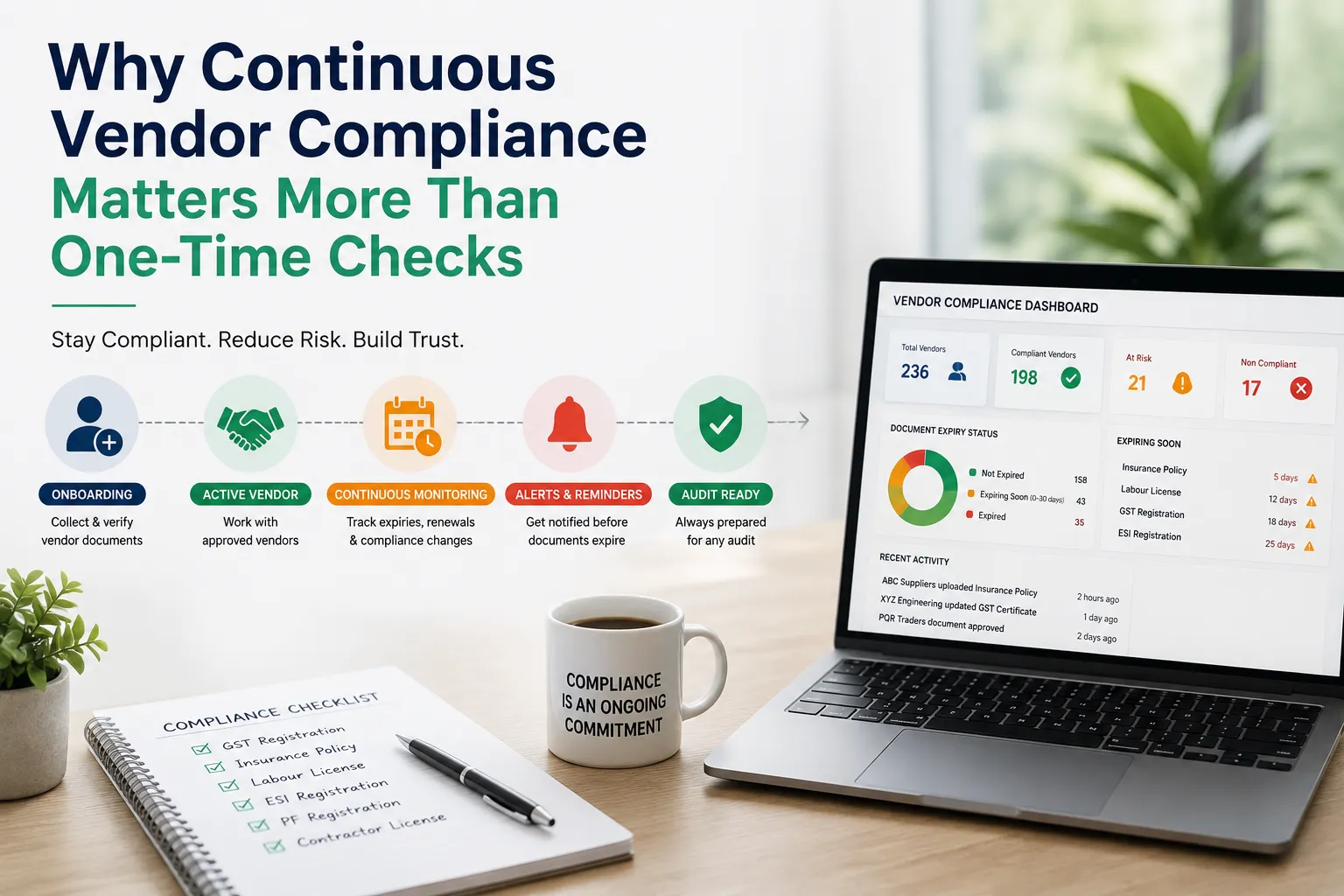
Why Continuous Vendor Compliance Matters More Than One-Time Checks
Many organizations believe vendor compliance ends once a vendor is approved.
The vendor submits the required documents, receives approval, and is added to the supplier list.
Unfortunately, that’s where many compliance problems begin.
Vendor documents expire, business licenses change, insurance policies lapse, and regulatory requirements evolve. A vendor that was fully compliant six months ago may now pose a significant compliance risk.
This is why modern organizations are moving away from one-time compliance checks and adopting continuous vendor compliance.
What Is Continuous Vendor Compliance?
Continuous vendor compliance is the process of monitoring vendor compliance throughout the entire business relationship—not just during onboarding.
Instead of verifying documents once, organizations continuously monitor:
- Document expiry dates
- Regulatory certificates
- Insurance policies
- Licenses
- Vendor risk status
- Compliance renewals
This ensures vendors remain compliant at all times.
Why One-Time Compliance Checks Are No Longer Enough
Business environments change constantly.
Examples include:
- Insurance policies expire.
- GST registrations are updated.
- Labour licenses require renewal.
- Company ownership changes.
- Government regulations evolve.
Without continuous monitoring, organizations may unknowingly work with non-compliant vendors.
1. Vendor Documents Expire
Many compliance documents have limited validity.
Examples include:
- Insurance Certificates
- Labour Licenses
- Pollution Certificates
- Factory Licenses
- Professional Tax Registration
Without automated tracking, expired documents often remain unnoticed until an audit.
2. Regulations Frequently Change
Compliance requirements don’t remain static.
Government authorities regularly introduce:
- New regulations
- Revised compliance requirements
- Updated reporting standards
- Industry-specific rules
Continuous monitoring helps organizations stay aligned with changing regulations.
3. Vendor Risk Changes Over Time
A vendor that was low-risk during onboarding may later become high-risk due to:
- Financial instability
- Legal disputes
- Regulatory violations
- Poor audit performance
Regular compliance reviews help identify emerging risks early.
4. Audits Can Happen Anytime
Organizations cannot predict when customers or regulators will conduct audits.
If compliance documents aren’t continuously maintained, audit preparation becomes stressful and time-consuming.
Continuous compliance ensures organizations remain audit-ready every day.
5. Manual Tracking Doesn’t Scale
Tracking hundreds of vendors using spreadsheets quickly becomes unmanageable.
Common issues include:
- Missed expiry dates
- Duplicate records
- Missing documents
- Human errors
- Manual follow-ups
Automation removes these bottlenecks.
6. Compliance Is a Shared Responsibility
Vendor compliance involves multiple departments, including:
- Procurement
- Finance
- Compliance
- Legal
- Operations
A centralized platform improves collaboration and accountability.
7. Continuous Compliance Builds Trust
Customers increasingly expect suppliers to demonstrate ongoing compliance.
Maintaining accurate, up-to-date vendor records improves:
- Customer confidence
- Audit performance
- Supplier relationships
- Brand reputation
Benefits of Continuous Vendor Compliance
Organizations that adopt continuous compliance experience:
- Fewer compliance gaps
- Faster audits
- Reduced operational risk
- Better visibility into vendor status
- Automated renewal reminders
- Improved productivity
- Stronger governance
How Technology Enables Continuous Compliance
Modern vendor compliance platforms automate many routine tasks, including:
Automated Expiry Tracking
Receive reminders before documents expire.
Vendor Self-Service Portal
Allow vendors to upload updated documents anytime.
AI-Powered Document Validation
Automatically identify document types and validate compliance information.
Real-Time Dashboards
Monitor vendor compliance status from a single dashboard.
Approval Workflows
Ensure updated documents are reviewed before approval.
Audit Trails
Track every compliance activity for complete transparency.
How VendorCompliancePro Supports Continuous Compliance
VendorCompliancePro is designed to help organizations move beyond one-time compliance checks.
The platform provides:
- Automated document expiry reminders
- Centralized document repository
- Vendor self-service portal
- AI-powered document validation
- Role-based approvals
- Compliance dashboards
- Audit-ready reporting
This enables organizations to maintain continuous visibility into vendor compliance throughout the vendor lifecycle.
Frequently Asked Questions
What is continuous vendor compliance?
It is the ongoing process of monitoring vendor compliance throughout the business relationship rather than only during onboarding.
Why isn’t one-time verification enough?
Vendor documents expire, regulations change, and vendor risks evolve over time.
Can automation improve continuous compliance?
Yes. Automated reminders, AI validation, dashboards, and approval workflows significantly reduce manual effort.
Which industries benefit the most?
Manufacturing, logistics, construction, engineering, healthcare, pharmaceuticals, retail, and organizations managing large vendor networks.
How does continuous compliance improve audits?
Organizations remain audit-ready by maintaining up-to-date vendor documentation and complete compliance history.
Conclusion
Vendor compliance isn’t a one-time activity.
It’s an ongoing process that requires continuous monitoring, timely renewals, and complete visibility into vendor status.
Organizations that adopt continuous vendor compliance reduce risk, improve operational efficiency, and remain prepared for audits at any time.
As regulatory requirements continue to evolve, continuous compliance is becoming a business necessity rather than a best practice.