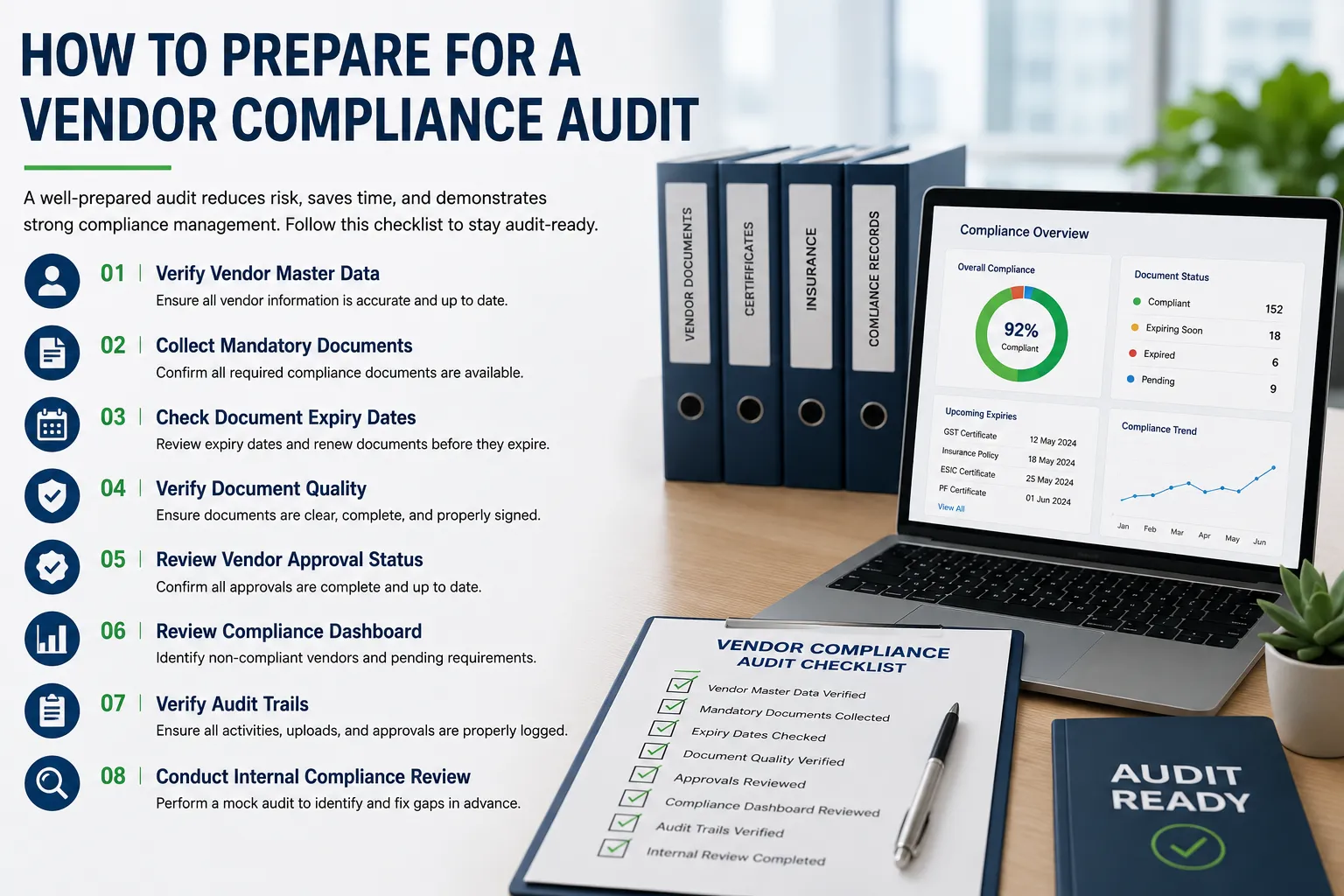
How to Prepare for a Vendor Compliance Audit: A Complete Checklist
Vendor compliance audits help organizations verify that suppliers, contractors, and service providers continue to meet legal, contractual, and organizational requirements.
Whether the audit is conducted internally, by customers, or by regulatory authorities, proper preparation can significantly reduce stress, avoid non-compliance findings, and improve operational efficiency.
Unfortunately, many organizations only begin collecting vendor documents when an audit is scheduled. By that time, expired certificates, missing records, and incomplete documentation often become major issues.
In this guide, we’ll explain how to prepare for a vendor compliance audit and provide a practical checklist that procurement and compliance teams can follow.
What Is a Vendor Compliance Audit?
A vendor compliance audit is a systematic review of supplier and contractor records to verify that vendors continue meeting business, statutory, contractual, and regulatory requirements.
The audit typically verifies:
- Vendor registration documents
- Statutory compliance
- Insurance policies
- Employee records
- Safety documentation
- Contract compliance
- Document validity
- Approval records
The objective is to identify compliance gaps before they create operational or legal risks.
Why Vendor Compliance Audits Are Important
Regular audits help organizations:
- Reduce compliance risks
- Identify expired documents
- Improve supplier accountability
- Ensure regulatory compliance
- Prepare for customer audits
- Improve operational transparency
- Reduce legal liabilities
Organizations that conduct periodic audits are generally better prepared for external inspections.
Who Should Prepare for Vendor Compliance Audits?
Vendor compliance audits are valuable for organizations working with:
- Suppliers
- Contractors
- Service providers
- Transport vendors
- Labour contractors
- Security agencies
- Housekeeping companies
- Maintenance contractors
Industries that commonly conduct vendor audits include:
- Manufacturing
- Logistics
- Warehousing
- Construction
- Engineering
- Healthcare
- Facility Management
Vendor Compliance Audit Checklist
The following checklist helps ensure your organization is audit-ready.
Step 1: Verify Vendor Master Data
Ensure every vendor record contains accurate information.
Review:
- Vendor name
- Business address
- Contact details
- GST Number
- PAN Number
- Vendor category
- Contract information
Incomplete vendor records often create audit observations.
Step 2: Collect Mandatory Documents
Ensure all required compliance documents are available.
Common documents include:
Registration Documents
- GST Registration Certificate
- PAN Card
- MSME Certificate
Statutory Documents
- PF Registration Certificate
- ESIC Registration Certificate
- Labour License
- Factory License
Insurance Documents
- Workmen Compensation Insurance
- Public Liability Insurance
Safety Documents
- Safety Training Records
- PPE Compliance Records
- Risk Assessment Reports
Employee Records
- Employee List
- Attendance Register
- Wage Register
- Salary Register
Step 3: Check Document Expiry Dates
Review every document for validity.
Identify:
- Expired documents
- Documents nearing expiry
- Missing renewals
Renew documents before the audit whenever possible.
Step 4: Verify Document Quality
Ensure uploaded documents are:
- Complete
- Readable
- Current
- Properly signed
- Uploaded against the correct vendor
Poor-quality documents often delay audit reviews.
Step 5: Review Vendor Approval Status
Confirm that every active vendor has completed the required approval process.
Review:
- Approval dates
- Approval authority
- Pending approvals
- Rejected documents
Step 6: Review Compliance Dashboard
Use reports to identify:
- Non-compliant vendors
- Missing documents
- Expired certificates
- Upcoming renewals
- High-risk suppliers
This allows procurement teams to resolve issues before auditors identify them.
Step 7: Verify Audit Trails
Auditors often request evidence showing:
- Who uploaded documents
- Who approved them
- When changes were made
- Previous document versions
Complete audit trails improve transparency and accountability.
Step 8: Conduct Internal Compliance Review
Before the official audit, perform an internal review.
This helps identify:
- Missing records
- Incorrect documents
- Duplicate files
- Policy deviations
- Compliance gaps
Resolving these issues early reduces audit findings.
Common Vendor Compliance Audit Findings
Organizations frequently encounter the following issues.
Expired Compliance Documents
Mandatory certificates have expired.
Missing Vendor Records
Required documents are unavailable.
Incorrect Document Uploads
Wrong files are attached to vendor profiles.
Incomplete Audit Trails
Approval history cannot be verified.
Spreadsheet Errors
Manual tracking results in inaccurate compliance status.
Manual Process vs Automated Audit Preparation
| Manual Process | Automated Process |
|---|---|
| Excel spreadsheets | Centralized repository |
| Manual reminders | Automated expiry alerts |
| Shared folders | Organized document library |
| Email follow-ups | Vendor self-service portal |
| Manual reporting | Compliance dashboards |
| Stressful audits | Audit-ready reporting |
Best Practices for Vendor Compliance Audits
Standardize Document Requirements
Create document checklists for each vendor category.
Centralize Documentation
Maintain all compliance records in one secure location.
Automate Expiry Tracking
Receive notifications before documents expire.
Conduct Regular Reviews
Review vendor compliance monthly or quarterly.
Maintain Audit Trails
Track every upload, approval, renewal, and modification.
Train Procurement Teams
Ensure procurement staff understand compliance requirements and audit procedures.
How AI Is Improving Vendor Compliance Audits
Modern AI-powered compliance platforms help organizations:
- Automatically identify document types
- Extract expiry dates
- Detect missing information
- Validate uploaded documents
- Flag expired certificates
- Reduce manual document verification
AI helps organizations become audit-ready with significantly less manual effort.
How VendorCompliancePro Helps
VendorCompliancePro simplifies audit preparation through:
- Centralized vendor document repository
- Vendor self-service portal
- Automated expiry reminders
- Approval workflows
- Compliance dashboards
- Audit-ready reports
- Role-based access
- Audit trails
- AI-powered document validation
Organizations can identify compliance gaps early and remain audit-ready throughout the year.
Frequently Asked Questions
What is a vendor compliance audit?
A vendor compliance audit reviews supplier and contractor records to ensure they continue meeting legal, contractual, and organizational requirements.
How often should vendor compliance audits be conducted?
Most organizations conduct internal audits quarterly or annually, depending on business requirements and regulatory obligations.
Which documents are commonly reviewed during an audit?
GST registration, PAN card, PF registration, ESIC registration, labour licenses, insurance policies, employee records, and safety documents are commonly reviewed.
How can organizations prepare for audits?
By centralizing documents, verifying expiry dates, maintaining audit trails, reviewing compliance dashboards, and conducting regular internal compliance reviews.
Can vendor compliance software simplify audits?
Yes. Dedicated vendor compliance software automates document management, expiry tracking, reporting, and audit preparation, significantly reducing manual effort.
Conclusion
Vendor compliance audits should never be treated as last-minute activities.
Organizations that continuously monitor vendor compliance, maintain complete documentation, and automate compliance processes are far better prepared for internal and external audits.
By following a structured audit checklist and leveraging modern compliance software, procurement teams can reduce compliance risks, improve operational efficiency, and confidently demonstrate audit readiness at any time.
Related Articles
- What Is Vendor Compliance?
- Vendor Compliance Checklist India
- Top 10 Vendor Compliance Mistakes Companies Make
- Vendor Document Management
- Procurement Compliance Explained