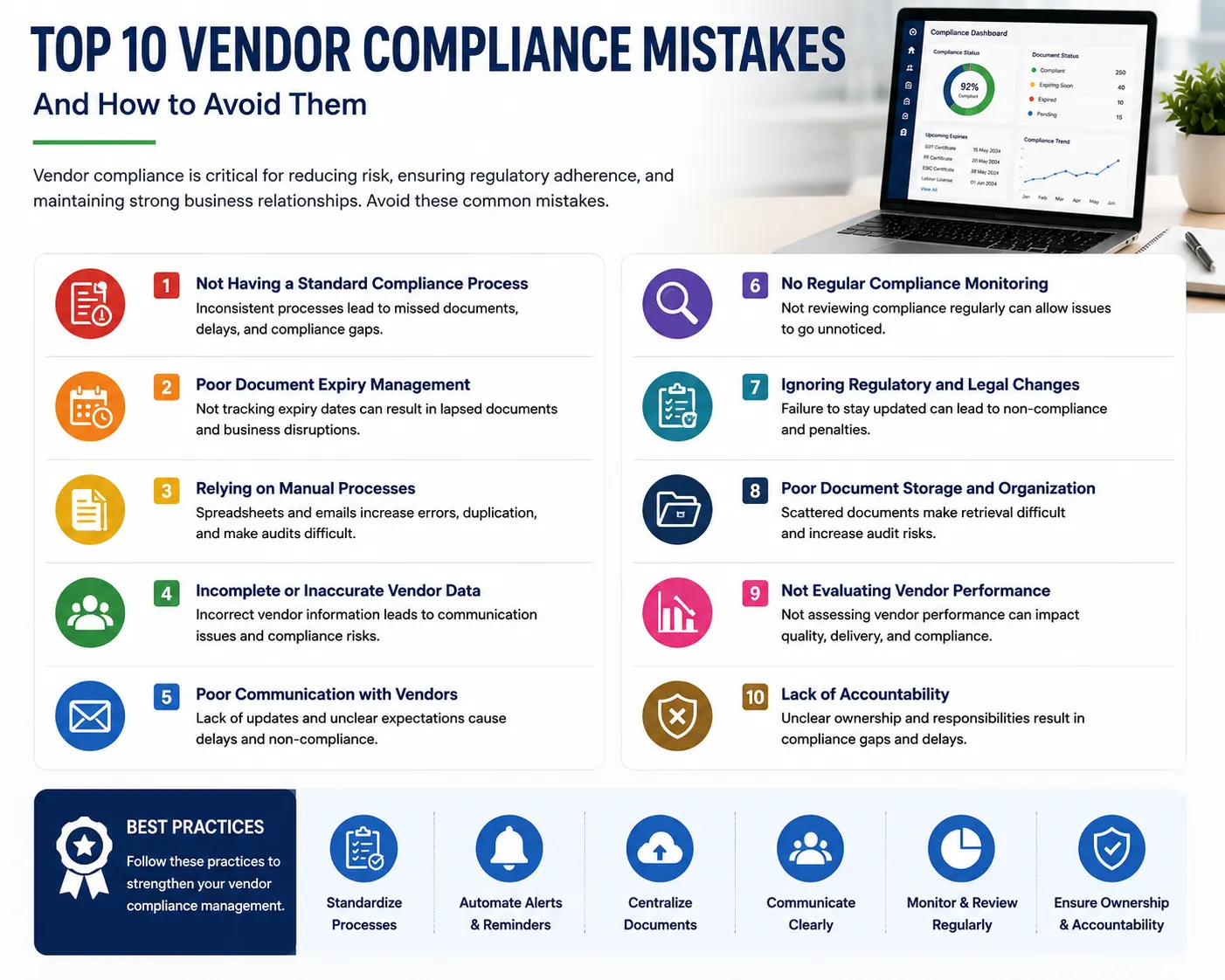
Top 10 Vendor Compliance Mistakes Companies Make (And How to Avoid Them)
Vendor compliance is no longer just an administrative responsibility. It has become a critical part of procurement, risk management, and business continuity.
However, many organizations still manage vendor compliance using spreadsheets, email reminders, and shared folders. As the number of vendors grows, these manual processes become increasingly difficult to maintain.
The result?
Expired documents, failed audits, compliance gaps, and unnecessary operational risks.
In this guide, we’ll explore the 10 most common vendor compliance mistakes organizations make and how you can avoid them.
Why Vendor Compliance Matters
Every organization depends on suppliers, contractors, and service providers.
If vendors fail to maintain valid statutory or contractual documents, organizations may face:
- Regulatory penalties
- Audit findings
- Operational disruptions
- Legal liabilities
- Safety risks
- Reputational damage
Avoiding common compliance mistakes helps organizations remain compliant, reduce administrative effort, and improve supplier relationships.
1. Relying on Excel Spreadsheets
Many organizations still manage vendor compliance using Excel.
Although spreadsheets work for a small number of vendors, they become difficult to maintain as organizations grow.
Common problems include:
- Manual updates
- Duplicate records
- Version conflicts
- Missed reminders
- Human errors
Best Practice
Use a centralized vendor compliance system that automatically tracks documents and expiry dates.
2. Missing Document Expiry Dates
One of the most common compliance failures is allowing important documents to expire unnoticed.
Examples include:
- GST Registration
- Labour License
- Factory License
- Insurance Policies
- ISO Certifications
- PF Registration
- ESIC Registration
Missing even one renewal can expose an organization to unnecessary risks.
Best Practice
Automate expiry tracking and configure reminder notifications before documents expire.
3. Collecting Incomplete Documents
Many organizations approve vendors before receiving all mandatory compliance documents.
This creates compliance gaps that are often discovered only during audits.
Best Practice
Create document checklists based on vendor category and require mandatory documents before approval.
4. No Standardized Vendor Onboarding Process
Different procurement team members often request different documents.
This creates confusion for vendors and inconsistent compliance practices.
Best Practice
Standardize onboarding workflows with predefined document requirements for each vendor type.
5. Poor Document Organization
Compliance documents are often stored across:
- Email inboxes
- Shared drives
- Local folders
- ERP attachments
- Paper files
Finding the correct document during an audit becomes difficult.
Best Practice
Maintain a centralized document repository with proper categorization and version history.
6. No Regular Compliance Reviews
Many organizations review vendor compliance only when an audit is scheduled.
By then, multiple documents may already have expired.
Best Practice
Conduct monthly or quarterly compliance reviews to identify issues early.
7. Manual Vendor Follow-Ups
Procurement teams spend countless hours sending emails and making phone calls requesting updated documents.
This repetitive work reduces productivity.
Best Practice
Use automated reminder emails and vendor self-service portals that allow suppliers to upload documents directly.
8. Limited Visibility Into Compliance Status
Managers often struggle to answer questions such as:
- Which vendors are fully compliant?
- Which documents expire this month?
- Which contractors require immediate attention?
Without dashboards, compliance becomes reactive rather than proactive.
Best Practice
Use real-time dashboards that provide organization-wide compliance visibility.
9. Ignoring Audit Trails
Many organizations cannot determine:
- Who uploaded a document?
- Who approved it?
- When was it modified?
- Which version is current?
Missing audit trails reduce accountability.
Best Practice
Maintain complete audit logs for uploads, approvals, renewals, and document changes.
10. Delaying Compliance Automation
Many businesses postpone investing in compliance automation because manual processes appear manageable.
Unfortunately, compliance complexity grows much faster than vendor count.
What works for 20 vendors often fails with 200 vendors.
Best Practice
Implement automation before compliance becomes a major operational challenge.
Common Documents Organizations Should Monitor
Vendor compliance commonly includes:
Registration Documents
- GST Registration Certificate
- PAN Card
- MSME Certificate
Statutory Documents
- PF Registration Certificate
- ESIC Registration Certificate
- Labour License
- Factory License
Insurance Documents
- Workmen Compensation Insurance
- Public Liability Insurance
Employee Records
- Employee List
- Attendance Register
- Wage Register
- Salary Register
Safety Documents
- Safety Training Records
- Risk Assessment Reports
- PPE Compliance Records
Manual Process vs Automated Vendor Compliance
| Manual Process | Automated Compliance |
|---|---|
| Excel spreadsheets | Centralized repository |
| Manual reminders | Automated notifications |
| Email follow-ups | Vendor self-service portal |
| Scattered documents | Organized document library |
| Manual reporting | Compliance dashboards |
| Difficult audits | Audit-ready reports |
Best Practices for Vendor Compliance
Standardize Compliance Requirements
Create document requirements based on vendor category.
Centralize Documentation
Store all vendor records in one secure location.
Automate Expiry Tracking
Receive notifications before documents expire.
Conduct Regular Compliance Reviews
Review vendor status every month or quarter.
Maintain Audit Trails
Track document history and approval activities.
Leverage Automation
Reduce repetitive administrative work through automated workflows.
How AI Is Improving Vendor Compliance
Modern AI-powered compliance platforms can:
- Detect document types automatically
- Extract expiry dates
- Identify missing information
- Validate uploaded documents
- Reduce manual verification
- Improve document accuracy
AI enables procurement teams to focus on decision-making rather than paperwork.
How VendorCompliancePro Helps
VendorCompliancePro helps organizations avoid these common compliance mistakes through:
- Centralized vendor document repository
- Vendor self-service portal
- Automated expiry reminders
- Approval workflows
- Compliance dashboards
- Audit reports
- Role-based access
- AI-powered document validation
Organizations can improve compliance visibility, reduce manual effort, and remain audit-ready throughout the year.
Frequently Asked Questions
What is the biggest vendor compliance mistake?
The most common mistake is relying on spreadsheets to track vendor documents and expiry dates, which often results in missed renewals and compliance gaps.
Why do companies fail vendor compliance audits?
Missing documents, expired certificates, poor document organization, and lack of audit trails are common reasons.
How often should vendor compliance be reviewed?
Organizations should review vendor compliance monthly or quarterly, depending on business requirements and regulatory obligations.
Can ERP systems manage vendor compliance?
ERP systems can store supplier information but often lack specialized features such as document expiry tracking, automated reminders, and compliance dashboards.
How can organizations improve vendor compliance?
By standardizing document requirements, centralizing records, automating reminders, and using dedicated vendor compliance software.
Conclusion
Vendor compliance failures rarely occur because organizations ignore compliance. More often, they result from manual processes that cannot scale as vendor numbers increase.
By recognizing these common mistakes and implementing standardized, automated compliance processes, organizations can reduce risks, improve operational efficiency, and remain audit-ready throughout the year.
Investing in modern vendor compliance software helps procurement teams spend less time chasing paperwork and more time building strong supplier relationships.
Related Articles
- What Is Vendor Compliance?
- Vendor Compliance Checklist India
- Vendor Compliance vs Vendor Management
- Procurement Compliance Explained
- Vendor Audit Readiness Checklist