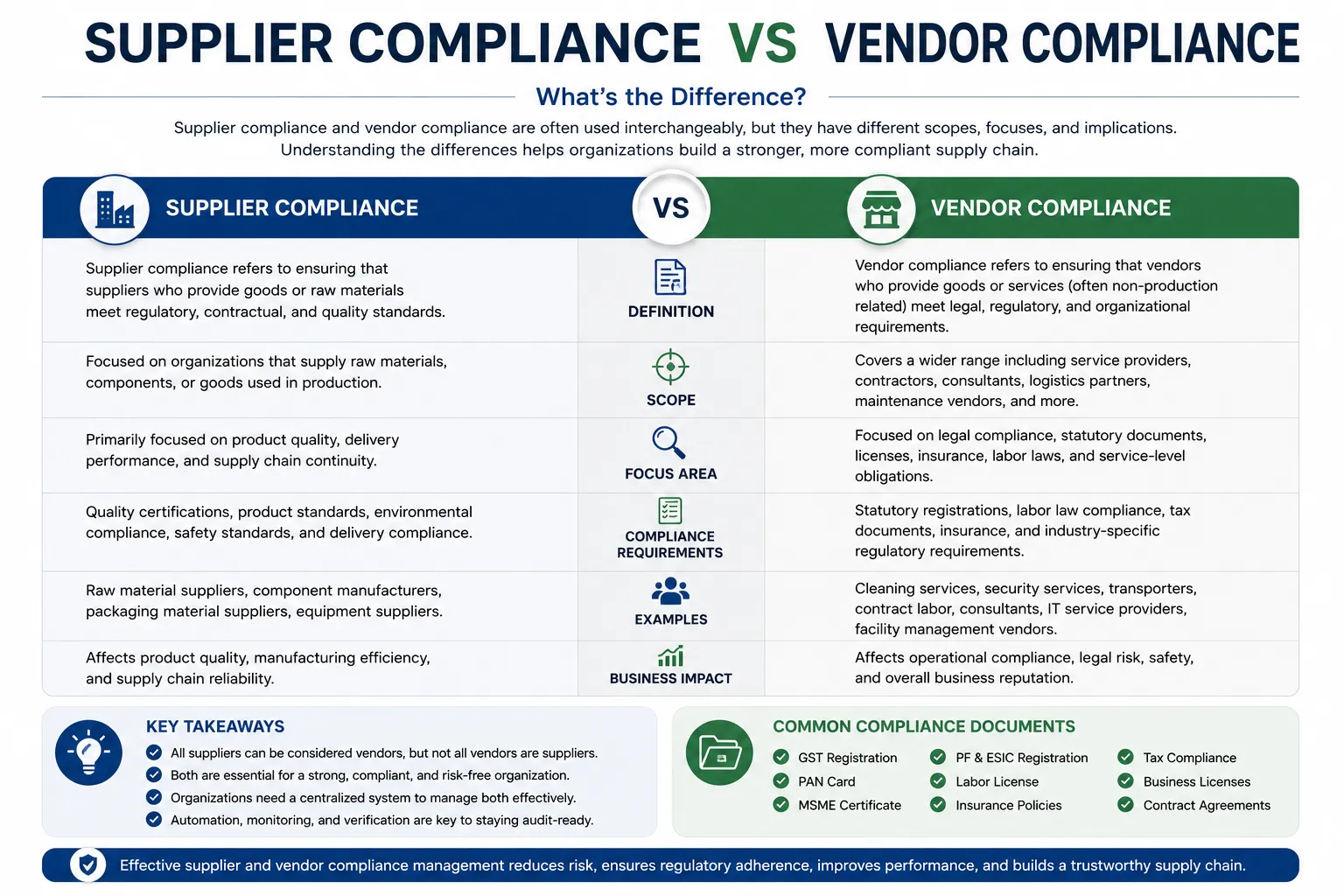
Supplier Compliance vs Vendor Compliance: What’s the Difference?
The terms Supplier Compliance and Vendor Compliance are often used interchangeably in procurement and supply chain management.
In many organizations, they mean almost the same thing. However, depending on company policies, industry standards, and procurement practices, there can be subtle differences in how these terms are used.
Understanding these differences helps procurement teams build better compliance processes, reduce operational risks, and improve supplier relationships.
In this guide, we’ll explain supplier compliance, vendor compliance, their similarities, their differences, and why both are essential for modern organizations.
What Is Supplier Compliance?
Supplier compliance is the process of ensuring that suppliers meet contractual, legal, regulatory, quality, and organizational requirements throughout the business relationship.
Supplier compliance commonly includes:
- Supplier qualification
- Quality standards
- Product certifications
- Regulatory compliance
- Delivery requirements
- Contract compliance
- Performance monitoring
- Audit readiness
Supplier compliance often focuses on organizations that manufacture or supply products.
What Is Vendor Compliance?
Vendor compliance is the process of ensuring vendors, contractors, and service providers continuously meet legal, statutory, contractual, and organizational requirements.
Vendor compliance typically includes:
- Vendor onboarding
- Document collection
- Document verification
- Expiry tracking
- Renewal reminders
- Compliance reporting
- Audit preparation
- Regulatory compliance
Vendor compliance generally focuses on document management and statutory compliance.
Supplier Compliance vs Vendor Compliance
Although the objectives are similar, organizations may use the terms differently.
| Supplier Compliance | Vendor Compliance |
|---|---|
| Focuses on suppliers of products and materials | Focuses on vendors, contractors, and service providers |
| Includes quality and delivery requirements | Focuses on statutory and compliance documents |
| Evaluates supplier performance | Tracks document validity and compliance |
| Monitors product certifications | Monitors legal and regulatory requirements |
| Supports supply chain quality | Supports audit readiness and compliance |
In many organizations, especially small and medium-sized businesses, both terms refer to the same compliance process.
Similarities Between Supplier and Vendor Compliance
Both processes share common objectives.
They help organizations:
- Reduce compliance risks
- Improve supplier accountability
- Ensure regulatory compliance
- Maintain complete documentation
- Prepare for audits
- Improve operational efficiency
- Build stronger business relationships
Whether you call them suppliers or vendors, the goal remains the same—working only with compliant business partners.
Common Compliance Documents
Organizations typically collect the following documents.
Business Registration Documents
- GST Registration Certificate
- PAN Card
- MSME Certificate
- Certificate of Incorporation
Statutory Documents
- PF Registration Certificate
- ESIC Registration Certificate
- Labour License
- Factory License
Insurance Documents
- Workmen Compensation Insurance
- Public Liability Insurance
- Professional Indemnity Insurance
Quality & Certification Documents
- ISO 9001 Certificate
- ISO 14001 Certificate
- ISO 45001 Certificate
- Product Test Certificates
Employee Records
- Employee List
- Attendance Register
- Wage Register
- Salary Register
Why Compliance Matters
Regardless of terminology, organizations face similar risks when supplier or vendor compliance is not properly managed.
Common risks include:
- Regulatory penalties
- Failed audits
- Operational disruptions
- Legal liabilities
- Safety risks
- Contract violations
- Reputational damage
A structured compliance process significantly reduces these risks.
Common Compliance Challenges
Many organizations still rely on manual processes.
This creates several challenges.
Spreadsheet Tracking
Manual tracking becomes difficult as supplier numbers increase.
Missed Expiry Dates
Important documents expire unnoticed.
Scattered Documentation
Compliance records are stored across multiple systems.
Manual Follow-Ups
Procurement teams spend excessive time requesting updated documents.
Limited Visibility
Management struggles to identify compliance risks.
Manual Process vs Automated Compliance
| Manual Process | Automated Compliance |
|---|---|
| Excel spreadsheets | Centralized repository |
| Manual reminders | Automated notifications |
| Shared folders | Vendor self-service portal |
| Email follow-ups | Compliance dashboards |
| Manual reporting | Audit-ready reports |
| Human errors | Improved accuracy |
Best Practices for Supplier and Vendor Compliance
Standardize Document Requirements
Define mandatory documents for each supplier or vendor category.
Centralize Documentation
Maintain all compliance records in one secure location.
Automate Expiry Tracking
Receive reminders before important documents expire.
Conduct Regular Reviews
Review supplier and vendor compliance every month or quarter.
Maintain Audit Trails
Track uploads, approvals, renewals, and document history.
Use Compliance Dashboards
Monitor compliance status through real-time reports.
How AI Is Transforming Compliance Management
Modern AI-powered compliance platforms help organizations:
- Identify document types automatically
- Extract expiry dates
- Detect missing information
- Validate uploaded documents
- Reduce manual verification
- Improve document accuracy
AI helps procurement teams manage compliance more efficiently while reducing administrative work.
How VendorCompliancePro Helps
VendorCompliancePro simplifies supplier and vendor compliance through:
- Centralized document repository
- Vendor self-service portal
- Automated expiry reminders
- Approval workflows
- Compliance dashboards
- Audit reports
- Role-based access
- Audit trails
- AI-powered document validation
Organizations can improve compliance visibility, reduce manual effort, and remain audit-ready throughout the year.
Frequently Asked Questions
Are supplier compliance and vendor compliance the same?
In many organizations, the terms are used interchangeably. However, supplier compliance often emphasizes product quality and supply chain requirements, while vendor compliance typically focuses on statutory documents and regulatory compliance.
Why is supplier compliance important?
Supplier compliance helps organizations reduce operational risks, maintain product quality, and ensure suppliers meet contractual and regulatory requirements.
What documents are commonly required?
Organizations commonly collect GST registration, PAN card, PF registration, ESIC registration, labour licenses, insurance policies, ISO certificates, and employee records.
Which industries benefit from compliance management?
Manufacturing, logistics, warehousing, engineering, healthcare, construction, facility management, and organizations working with suppliers or contractors.
Can compliance software manage both suppliers and vendors?
Yes. Modern compliance management software can manage documents, approvals, expiry tracking, reporting, and audit readiness for both suppliers and vendors.
Conclusion
Whether your organization uses the term supplier or vendor, the objective remains the same—ensuring external business partners continue meeting legal, contractual, quality, and regulatory requirements.
By implementing a structured compliance process and leveraging automation, organizations can improve visibility, reduce manual work, minimize compliance risks, and remain audit-ready throughout the supplier lifecycle.
Related Articles
- What Is Vendor Compliance?
- Vendor Compliance vs Vendor Management
- Procurement Compliance Explained
- Vendor Compliance Software India
- Vendor Document Management