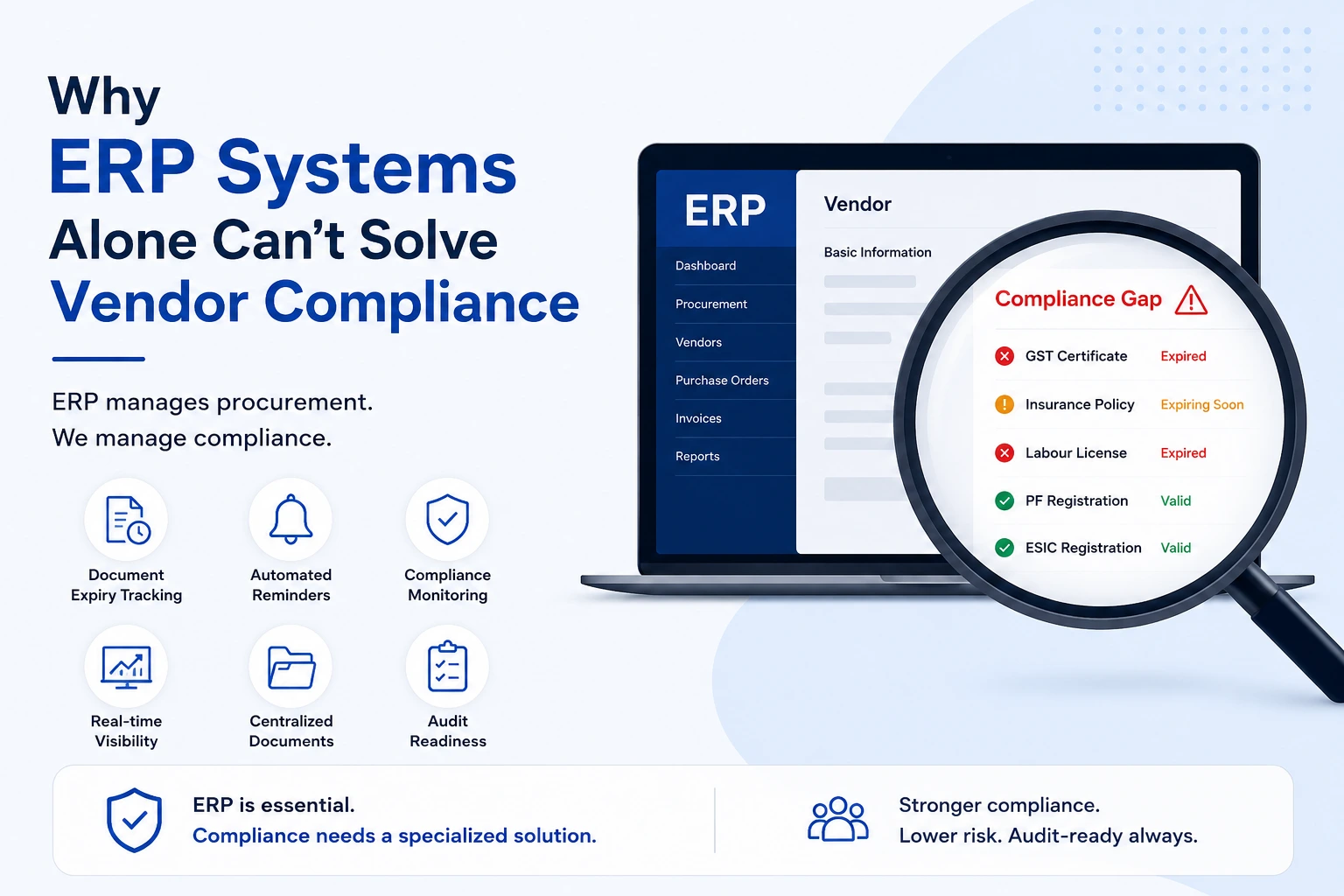
Why ERP Systems Alone Can’t Solve Vendor Compliance
Enterprise Resource Planning (ERP) systems are the backbone of modern businesses. They streamline procurement, inventory, finance, purchasing, and supplier management into a single platform.
Solutions such as SAP, Oracle, Microsoft Dynamics 365, and other ERP platforms have transformed the way organizations manage business operations.
However, one common misconception remains:
“Our ERP already manages vendors, so we don’t need separate vendor compliance software.”
In reality, ERP systems and vendor compliance software solve different business problems.
While ERP systems excel at managing procurement transactions and supplier master data, they often lack the specialized capabilities required to continuously monitor vendor documents, automate expiry tracking, validate compliance records, and prepare organizations for audits.
This is why many manufacturing companies, logistics providers, warehouses, and engineering firms continue using Excel spreadsheets alongside their ERP systems.
In this guide, we’ll explain where ERP systems excel, where they fall short, and why organizations increasingly implement dedicated vendor compliance solutions to bridge the gap.
What ERP Systems Do Well
ERP software is designed to centralize business operations across departments.
Typical ERP capabilities include:
- Procurement Management
- Purchase Orders
- Supplier Master Data
- Inventory Management
- Accounts Payable
- Contract Management
- Financial Reporting
- Approval Workflows
- Material Planning
These features help organizations improve operational efficiency, maintain accurate financial records, and standardize procurement processes.
For supplier management, ERP systems provide visibility into:
- Approved vendors
- Purchase history
- Vendor payments
- Contract information
- Supplier master records
These are essential capabilities for running day-to-day business operations.
However, vendor compliance extends well beyond procurement.
What Vendor Compliance Actually Means
Vendor compliance is the process of ensuring suppliers, contractors, and service providers continuously meet legal, statutory, safety, and organizational requirements throughout the business relationship.
A complete vendor compliance process typically includes:
- Vendor onboarding
- Document collection
- Document verification
- Compliance approval
- Expiry tracking
- Renewal reminders
- Compliance reporting
- Audit preparation
Unlike procurement data, compliance information changes frequently.
Documents expire.
Licenses require renewal.
Insurance policies need updating.
Government regulations evolve.
Keeping track of these changes manually becomes increasingly difficult as the number of vendors grows.
The Gap Between ERP and Vendor Compliance
Most ERP systems allow organizations to attach vendor documents.
However, storing documents is not the same as managing compliance.
Let’s examine the common gaps.
1. No Automatic Document Expiry Tracking
ERP systems may store a GST certificate or labour license, but they generally don’t monitor expiry dates automatically.
Compliance teams must manually review:
- GST Registration Certificates
- Labour Licenses
- Factory Licenses
- Insurance Policies
- ISO Certifications
- Pollution Control Certificates
As the number of vendors increases, manually checking expiry dates becomes impractical.
Missing a single expired document can expose the organization to unnecessary compliance risks.
2. Limited Document Validation
Uploading a document into an ERP doesn’t guarantee that it is:
- The correct document
- Current and valid
- Complete
- Readable
- Uploaded by the correct vendor
Procurement teams still spend significant time manually reviewing every submission.
This manual verification process consumes valuable time that could be spent on strategic procurement activities.
3. Manual Renewal Follow-Ups
Many organizations continue using:
- Excel spreadsheets
- Outlook reminders
- Shared drives
- Email follow-ups
- Phone calls
A typical workflow often looks like this:
- Review the spreadsheet
- Identify expiring documents
- Send reminder emails
- Follow up with vendors
- Receive updated documents
- Update records manually
Repeating this process every month creates a significant administrative burden.
4. Limited Compliance Visibility
Procurement managers often need answers to questions such as:
- Which vendors are fully compliant?
- Which documents expire this month?
- Which contractors require immediate attention?
- Which vendors are missing mandatory documents?
Most ERP systems require custom reports or additional development to provide this level of visibility.
Dedicated compliance dashboards are rarely available out of the box.
5. Difficult Audit Preparation
During internal or external audits, compliance teams often search for documents across multiple locations:
- ERP attachments
- Email inboxes
- Shared network folders
- Local drives
- Excel spreadsheets
Finding the correct version of every required document becomes stressful and time-consuming.
Without a centralized compliance repository, audit preparation can take days instead of hours.
Why Companies Still Use Excel Alongside ERP
Even organizations running enterprise ERP platforms often maintain compliance information in spreadsheets.
Common reasons include:
- Tracking document expiry dates
- Monitoring vendor compliance status
- Managing renewal schedules
- Recording document approvals
- Following up with contractors
Although Excel provides flexibility, it also introduces new risks.
Challenges of Manual Compliance Management
Manual processes become increasingly difficult as organizations grow.
Missed Expiry Dates
Important documents may expire without anyone noticing.
Human Errors
Manual updates increase the likelihood of inaccurate information.
Scattered Documentation
Vendor records become distributed across multiple systems.
Limited Visibility
Management cannot quickly identify compliance risks.
Administrative Burden
Compliance teams spend excessive time chasing vendors for updated documents.
ERP vs Vendor Compliance Software
| ERP System | Vendor Compliance Software |
|---|---|
| Supplier Master Data | Centralized Document Repository |
| Purchase Orders | Document Expiry Tracking |
| Procurement Workflows | Automated Renewal Reminders |
| Inventory Management | Compliance Dashboards |
| Financial Reporting | Audit Readiness |
| Contract Management | AI Document Validation |
ERP systems and vendor compliance platforms complement each other rather than compete.
Benefits of Adding a Vendor Compliance Solution
Organizations that combine ERP with dedicated vendor compliance software gain several advantages.
Automated Expiry Tracking
Receive notifications before important documents expire.
Reduced Manual Work
Eliminate repetitive follow-up activities through automation.
Better Audit Readiness
Maintain organized records that are always available during audits.
Improved Compliance Visibility
Monitor vendor status using real-time dashboards and reports.
Faster Vendor Onboarding
Collect, verify, and approve vendor documents through structured workflows.
Reduced Compliance Risk
Identify missing or expired documents before they create operational or regulatory issues.
Best Practices for Managing Vendor Compliance
Centralize Vendor Documents
Maintain all compliance records in one secure location.
Automate Expiry Reminders
Notify vendors well before documents expire.
Verify Documents Before Approval
Ensure every uploaded document is accurate and valid.
Review Compliance Regularly
Use dashboards to monitor vendor status continuously.
Maintain Audit Trails
Track uploads, approvals, document history, and user activities.
Why ERP and Vendor Compliance Software Work Better Together
ERP systems are designed to manage procurement.
Vendor compliance software is designed to manage compliance.
These are two different business functions.
ERP focuses on:
- Procurement
- Purchasing
- Finance
- Inventory
- Supplier Records
Vendor compliance platforms focus on:
- Document Management
- Compliance Monitoring
- Expiry Tracking
- Vendor Communication
- Audit Readiness
- Regulatory Compliance
Together, they provide a complete supplier management ecosystem.
How AI Is Transforming Vendor Compliance
Modern AI-powered compliance platforms help organizations reduce manual effort by:
- Automatically identifying document types
- Extracting expiry dates
- Detecting missing information
- Flagging expired certificates
- Validating uploaded documents
- Reducing manual document verification
Instead of reviewing every submission manually, procurement teams can focus only on documents that require attention.
What Features Should Vendor Compliance Software Provide?
When evaluating vendor compliance software, look for features such as:
- Centralized document repository
- Vendor self-service portal
- Automated expiry reminders
- Approval workflows
- Compliance dashboards
- Audit reports
- Role-based access
- Audit trails
- Document version history
- AI-powered document validation
How VendorCompliancePro Helps
VendorCompliancePro complements your existing ERP by providing:
- Centralized vendor document management
- Vendor self-service portal
- Automated expiry reminders
- Compliance dashboards
- Approval workflows
- Audit-ready reporting
- Role-based access
- AI-powered document validation
Rather than replacing your ERP, VendorCompliancePro fills the compliance gap, helping organizations reduce manual work, improve visibility, and stay audit-ready throughout the year.
Frequently Asked Questions
Does an ERP system handle vendor compliance?
ERP systems manage supplier information and procurement processes, but they generally lack specialized compliance features such as expiry tracking, automated reminders, and document validation.
Why do companies still use Excel with ERP?
Many organizations rely on Excel to manage document expiries, compliance status, and vendor follow-ups because these functions are often not fully supported within ERP platforms.
Should vendor compliance software replace ERP?
No. Vendor compliance software complements ERP systems by managing compliance-specific processes while ERP continues handling procurement and financial operations.
Which documents should organizations monitor?
Common documents include GST registration, PAN card, PF registration, ESIC registration, labour licenses, insurance policies, factory licenses, ISO certificates, and contractor records.
Who benefits from vendor compliance software?
Manufacturing companies, logistics firms, warehouses, engineering companies, construction firms, facility management organizations, and any business working with suppliers or contractors benefit from dedicated compliance management.
Conclusion
ERP systems are indispensable for managing procurement and core business operations, but they are not designed to handle the ongoing complexities of vendor compliance.
By combining your ERP with a dedicated vendor compliance solution, organizations can automate document tracking, reduce manual work, improve audit readiness, and maintain continuous compliance without changing their existing procurement processes.
The most effective strategy isn’t replacing your ERP—it’s extending it with a compliance platform built specifically for managing vendor documentation and regulatory requirements.
Related Articles
- What Is Vendor Compliance?
- Excel vs Vendor Compliance Software
- Vendor Compliance Software India
- Vendor Document Management
- Vendor Audit Readiness Checklist