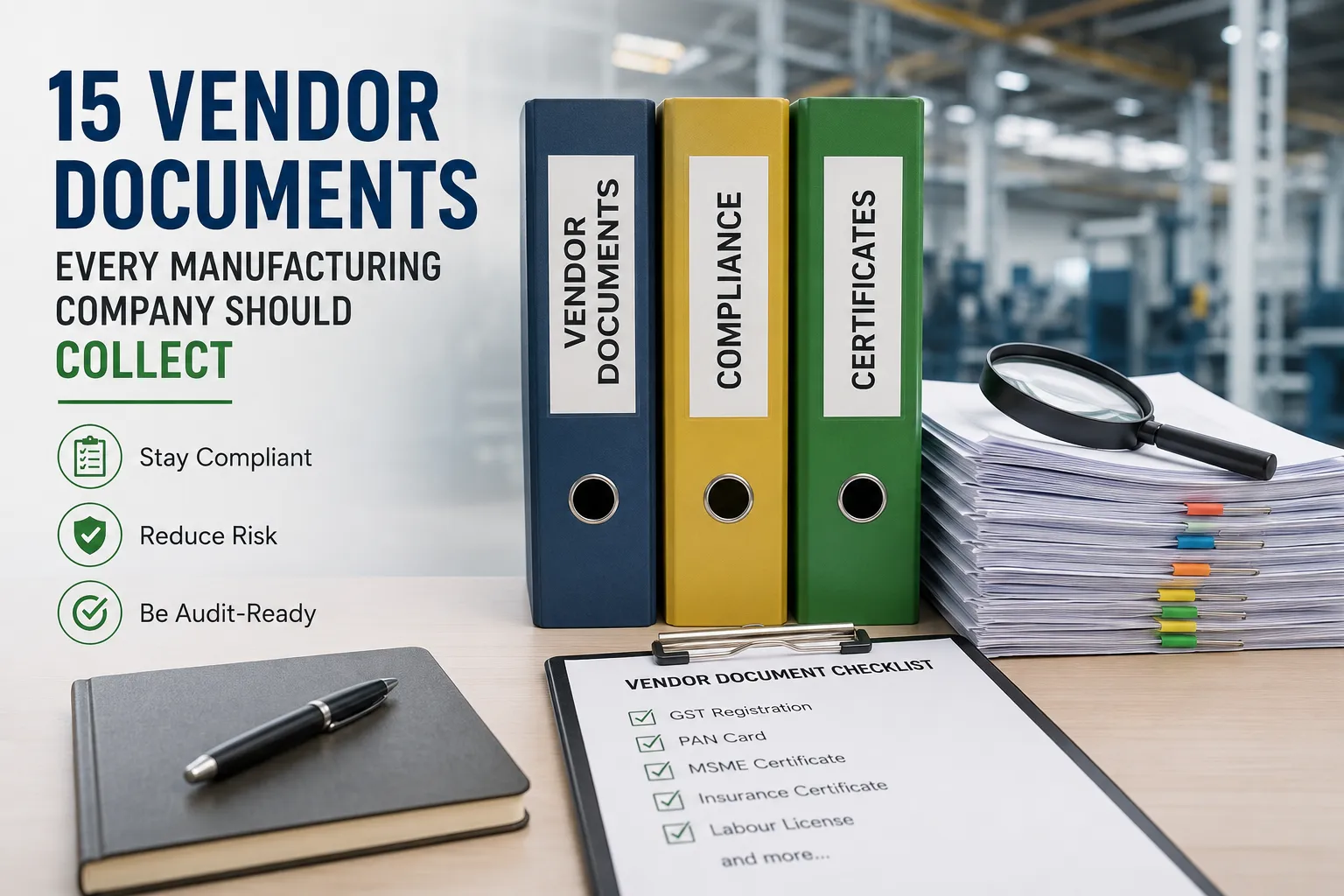
15 Vendor Documents Every Manufacturing Company Should Collect
Onboarding a new vendor isn’t just about negotiating prices and issuing purchase orders.
Before doing business, manufacturing companies must ensure that vendors are legally registered, financially reliable, and compliant with statutory requirements.
Unfortunately, many organizations only realize a document is missing when:
- An audit is scheduled
- A contractor arrives on-site
- A payment is held
- A customer requests compliance records
By then, it’s often too late.
Having a standardized vendor document checklist helps procurement teams onboard vendors faster while reducing compliance and operational risks.
In this guide, we’ll cover the 15 essential vendor documents every manufacturing company should collect.
Why Vendor Documents Matter
Vendor documents help organizations verify that suppliers meet legal, regulatory, contractual, and internal compliance requirements.
Maintaining complete and up-to-date records helps:
- Reduce compliance risk
- Improve audit readiness
- Speed up vendor onboarding
- Prevent operational disruptions
- Build stronger supplier relationships
1. GST Registration Certificate
The GST Registration Certificate confirms that a vendor is legally registered under India’s Goods and Services Tax system.
Verify:
- GSTIN
- Business name
- Registration status
- Address
This is one of the first documents procurement teams request.
2. PAN Card
A Permanent Account Number (PAN) verifies the vendor’s tax identity.
Ensure that:
- The PAN matches the business entity.
- The name is consistent across all documents.
3. MSME Registration Certificate (Udyam)
If the supplier qualifies as an MSME, request the Udyam Registration Certificate.
Benefits include:
- Government recognition
- MSME procurement benefits
- Easier vendor classification
4. Certificate of Incorporation
For companies, this document confirms legal incorporation.
It includes:
- Company name
- CIN
- Date of incorporation
- Registrar details
5. Cancelled Cheque or Bank Verification
Bank verification reduces payment errors.
Typical documents include:
- Cancelled cheque
- Bank verification letter
- Bank account confirmation
6. PF Registration Certificate
If the vendor employs workers covered under the Employees’ Provident Fund scheme, request the PF Registration Certificate.
This is particularly important for labour contractors.
7. ESIC Registration Certificate
For vendors covered under the Employees’ State Insurance Scheme, obtain the ESIC Registration Certificate.
This demonstrates statutory compliance.
8. Labour License
Contractors providing manpower often require a valid Labour License.
Always verify:
- Validity period
- Issuing authority
- Expiry date
9. Insurance Certificate
Many manufacturing companies require vendors to maintain insurance.
Examples include:
- Workmen Compensation Insurance
- Public Liability Insurance
- General Liability Insurance
- Professional Indemnity Insurance
Ensure policies remain active throughout the engagement.
10. Quality Certifications
Quality certifications demonstrate that suppliers follow recognized management standards.
Common certifications include:
- ISO 9001
- ISO 14001
- ISO 45001
- IATF 16949
The required certification depends on the industry.
11. Safety Documents
For contractors working on-site, safety compliance is essential.
Common documents include:
- Safety Policy
- PPE Declaration
- Employee Safety Training Records
- Emergency Response Procedures
These help reduce workplace risks.
12. Signed Non-Disclosure Agreement (NDA)
If vendors access confidential information, an NDA helps protect sensitive business data.
This is especially important for:
- Engineering vendors
- IT vendors
- Product development partners
13. Master Service Agreement (MSA)
The MSA defines the commercial relationship between your organization and the vendor.
It typically includes:
- Scope of work
- Responsibilities
- Payment terms
- Liability clauses
- Termination conditions
14. Supplier Code of Conduct
Many organizations require vendors to acknowledge and sign a Supplier Code of Conduct.
It often covers:
- Ethical business practices
- Anti-corruption
- Human rights
- Environmental responsibility
- Workplace safety
15. Vendor Compliance Declaration
A compliance declaration confirms that the vendor agrees to comply with your organization’s policies and regulatory requirements.
This document demonstrates the vendor’s commitment to maintaining compliance throughout the business relationship.
Bonus Documents (Depending on Vendor Type)
Some vendors may require additional documentation, including:
- Factory License
- Fire Safety Certificate
- Pollution Control Certificate
- FSSAI License
- Import Export Code (IEC)
- Drug License
- Hazardous Material Permits
- Financial Statements
- Business References
The required documents depend on the vendor’s services and risk level.
Best Practices for Managing Vendor Documents
Collecting documents is only the beginning.
Organizations should also:
Store Documents Centrally
Avoid saving files across emails, desktops, and shared folders.
Use a centralized repository.
Verify Every Document
Check that:
- Documents are valid.
- Information matches vendor records.
- Expiry dates are current.
Track Expiry Dates
Many compliance documents expire periodically.
Automated reminders help prevent missed renewals.
Standardize Checklists
Different vendor categories may require different document sets.
For example:
- Labour Contractors
- Raw Material Suppliers
- Logistics Providers
- Consultants
- Equipment Vendors
Using predefined checklists simplifies onboarding.
Review Documents Regularly
Vendor compliance is not a one-time activity.
Documents should be reviewed and renewed throughout the vendor lifecycle.
Common Mistakes to Avoid
Manufacturing companies often make avoidable mistakes such as:
- Relying on email attachments
- Tracking documents in Excel
- Missing expiry dates
- Accepting incomplete documentation
- Storing multiple document versions
- Waiting until audits to verify compliance
These issues increase compliance and operational risks.
How VendorCompliancePro Helps
VendorCompliancePro simplifies vendor document management by providing:
- Configurable document checklists
- Vendor self-service portal
- Centralized document repository
- AI-powered document validation
- Approval workflows
- Automated expiry reminders
- Compliance dashboards
- Audit-ready reporting
- Complete document history
Instead of manually chasing documents, procurement teams gain complete visibility into vendor compliance from a single platform.
Frequently Asked Questions
Why should manufacturing companies collect vendor documents?
Vendor documents verify that suppliers meet legal, statutory, contractual, and organizational compliance requirements, reducing operational and audit risks.
Which vendor document is the most important?
There isn’t a single most important document. GST Registration, PAN Card, statutory registrations, insurance policies, and commercial agreements all play critical roles depending on the vendor type.
How often should vendor documents be updated?
Documents should be reviewed continuously and renewed before their expiry dates.
Should every vendor submit the same documents?
No. Document requirements should be based on the vendor’s risk level, industry, and the services they provide.
Can vendor document collection be automated?
Yes. Vendor compliance software automates document collection, validation, approval workflows, expiry tracking, and reporting.
Conclusion
Collecting the right vendor documents is one of the most effective ways to reduce compliance risk and improve operational efficiency.
A standardized document checklist helps procurement teams onboard vendors faster, maintain accurate records, and stay prepared for audits.
The goal isn’t simply to collect paperwork.
It’s to ensure every vendor remains compliant throughout the entire business relationship.
Related Articles
- Vendor Compliance Checklist for Manufacturing Companies
- How to Prepare for a Vendor Compliance Audit
- The Hidden Cost of Expired Vendor Documents
- 7 Reasons Vendor Documents Go Missing During Audits
- Why “Email + Excel” Still Dominates Vendor Onboarding
- How Risk-Based Vendor Onboarding Saves Time and Reduces Compliance Risk