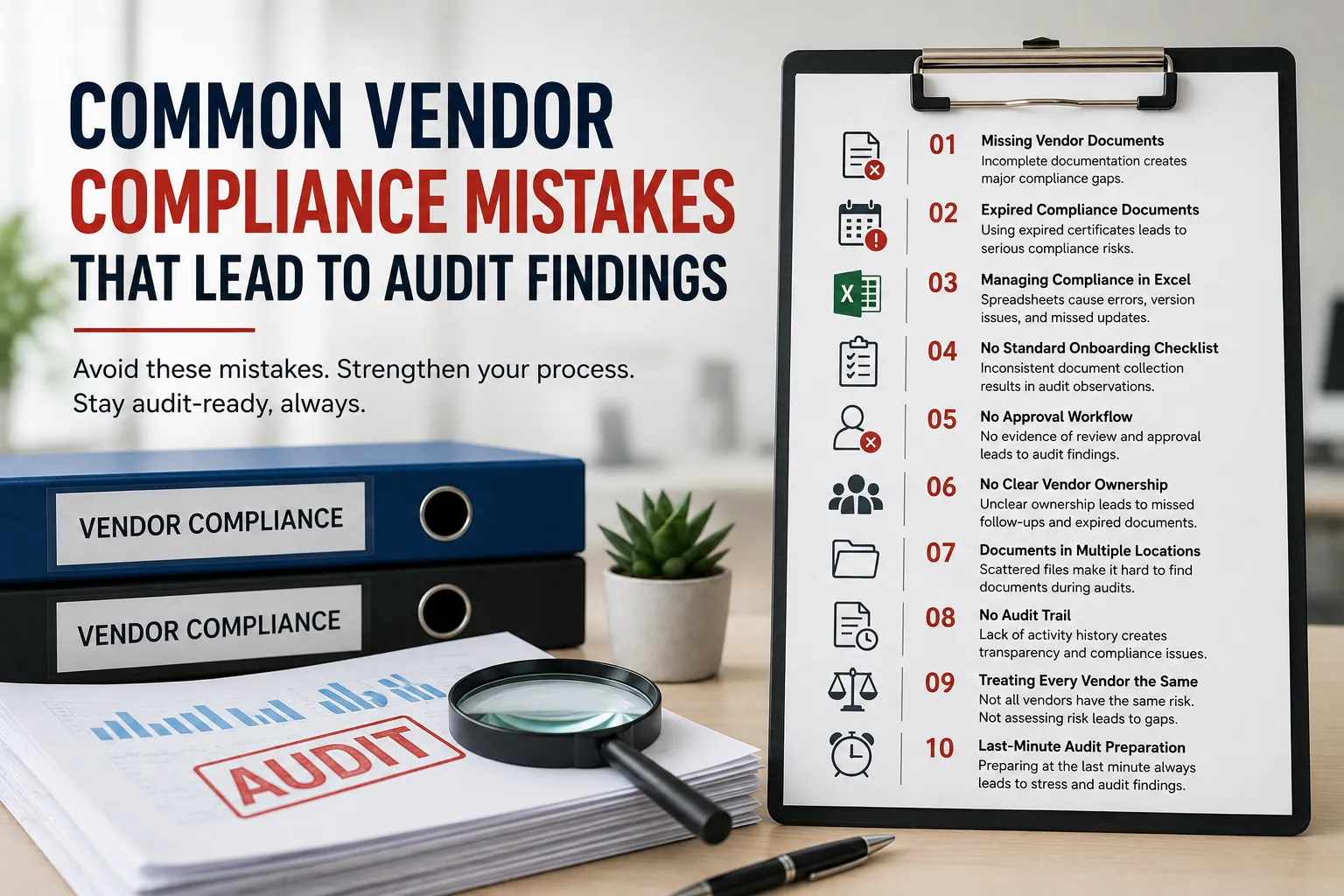
10 Common Vendor Compliance Mistakes That Lead to Audit Findings
When an auditor reviews your vendor records, they’re not just checking whether documents exist.
They’re evaluating whether your organization has an effective process for managing vendor compliance.
Unfortunately, many audit findings are caused by the same avoidable mistakes.
These issues often remain unnoticed until an audit uncovers them, resulting in corrective actions, compliance observations, delayed approvals, and unnecessary stress for procurement teams.
The good news?
Most vendor compliance findings can be prevented with the right processes and tools.
Let’s explore the ten most common vendor compliance mistakes—and how to avoid them.
Why Vendor Compliance Audits Matter
Vendor compliance audits help organizations verify that suppliers continue to meet:
- Legal requirements
- Regulatory obligations
- Contractual commitments
- Internal procurement policies
A successful audit demonstrates strong governance.
A poor audit can result in:
- Compliance findings
- Customer concerns
- Operational disruptions
- Regulatory penalties
- Increased business risk
1. Missing Vendor Documents
One of the most common audit findings is simply missing documentation.
Examples include:
- GST Registration Certificate
- PAN Card
- Insurance Certificate
- Labour License
- MSME Certificate
If auditors request a document that cannot be produced immediately, it raises questions about your compliance process.
Best Practice
Maintain a centralized repository where every vendor document is stored and easily searchable.
2. Expired Compliance Documents
Having a document is not enough.
It must also be valid.
Auditors frequently discover:
- Expired insurance policies
- Expired labour licenses
- Expired ISO certificates
- Outdated statutory registrations
Expired documents indicate poor compliance monitoring.
Best Practice
Track document expiry dates and automate renewal reminders before documents expire.
3. Managing Compliance in Excel
Excel is useful for small vendor lists.
However, it becomes increasingly difficult to manage hundreds of vendors.
Common spreadsheet issues include:
- Manual updates
- Duplicate entries
- Broken formulas
- Missed reminders
- Version confusion
These problems often lead to audit observations.
Best Practice
Use a centralized compliance platform with automated tracking and dashboards.
4. No Standard Vendor Onboarding Checklist
Different procurement executives requesting different documents creates inconsistency.
Some vendors may submit:
- GST Certificate
- PAN Card
- Bank Details
Others may be approved without complete documentation.
This inconsistency creates compliance gaps.
Best Practice
Use standardized onboarding checklists based on vendor category and risk.
5. No Approval Workflow
Some organizations collect documents but never formally approve them.
Auditors often ask:
- Who reviewed the documents?
- Who approved the vendor?
- When was approval granted?
Without approval records, there is no evidence that compliance checks were completed.
Best Practice
Implement documented approval workflows with reviewer names and timestamps.
6. No Clear Vendor Ownership
When nobody owns the vendor relationship, important activities are often missed.
Common examples include:
- Expired documents not renewed
- Vendor queries unanswered
- Compliance issues ignored
Every vendor should have a clearly assigned business owner.
Best Practice
Assign one accountable owner responsible for vendor compliance throughout the vendor lifecycle.
7. Documents Stored Across Multiple Locations
Many organizations keep vendor documents in:
- Email inboxes
- Shared drives
- Google Drive
- OneDrive
- Local desktops
When auditors request a document, teams spend valuable time searching multiple locations.
Best Practice
Maintain one centralized repository for all vendor documents.
8. No Audit Trail
Auditors often ask questions such as:
- Who uploaded this document?
- When was it approved?
- Has it been modified?
Without an audit trail, these questions become difficult to answer.
Best Practice
Maintain complete activity history for every document, approval, and modification.
9. Treating Every Vendor the Same
Not every supplier carries the same level of compliance risk.
Yet many organizations apply identical document requirements to every vendor.
This creates unnecessary work while allowing high-risk vendors to receive insufficient scrutiny.
Best Practice
Adopt a risk-based vendor onboarding process with different document requirements for different vendor categories.
10. Preparing for Audits at the Last Minute
Many organizations only review vendor compliance when an audit is announced.
This results in:
- Last-minute document collection
- Missing approvals
- Expired certificates
- Procurement panic
Audit readiness should be continuous—not seasonal.
Best Practice
Monitor vendor compliance throughout the year instead of preparing only before audits.
Warning Signs Your Compliance Process Needs Improvement
Your organization may be at risk if:
- Vendor documents are tracked in Excel.
- Procurement spends hours chasing documents.
- Expired certificates are discovered during audits.
- Vendors submit documents through email.
- Nobody knows who owns vendor compliance.
- Audit preparation takes several days.
If these situations sound familiar, it’s time to modernize your vendor compliance process.
Best Practices for Avoiding Audit Findings
Leading organizations follow these principles:
Centralize Vendor Documents
Maintain one secure repository for every compliance document.
Standardize Document Collection
Use predefined checklists for each vendor category.
Automate Expiry Tracking
Receive notifications before documents expire.
Assign Business Owners
Every vendor should have one accountable owner.
Use Approval Workflows
Ensure every document is reviewed before vendor activation.
Maintain Complete Audit Trails
Track every upload, approval, renewal, and modification automatically.
Monitor Compliance Continuously
Vendor compliance should be managed every day—not only during audits.
How VendorCompliancePro Helps
VendorCompliancePro helps organizations eliminate the most common causes of audit findings by providing:
- Centralized document repository
- Vendor self-service portal
- AI-powered document validation
- Automated expiry reminders
- Configurable onboarding checklists
- Approval workflows
- Compliance dashboards
- Role-based access
- Complete audit trails
- Audit-ready reporting
Instead of reacting to compliance issues, procurement teams can identify and resolve them before they become audit findings.
Frequently Asked Questions
What is the most common vendor compliance audit finding?
Missing or expired vendor documents are among the most common findings during procurement and compliance audits.
Why do vendor compliance audits fail?
Audits often identify missing documents, inconsistent onboarding, lack of approval records, poor document management, and insufficient compliance monitoring.
How can organizations reduce audit findings?
By standardizing vendor onboarding, centralizing documents, tracking expiry dates, assigning business owners, and automating compliance workflows.
Is Excel suitable for vendor compliance management?
Excel may work for very small organizations, but it becomes difficult to manage as vendor numbers increase and compliance requirements become more complex.
How does automation improve audit readiness?
Automation reduces manual work, improves visibility, maintains audit trails, tracks document expiry, and helps organizations stay compliant throughout the year.
Conclusion
Most vendor compliance audit findings aren’t caused by complex regulations.
They’re caused by inconsistent processes, manual tracking, and a lack of visibility.
Organizations that centralize vendor documents, automate compliance monitoring, standardize onboarding, and assign clear ownership are far better prepared for audits.
The best way to pass a vendor compliance audit is to make compliance part of your daily operations—not something you scramble to fix when auditors arrive.
Related Articles
- How to Prepare for a Vendor Compliance Audit
- Vendor Compliance Checklist for Manufacturing Companies
- 15 Vendor Documents Every Manufacturing Company Should Collect
- The Hidden Cost of Expired Vendor Documents
- 7 Reasons Vendor Documents Go Missing During Audits
- How Risk-Based Vendor Onboarding Saves Time and Reduces Compliance Risk