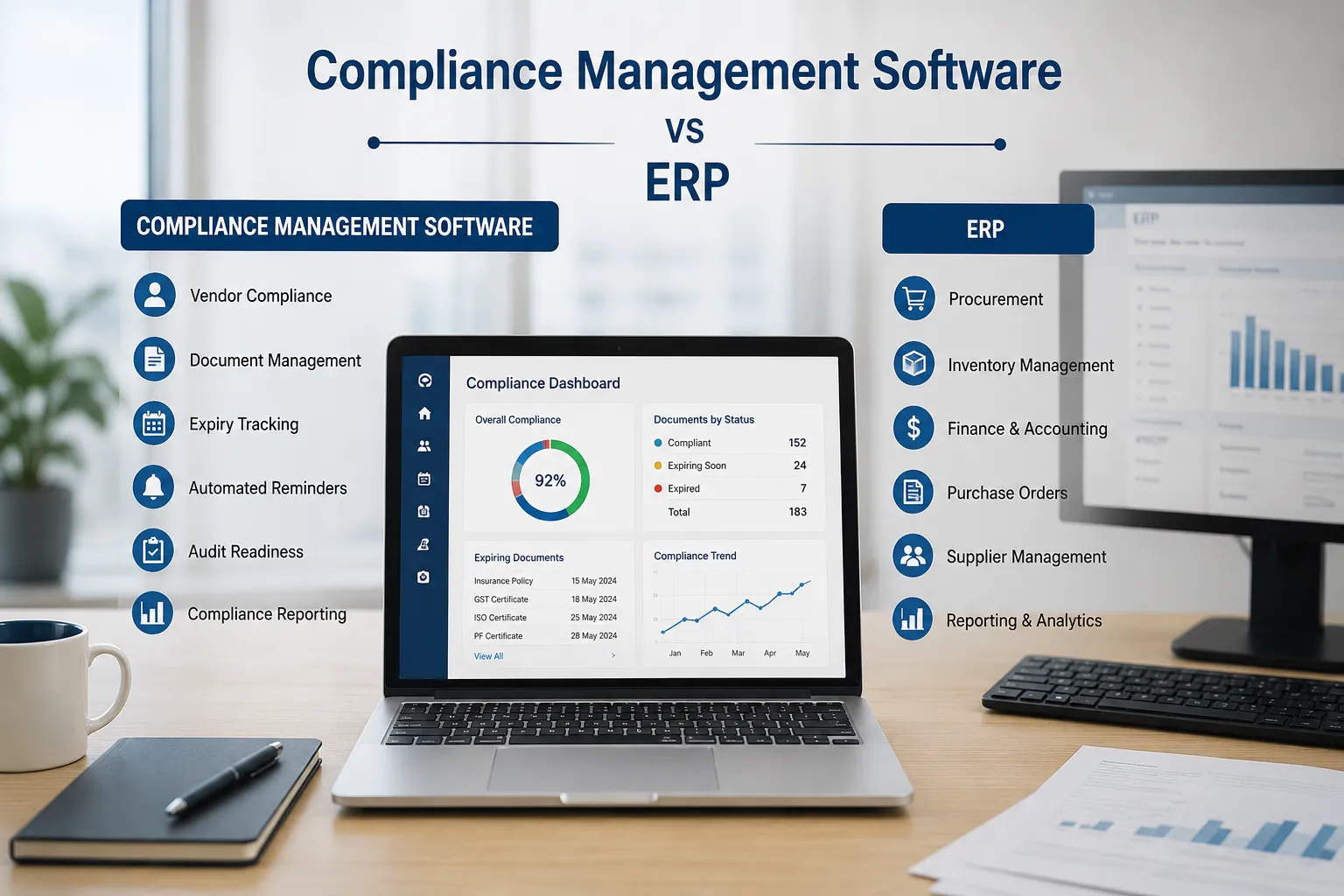
Compliance Management Software vs ERP: What’s the Difference?
Many organizations invest in Enterprise Resource Planning (ERP) systems to manage procurement, finance, inventory, manufacturing, and supplier information.
However, when compliance requirements become more complex, businesses often discover that their ERP system alone isn’t enough.
This is where Compliance Management Software comes into the picture.
Although both systems support business operations, they solve different problems.
ERP systems focus on managing business transactions, while compliance management software focuses on ensuring vendors, suppliers, contractors, and documents remain compliant with legal, contractual, and organizational requirements.
In this guide, we’ll explain the differences between Compliance Management Software and ERP systems, when each should be used, and why many organizations use both together.
What Is an ERP System?
Enterprise Resource Planning (ERP) software integrates multiple business functions into a single platform.
ERP systems commonly manage:
- Procurement
- Purchasing
- Finance
- Inventory
- Manufacturing
- Warehouse Management
- Supplier Master Data
- Sales
- Human Resources
Popular ERP solutions include:
- SAP
- Oracle
- Microsoft Dynamics 365
- Infor
- Epicor
ERP systems become the central system of record for business operations.
What Is Compliance Management Software?
Compliance Management Software helps organizations ensure suppliers, contractors, and service providers continue meeting statutory, contractual, and organizational requirements.
Typical compliance management activities include:
- Vendor onboarding
- Document collection
- Compliance verification
- Document expiry tracking
- Automated reminders
- Approval workflows
- Audit reporting
- Compliance dashboards
Rather than replacing ERP systems, compliance software extends them by managing compliance-related processes.
ERP vs Compliance Management Software
The following comparison highlights the primary differences.
| ERP System | Compliance Management Software |
|---|---|
| Procurement management | Compliance management |
| Purchase orders | Vendor document repository |
| Inventory management | Expiry tracking |
| Financial reporting | Automated reminders |
| Supplier master records | Compliance dashboards |
| Contract management | Audit readiness |
| Business transactions | Regulatory compliance |
| Workflow approvals | AI document validation |
Both systems complement one another.
What ERP Systems Do Well
ERP platforms excel at managing core business operations.
Key strengths include:
Procurement Management
Manage purchase requests, purchase orders, and supplier records.
Inventory Management
Track stock movement and warehouse operations.
Financial Management
Manage invoices, payments, budgeting, and accounting.
Manufacturing Planning
Support production planning and material requirements.
Contract Management
Maintain procurement contracts and agreements.
ERP systems provide an excellent operational foundation.
Where ERP Systems Fall Short
Although ERP systems store supplier information, they often provide limited compliance functionality.
Common limitations include:
No Automated Document Expiry Tracking
Most ERP systems do not continuously monitor compliance document validity.
Limited Document Validation
Uploading a document does not verify that it is correct, complete, or current.
Manual Compliance Monitoring
Procurement teams often manage compliance separately using spreadsheets.
Limited Compliance Dashboards
Real-time visibility into vendor compliance is often unavailable without customization.
Difficult Audit Preparation
Collecting compliance documents from multiple ERP attachments can be time-consuming.
What Compliance Management Software Does Well
Compliance management platforms specialize in monitoring supplier compliance throughout the vendor lifecycle.
Typical capabilities include:
Vendor Self-Service Portal
Allow vendors to upload and update compliance documents directly.
Centralized Document Repository
Maintain all compliance records in one location.
Automated Expiry Tracking
Receive notifications before important documents expire.
Approval Workflows
Route documents through structured approval processes.
Compliance Dashboards
Monitor vendor compliance using real-time reports.
Audit Readiness
Prepare for audits with organized documentation and complete audit trails.
Why Organizations Use Both
Many organizations integrate compliance management software with their ERP rather than replacing it.
A typical workflow looks like this:
ERP System
- Purchase Orders
- Vendor Master
- Finance
- Inventory
- Contracts
↓
Compliance Management Software
- Vendor onboarding
- Compliance verification
- Document management
- Expiry monitoring
- Compliance reporting
- Audit preparation
This combination allows each system to perform the tasks it was designed for.
Common Compliance Documents
Organizations typically manage:
Registration Documents
- GST Registration Certificate
- PAN Card
- MSME Certificate
Statutory Documents
- PF Registration Certificate
- ESIC Registration Certificate
- Labour License
- Factory License
Insurance Documents
- Workmen Compensation Insurance
- Public Liability Insurance
Employee Records
- Employee List
- Attendance Register
- Wage Register
- Salary Register
Safety Documents
- Safety Training Records
- PPE Compliance Records
- Risk Assessment Reports
Benefits of Compliance Management Software
Reduced Compliance Risk
Identify missing and expired documents before they become operational issues.
Better Audit Readiness
Maintain complete compliance records throughout the year.
Faster Vendor Onboarding
Automate document collection and approval workflows.
Improved Visibility
Monitor compliance using centralized dashboards.
Reduced Manual Work
Eliminate repetitive administrative activities.
Better Regulatory Compliance
Ensure vendors continuously meet statutory requirements.
Manual Process vs Compliance Management Software
| Manual Process | Compliance Management Software |
|---|---|
| Excel spreadsheets | Centralized repository |
| Manual reminders | Automated notifications |
| Shared folders | Digital document management |
| Email follow-ups | Vendor self-service portal |
| Manual reporting | Compliance dashboards |
| Difficult audits | Audit-ready reports |
How AI Is Transforming Compliance Management
Modern compliance platforms increasingly use AI to:
- Identify document types automatically
- Extract expiry dates
- Validate uploaded documents
- Detect missing information
- Reduce manual verification
- Improve compliance accuracy
AI allows procurement teams to spend less time reviewing paperwork and more time managing supplier relationships.
How VendorCompliancePro Helps
VendorCompliancePro complements existing ERP systems by providing:
- Vendor self-service portal
- Centralized compliance document repository
- Automated expiry reminders
- Approval workflows
- Compliance dashboards
- Audit-ready reporting
- Role-based access
- Audit trails
- AI-powered document validation
Organizations can continue using their ERP for procurement and finance while using VendorCompliancePro to automate vendor compliance and improve audit readiness.
Frequently Asked Questions
Can ERP systems manage vendor compliance?
ERP systems can store supplier information and documents, but they often lack specialized features such as expiry tracking, automated reminders, compliance dashboards, and AI-powered document validation.
Should compliance management software replace ERP?
No. Compliance management software is designed to complement ERP systems, not replace them.
Why do organizations use both systems?
ERP systems manage procurement, inventory, finance, and business transactions, while compliance management software manages vendor documents, compliance monitoring, audit readiness, and regulatory requirements.
What are the benefits of compliance management software?
Organizations gain improved compliance visibility, reduced manual work, automated expiry tracking, faster vendor onboarding, and better audit readiness.
Which industries benefit from compliance management software?
Manufacturing, logistics, warehousing, engineering, construction, healthcare, pharmaceuticals, and facility management organizations commonly use compliance management software.
Conclusion
ERP systems are essential for managing core business operations, but they are not designed to solve every compliance challenge.
Compliance Management Software fills this gap by automating document management, expiry tracking, compliance monitoring, and audit preparation.
Rather than choosing one over the other, organizations achieve the best results by combining ERP systems with dedicated compliance management software.
This approach improves operational efficiency, reduces compliance risks, and helps businesses remain audit-ready throughout the year.
Related Articles
- Why ERP Systems Alone Can’t Solve Vendor Compliance
- Procurement Compliance Explained
- Vendor Compliance vs Vendor Management
- Vendor Compliance Software India
- How to Prepare for a Vendor Compliance Audit