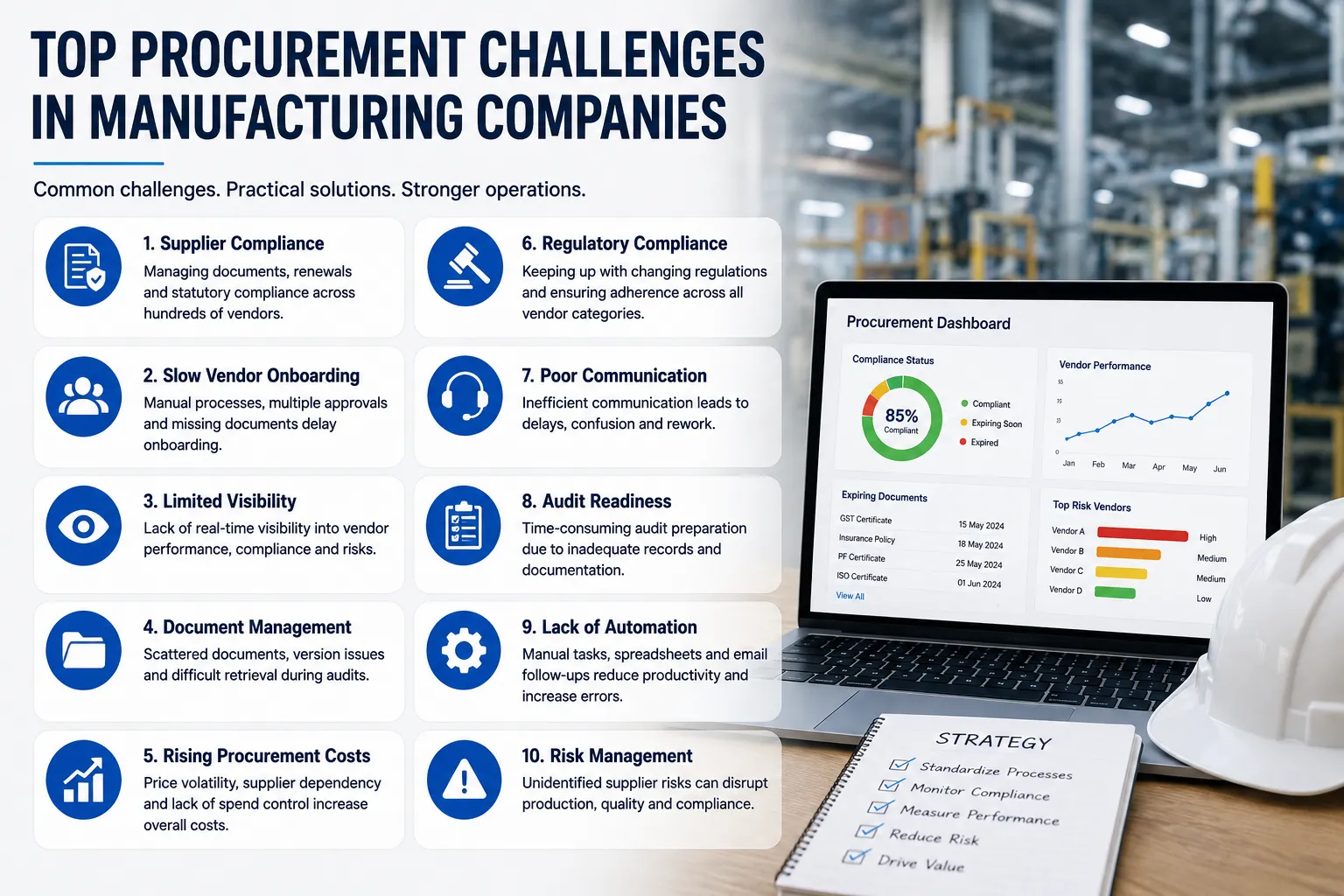
Top Procurement Challenges in Manufacturing Companies (And How to Overcome Them)
Procurement plays a critical role in manufacturing operations. Every production line depends on the timely availability of raw materials, spare parts, maintenance services, logistics providers, and contractors.
Even a small disruption in procurement can delay production, increase operational costs, and affect customer deliveries.
Today’s procurement teams are expected to do much more than negotiate prices. They must manage supplier relationships, ensure vendor compliance, reduce procurement risks, maintain regulatory compliance, and improve operational efficiency.
In this guide, we’ll explore the biggest procurement challenges manufacturing companies face and practical strategies to overcome them.
Why Procurement Is Critical in Manufacturing
Manufacturing companies depend on an extensive supplier ecosystem.
Typical procurement categories include:
- Raw materials
- Packaging materials
- Machinery and spare parts
- Logistics services
- Labour contractors
- Maintenance contractors
- Housekeeping services
- Security services
- Industrial consumables
Any delay in procurement can directly impact production schedules and business performance.
Common Procurement Challenges
1. Supplier Compliance Management
Managing compliance across hundreds of suppliers is one of the biggest procurement challenges.
Organizations must continuously monitor documents such as:
- GST Registration Certificate
- PAN Card
- MSME Certificate
- PF Registration
- ESIC Registration
- Labour License
- Insurance Policies
Missing or expired documents increase legal and operational risks.
Solution
Implement a centralized vendor compliance system with automated document tracking and expiry reminders.
2. Slow Vendor Onboarding
Many organizations still onboard vendors through manual processes involving emails, spreadsheets, and paper documents.
Common delays occur because of:
- Missing documents
- Multiple approval levels
- Manual verification
- Poor communication
Solution
Use digital onboarding workflows with vendor self-service portals and automated approval processes.
3. Limited Supplier Visibility
Procurement managers often struggle to answer questions such as:
- Which suppliers are approved?
- Which vendors are non-compliant?
- Which contracts expire soon?
- Which suppliers require attention?
Without centralized dashboards, decision-making becomes reactive.
Solution
Use procurement dashboards that provide real-time supplier visibility.
4. Manual Document Management
Vendor documents are often stored across:
- Email inboxes
- Shared folders
- ERP attachments
- Local drives
- Paper files
Finding documents during audits becomes difficult.
Solution
Maintain a centralized document repository with role-based access.
5. Managing Vendor Performance
Supplier performance affects:
- Product quality
- Delivery timelines
- Production schedules
- Customer satisfaction
Many organizations measure performance manually.
Solution
Track supplier KPIs such as delivery performance, quality issues, response time, and compliance status.
6. Rising Procurement Costs
Increasing material prices, transportation costs, and supplier shortages directly affect procurement budgets.
Solution
Develop long-term supplier relationships, diversify sourcing, and continuously evaluate procurement strategies.
7. Regulatory Compliance
Manufacturing companies must comply with various statutory and industry requirements.
These often include:
- Labour regulations
- Tax compliance
- Environmental regulations
- Safety standards
- Industry certifications
Monitoring compliance manually becomes increasingly difficult.
Solution
Automate compliance monitoring and document verification.
8. Poor Communication with Vendors
Communication delays often occur because procurement teams rely on:
- Phone calls
- Spreadsheets
Vendors frequently ask for onboarding updates and document status.
Solution
Provide vendors with a self-service portal that allows them to upload documents and track approvals.
9. Audit Readiness
Internal and external audits often require procurement teams to produce:
- Vendor documents
- Approval history
- Contracts
- Compliance reports
- Audit trails
Collecting this information manually is time-consuming.
Solution
Maintain audit-ready documentation throughout the year rather than preparing only when audits are scheduled.
10. Lack of Procurement Automation
Many procurement departments still perform repetitive activities manually.
Examples include:
- Vendor registration
- Document verification
- Expiry tracking
- Reminder emails
- Compliance reporting
These activities consume valuable time.
Solution
Automate repetitive procurement workflows using modern procurement and vendor compliance software.
Common Procurement Documents
Manufacturing companies commonly manage the following documents.
Vendor Registration Documents
- GST Registration Certificate
- PAN Card
- MSME Certificate
Compliance Documents
- PF Registration Certificate
- ESIC Registration Certificate
- Labour License
- Factory License
Insurance Documents
- Workmen Compensation Insurance
- Public Liability Insurance
Contracts
- Service Agreements
- Purchase Agreements
- Non-Disclosure Agreements
Employee Records
- Employee List
- Attendance Register
- Wage Register
- Salary Register
Manual Procurement vs Digital Procurement
| Traditional Procurement | Modern Procurement |
|---|---|
| Excel spreadsheets | Centralized platform |
| Email communication | Vendor self-service portal |
| Manual approvals | Workflow automation |
| Paper documents | Digital repository |
| Manual reporting | Real-time dashboards |
| Reactive compliance | Continuous monitoring |
Best Practices for Manufacturing Procurement
Standardize Procurement Processes
Create consistent procurement workflows across departments.
Centralize Supplier Information
Maintain supplier documents in one secure location.
Automate Vendor Compliance
Monitor document validity and renewals automatically.
Measure Supplier Performance
Review supplier KPIs regularly.
Conduct Procurement Reviews
Review supplier performance and compliance every quarter.
Invest in Digital Procurement Tools
Reduce manual work through automation.
How AI Is Transforming Manufacturing Procurement
Modern AI-powered procurement solutions help organizations:
- Classify supplier documents automatically
- Extract information from documents
- Detect expiry dates
- Validate compliance records
- Identify procurement risks
- Improve supplier onboarding
AI enables procurement teams to focus more on strategic sourcing and supplier relationships.
How VendorCompliancePro Helps
VendorCompliancePro supports manufacturing procurement teams by providing:
- Vendor self-service portal
- Centralized document repository
- Automated expiry reminders
- Approval workflows
- Compliance dashboards
- Audit-ready reports
- AI-powered document validation
- Role-based access
Organizations can improve procurement efficiency while reducing compliance risks and administrative effort.
Frequently Asked Questions
What is the biggest procurement challenge in manufacturing?
Managing supplier compliance, vendor onboarding, document management, and maintaining audit readiness are among the biggest procurement challenges.
Why is vendor compliance important in procurement?
Vendor compliance ensures suppliers continue meeting statutory, contractual, and organizational requirements, reducing operational and regulatory risks.
How can procurement processes be improved?
Organizations can improve procurement by automating vendor onboarding, document management, compliance tracking, approval workflows, and reporting.
Can ERP systems solve procurement challenges?
ERP systems manage procurement transactions effectively but often require specialized vendor compliance solutions for document tracking, expiry monitoring, and audit readiness.
How does AI improve procurement?
AI automates document verification, OCR, expiry tracking, compliance monitoring, and supplier onboarding, allowing procurement teams to work more efficiently.
Conclusion
Procurement in manufacturing is becoming increasingly complex as organizations manage larger supplier networks, stricter regulations, and growing compliance requirements.
By standardizing procurement processes, automating vendor compliance, centralizing documentation, and leveraging AI-powered solutions, manufacturing companies can reduce procurement risks, improve supplier relationships, and ensure uninterrupted business operations.
Modern procurement is no longer just about purchasing materials—it’s about building a compliant, efficient, and resilient supplier ecosystem.
Related Articles
- Procurement Compliance Explained
- Vendor Compliance Best Practices for Manufacturing Companies
- Vendor Compliance vs Vendor Management
- How to Prepare for a Vendor Compliance Audit
- Vendor Compliance Software India