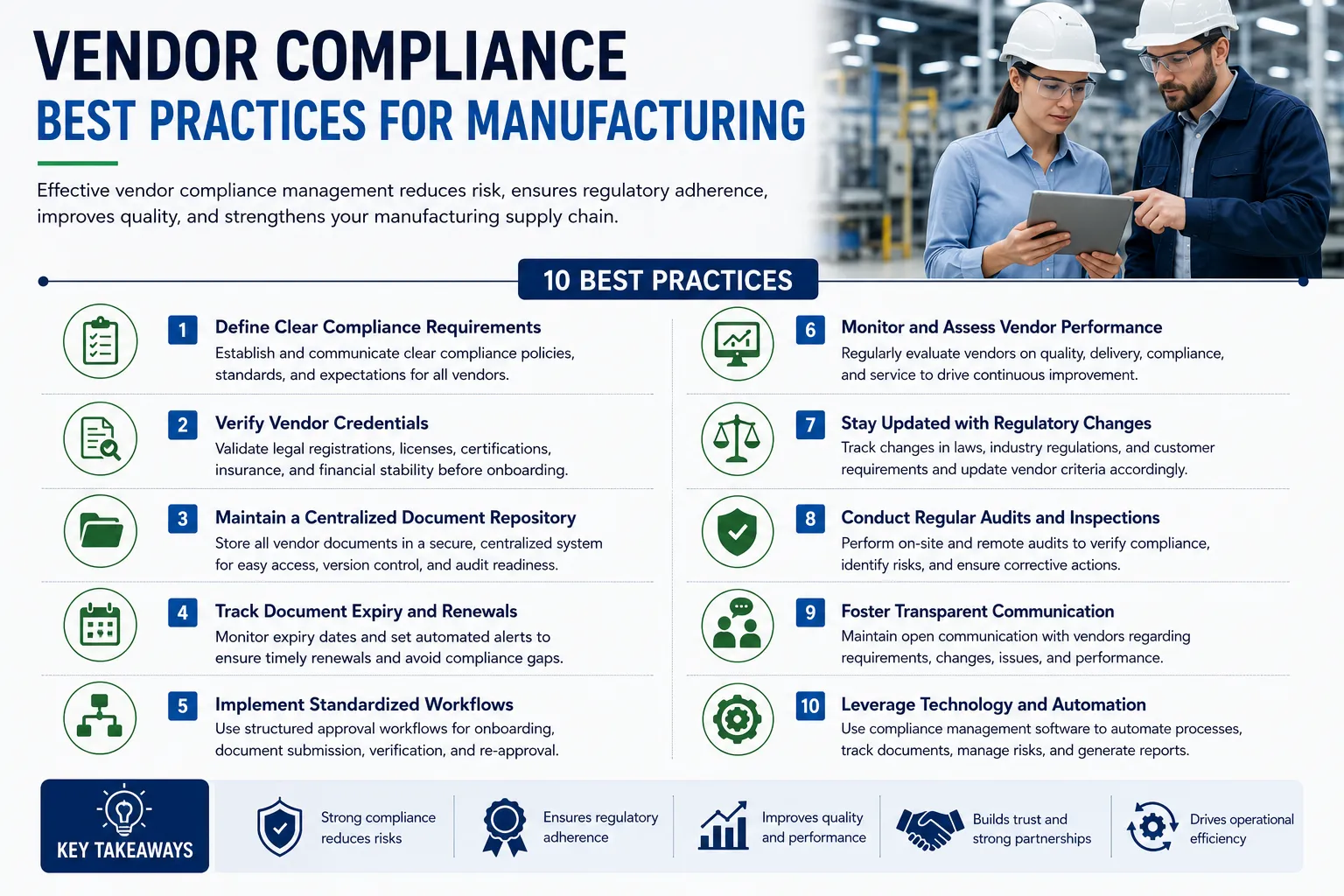
Vendor Compliance Best Practices for Manufacturing Companies
Manufacturing companies depend on hundreds of suppliers, contractors, transport vendors, maintenance teams, and service providers to keep operations running smoothly.
However, managing these external partners isn’t just about purchasing materials or services—it also requires ensuring every vendor complies with legal, statutory, contractual, and organizational requirements.
Without a structured vendor compliance process, manufacturers may face production delays, failed audits, safety risks, regulatory penalties, and unnecessary operational disruptions.
In this guide, we’ll explore the best vendor compliance practices manufacturing companies can implement to improve efficiency, reduce risks, and remain audit-ready.
Why Vendor Compliance Is Critical for Manufacturing
Manufacturing environments operate under strict regulatory and safety requirements.
Vendors often work inside factories, warehouses, and production facilities where compliance is essential.
Poor vendor compliance can result in:
- Production interruptions
- Safety incidents
- Regulatory penalties
- Audit findings
- Legal liabilities
- Delayed vendor payments
- Increased operational risk
A structured compliance program helps organizations prevent these issues before they affect operations.
Common Vendors in Manufacturing Companies
Manufacturing organizations commonly work with:
- Raw material suppliers
- Packaging suppliers
- Logistics providers
- Labour contractors
- Machine maintenance contractors
- Housekeeping agencies
- Security agencies
- Electrical contractors
- Civil contractors
- Facility management companies
Each vendor category requires different compliance documents and approval processes.
Common Compliance Documents
Manufacturing companies typically collect the following documents.
Business Registration Documents
- GST Registration Certificate
- PAN Card
- MSME Certificate
- Certificate of Incorporation
Statutory Documents
- PF Registration Certificate
- ESIC Registration Certificate
- Labour License
- Factory License (where applicable)
Insurance Documents
- Workmen Compensation Insurance
- Public Liability Insurance
- Professional Indemnity Insurance
Employee Records
- Employee List
- Attendance Register
- Wage Register
- Salary Register
Safety Documents
- Safety Training Records
- PPE Compliance Records
- Risk Assessment Reports
- Safety Certifications
Best Practices for Vendor Compliance
1. Standardize Vendor Requirements
Different vendor categories require different compliance documents.
For example:
- Labour contractors require employee-related records.
- Logistics vendors require vehicle and insurance documents.
- Maintenance contractors require safety certifications.
Create standardized document checklists for every vendor category.
2. Centralize Vendor Documentation
Avoid storing compliance documents in:
- Email inboxes
- Shared folders
- Local computers
- Paper files
Instead, maintain a centralized digital repository where procurement teams can easily access the latest documents.
3. Automate Document Expiry Tracking
Many compliance documents have validity periods.
Examples include:
- Labour Licenses
- Insurance Policies
- ISO Certifications
- Pollution Control Certificates
- Factory Licenses
Automated reminders help vendors renew documents before they expire.
4. Verify Documents Before Approval
Collecting documents alone is not enough.
Ensure every document is:
- Valid
- Complete
- Readable
- Uploaded by the correct vendor
- Not expired
Verification before approval reduces future compliance issues.
5. Implement Vendor Self-Service
Allow vendors to:
- Upload documents
- Update company information
- Track approval status
- Respond to compliance requests
Self-service portals reduce manual communication and improve vendor experience.
6. Automate Approval Workflows
Vendor approvals often involve multiple departments.
Typical approvers include:
- Procurement
- Finance
- Compliance
- Operations
- Safety
- HR
Automated workflows reduce delays and improve accountability.
7. Conduct Regular Compliance Reviews
Don’t wait until an audit begins.
Schedule:
- Monthly reviews
- Quarterly compliance audits
- Annual vendor assessments
Regular reviews help identify compliance gaps early.
8. Maintain Complete Audit Trails
Track every compliance activity including:
- Document uploads
- Approvals
- Renewals
- Rejections
- User activities
Audit trails improve transparency during inspections.
9. Monitor Compliance Through Dashboards
Procurement managers should be able to answer questions such as:
- Which vendors are compliant?
- Which documents expire this month?
- Which vendors require immediate attention?
- Which contractor licenses have expired?
Real-time dashboards provide complete visibility.
10. Continuously Improve Compliance Processes
Regulations change over time.
Review and update compliance requirements regularly to reflect:
- New regulations
- Internal policies
- Customer requirements
- Industry standards
Continuous improvement keeps compliance programs effective.
Common Vendor Compliance Challenges
Manufacturing companies frequently experience:
Manual Document Collection
Documents are requested through email.
Spreadsheet Tracking
Expiry dates are managed manually.
Scattered Documentation
Records are stored across multiple systems.
Missed Renewals
Important licenses expire unnoticed.
Limited Visibility
Management cannot easily identify compliance risks.
Time-Consuming Audits
Preparing for audits requires significant manual effort.
Manual Process vs Automated Vendor Compliance
| Manual Process | Automated Compliance |
|---|---|
| Excel spreadsheets | Centralized repository |
| Manual reminders | Automated notifications |
| Email follow-ups | Vendor self-service portal |
| Shared folders | Digital document management |
| Manual reporting | Compliance dashboards |
| Difficult audits | Audit-ready reports |
Benefits of Following Vendor Compliance Best Practices
Reduced Compliance Risk
Identify compliance gaps before they become operational issues.
Better Audit Readiness
Maintain organized documentation throughout the year.
Faster Vendor Onboarding
Reduce onboarding delays through standardized processes.
Increased Operational Efficiency
Automate repetitive administrative tasks.
Improved Vendor Relationships
Provide a structured and transparent compliance process.
Better Decision Making
Use dashboards and reports to monitor compliance across all vendors.
How AI Is Transforming Vendor Compliance
Modern AI-powered compliance platforms help manufacturing companies:
- Identify document types automatically
- Extract expiry dates
- Detect missing information
- Validate uploaded documents
- Reduce manual verification
- Improve compliance accuracy
AI enables procurement teams to manage hundreds of vendors more efficiently.
How VendorCompliancePro Helps
VendorCompliancePro simplifies vendor compliance management for manufacturing companies through:
- Centralized vendor document repository
- Vendor self-service portal
- Automated expiry reminders
- Approval workflows
- Compliance dashboards
- Audit-ready reporting
- Role-based access
- Audit trails
- AI-powered document validation
Organizations can reduce manual work, improve compliance visibility, and remain audit-ready throughout the year.
Frequently Asked Questions
Why is vendor compliance important in manufacturing?
Manufacturing companies work with multiple suppliers and contractors who must meet statutory, safety, and contractual requirements. Proper compliance reduces operational risks and improves audit readiness.
Which compliance documents are commonly required?
Organizations typically collect GST registration, PAN card, PF registration, ESIC registration, labour licenses, insurance policies, safety records, and employee registers.
How often should vendor compliance be reviewed?
Most manufacturing companies review vendor compliance monthly or quarterly, depending on business and regulatory requirements.
Can ERP systems manage vendor compliance?
ERP systems can store supplier information but often lack specialized features such as automated expiry tracking, compliance dashboards, vendor portals, and document validation.
How can manufacturing companies improve vendor compliance?
By centralizing documentation, automating reminders, standardizing compliance requirements, implementing approval workflows, and using dedicated vendor compliance software.
Conclusion
Vendor compliance is a critical component of manufacturing operations.
By implementing standardized processes, centralizing documentation, automating compliance monitoring, and leveraging AI-powered tools, manufacturing companies can reduce operational risks, improve supplier accountability, and remain audit-ready throughout the year.
A proactive compliance strategy not only protects the business but also creates stronger relationships with suppliers and contractors while improving procurement efficiency.
Related Articles
- What Is Vendor Compliance?
- Vendor Compliance Checklist India
- Procurement Compliance Explained
- How to Prepare for a Vendor Compliance Audit
- Vendor Compliance Software India