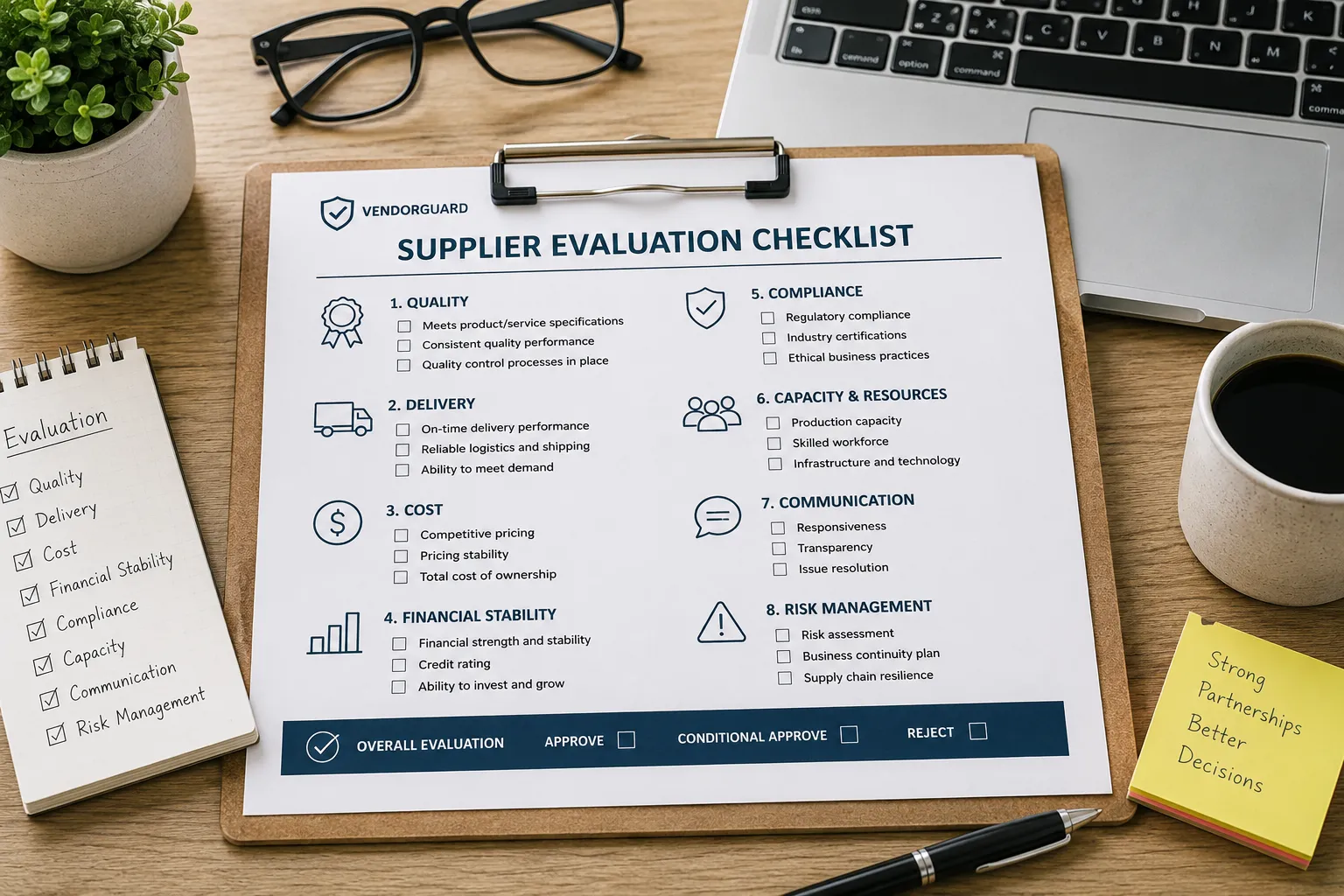
Supplier Evaluation Checklist: Complete Guide for Indian Businesses (2026)
Selecting the right supplier is only the beginning of building a reliable supply chain. To maintain consistent product quality, timely deliveries, and regulatory compliance, organizations must regularly evaluate supplier performance.
Many businesses approve suppliers during onboarding but rarely assess their ongoing performance. Over time, suppliers may experience financial challenges, quality issues, compliance gaps, or operational inefficiencies that can negatively impact your business.
A structured Supplier Evaluation Checklist helps procurement and compliance teams measure supplier performance using objective criteria. Regular supplier evaluations improve purchasing decisions, reduce operational risks, strengthen supplier relationships, and ensure continuous improvement.
Whether you’re managing manufacturing suppliers, logistics providers, contractors, or service vendors, a standardized evaluation process helps ensure every supplier continues to meet your organization’s expectations.
In this guide, we’ll explain what supplier evaluation is, why it matters, provide a practical supplier evaluation checklist, share best practices, discuss common mistakes, and answer frequently asked questions.
What Is Supplier Evaluation?
Supplier evaluation is the process of assessing a supplier’s performance against predefined business, quality, operational, and compliance criteria.
Unlike supplier qualification, which occurs before a supplier is approved, supplier evaluation is an ongoing activity performed throughout the supplier relationship.
The objective is to determine whether suppliers continue to meet organizational expectations regarding:
- Product quality
- Delivery performance
- Regulatory compliance
- Cost competitiveness
- Customer service
- Financial stability
- Risk management
- Continuous improvement
Organizations commonly perform supplier evaluations annually, quarterly, or after significant projects.
Why Supplier Evaluation Is Important
Even suppliers with an excellent track record can experience changes that affect performance.
Examples include:
- Declining product quality
- Delayed deliveries
- Expired compliance documents
- Financial instability
- Increased customer complaints
- Capacity limitations
- Regulatory violations
A structured supplier evaluation process helps organizations identify these issues early and take corrective action before they affect business operations.
Supplier evaluation helps organizations:
- Improve supplier performance
- Reduce procurement risks
- Strengthen quality management
- Improve regulatory compliance
- Build long-term supplier relationships
- Improve supply chain resilience
- Support continuous improvement
- Maintain audit readiness
Supplier Evaluation Checklist
The following checklist covers the most important areas organizations should evaluate.
1. Company Information
Verify that supplier information remains accurate.
Review:
- Company Name
- Registered Address
- Contact Details
- Business Registration
- Ownership Changes
- Key Management
Keeping supplier information updated supports effective communication and compliance.
2. Compliance Status
Ensure statutory registrations and licenses remain valid.
Verify:
- GST Registration
- PAN Details
- Udyam Registration
- Factory License
- Labour License
- Fire NOC
- Pollution Control Board Consent
- Professional Tax Registration
Expired registrations should be renewed promptly.
3. Document Compliance
Review vendor compliance documentation.
Typical documents include:
- PF Registration
- ESIC Registration
- Insurance Certificates
- ISO Certifications
- Labour Compliance Documents
- Monthly PF Challans
- Monthly ESIC Challans
Organizations managing contractors often review these documents monthly.
4. Product or Service Quality
Assess whether products or services consistently meet expectations.
Evaluation criteria include:
- Defect Rate
- Product Reliability
- Inspection Results
- Customer Complaints
- Product Returns
- Corrective Actions
Quality should be measured using objective performance data whenever possible.
5. Delivery Performance
Reliable delivery is critical to business continuity.
Review:
- On-Time Delivery Percentage
- Lead Time
- Delivery Accuracy
- Emergency Response
- Shipment Quality
Suppliers with poor delivery performance should receive corrective action plans.
6. Pricing and Cost Competitiveness
Evaluate whether the supplier continues to provide competitive pricing.
Consider:
- Market Price Comparison
- Cost Stability
- Payment Terms
- Value for Money
- Cost Reduction Initiatives
Price should never be the only evaluation criterion.
7. Financial Stability
A financially stable supplier is more likely to support long-term business relationships.
Review:
- Financial Statements
- Credit Rating
- Years in Business
- Business Growth
- Payment History
High-risk suppliers may require more frequent reviews.
8. Customer Service and Communication
Good communication improves supplier relationships.
Evaluate:
- Response Time
- Technical Support
- Complaint Resolution
- Professionalism
- Collaboration
Strong communication often leads to faster issue resolution.
9. Operational Capability
Review whether the supplier can continue supporting future business growth.
Assess:
- Manufacturing Capacity
- Workforce
- Equipment
- Warehouse Facilities
- Technology
- Production Planning
Operational capability becomes increasingly important as business volumes increase.
10. Continuous Improvement
Evaluate the supplier’s commitment to improvement.
Look for:
- Process Improvements
- Quality Initiatives
- Employee Training
- Technology Investments
- Sustainability Programs
- Innovation
Suppliers committed to continuous improvement generally become stronger long-term partners.
Supplier Evaluation Scorecard
Many organizations use a weighted scorecard for objective evaluations.
| Evaluation Area | Suggested Weight |
|---|---|
| Product Quality | 30% |
| Delivery Performance | 20% |
| Compliance | 15% |
| Cost Competitiveness | 10% |
| Customer Service | 10% |
| Technical Capability | 10% |
| Financial Stability | 5% |
Organizations may adjust these weightings based on industry requirements.
Supplier Evaluation vs Supplier Qualification
These two processes serve different purposes.
| Supplier Qualification | Supplier Evaluation |
|---|---|
| Conducted before approval | Conducted after approval |
| Determines supplier eligibility | Measures ongoing performance |
| Focuses on capability | Focuses on actual results |
| Includes document verification | Includes performance monitoring |
| One-time or occasional activity | Periodic activity |
Supplier qualification determines whether a supplier should be approved, while supplier evaluation ensures they continue meeting expectations.
Best Practices for Supplier Evaluation
Organizations with mature supplier management programs typically follow these best practices.
- Use standardized evaluation criteria.
- Define measurable KPIs.
- Perform evaluations at regular intervals.
- Maintain digital supplier records.
- Review compliance documents before expiry.
- Conduct supplier performance meetings.
- Share evaluation results with suppliers.
- Track corrective actions until completion.
Consistent evaluations help organizations improve supplier performance over time.
Common Mistakes to Avoid
Many organizations conduct supplier evaluations inconsistently or rely on subjective opinions.
Common mistakes include:
- Evaluating suppliers only during audits.
- Measuring suppliers based only on price.
- Ignoring compliance document expiry.
- Not documenting evaluation results.
- Using inconsistent scoring methods.
- Delaying corrective actions.
- Never reviewing supplier performance trends.
- Managing supplier records using spreadsheets alone.
Avoiding these mistakes leads to better procurement decisions and stronger supplier relationships.
Why Organizations Automate Supplier Evaluations
As supplier databases grow, manual evaluation processes become increasingly difficult to manage.
Challenges include:
- Spreadsheet errors
- Manual reminders
- Missing compliance documents
- Inconsistent evaluations
- Difficult reporting
- No approval history
- Poor visibility
Modern vendor compliance software helps organizations centralize supplier information, automate compliance tracking, generate performance reports, maintain audit trails, and improve supplier visibility.
Frequently Asked Questions
What is a supplier evaluation checklist?
A supplier evaluation checklist is a structured framework used to assess supplier performance based on quality, delivery, compliance, financial stability, customer service, and operational capability.
Why is supplier evaluation important?
Supplier evaluation helps organizations improve supplier performance, reduce procurement risks, maintain compliance, and strengthen long-term supplier relationships.
How often should suppliers be evaluated?
Most organizations evaluate critical suppliers quarterly or annually. High-risk suppliers may require more frequent reviews.
What KPIs are commonly used for supplier evaluation?
Common KPIs include product quality, on-time delivery, defect rate, compliance status, response time, customer complaints, and corrective action completion.
What is the difference between supplier qualification and supplier evaluation?
Supplier qualification occurs before approval and determines supplier eligibility. Supplier evaluation is an ongoing process that measures supplier performance after approval.
Can supplier evaluations be automated?
Yes. Vendor compliance software can automate document tracking, supplier scorecards, compliance monitoring, performance reporting, approval workflows, and audit readiness.
Conclusion
Supplier evaluation is an essential part of effective supplier management. Regular evaluations help organizations monitor supplier performance, reduce operational risks, improve compliance, and strengthen supply chain reliability.
By using a standardized supplier evaluation checklist, procurement teams can make objective decisions based on measurable criteria rather than assumptions or past experience.
As supplier networks continue to grow, managing evaluations through spreadsheets and emails becomes increasingly difficult. Organizations can improve efficiency, visibility, and audit readiness by adopting dedicated vendor compliance software that centralizes supplier information and automates performance monitoring.