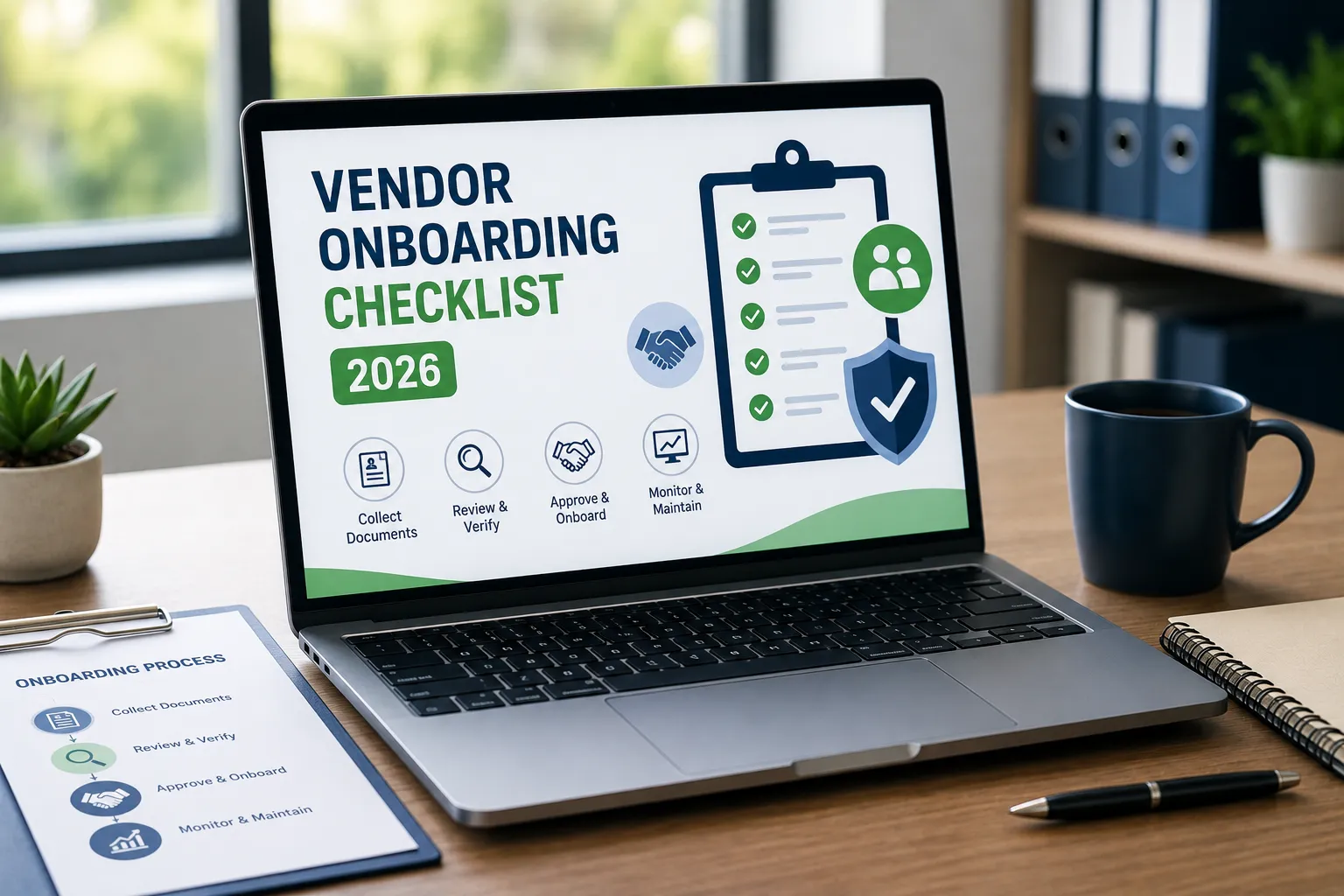
Vendor Onboarding Checklist (2026): Complete Procurement Guide
Vendor onboarding is one of the most important processes in procurement. Yet many organizations still rely on emails, spreadsheets, and manual follow-ups to collect vendor information and compliance documents.
The result?
- Delayed purchase orders
- Missing compliance documents
- Increased procurement workload
- Audit findings
- Higher vendor risks
An effective vendor onboarding checklist helps procurement teams standardize the onboarding process, reduce manual effort, and ensure every supplier meets legal, financial, and compliance requirements before doing business.
In this complete guide, you’ll learn everything procurement teams need to know about creating a vendor onboarding checklist in 2026.
What Is Vendor Onboarding?
Vendor onboarding is the process of collecting, verifying, approving, and registering a new supplier before they can provide goods or services to an organization.
The onboarding process typically includes:
- Vendor registration
- Business verification
- Compliance document collection
- Financial verification
- Risk assessment
- Internal approvals
- Vendor activation
A structured onboarding process ensures every vendor is qualified before procurement begins.
Why Is Vendor Onboarding Important?
A poor onboarding process creates unnecessary risks for the organization.
Without proper onboarding, companies may unknowingly work with vendors who have:
- Expired licenses
- Invalid GST registrations
- Missing insurance certificates
- Financial instability
- Regulatory compliance issues
- Incomplete documentation
A standardized checklist eliminates these risks and creates a repeatable procurement process.
Benefits of a Vendor Onboarding Checklist
Organizations using a structured onboarding checklist experience several advantages:
- Faster vendor approvals
- Improved procurement efficiency
- Reduced compliance risks
- Better document management
- Consistent onboarding across departments
- Improved audit readiness
- Better supplier relationships
- Reduced manual follow-ups
Instead of reinventing the process for every supplier, procurement teams follow the same proven workflow.
Complete Vendor Onboarding Checklist (2026)
Below is a comprehensive checklist that procurement teams can use for onboarding new vendors.
Step 1: Collect Basic Vendor Information
Begin by gathering essential business information.
Typical details include:
- Company Name
- Legal Entity Name
- Registered Address
- Corporate Office Address
- Contact Person
- Email Address
- Phone Number
- Website
- Business Type
- Industry
- Year of Incorporation
This information forms the foundation of the vendor master record.
Step 2: Verify Business Registration
Verify that the supplier is a legally registered business.
Common documents include:
- Certificate of Incorporation
- Business Registration Certificate
- Partnership Deed
- LLP Registration
- Trade License
- Company PAN
Always verify the authenticity of these documents before approval.
Step 3: Collect Tax Documents
Tax compliance is mandatory before engaging vendors.
Typical documents include:
- GST Registration Certificate
- PAN Card
- TAN (if applicable)
- MSME/Udyam Registration
- Tax Residency Certificate (international suppliers)
Verify that the registration numbers are valid and active.
Step 4: Collect Banking Information
Finance teams usually require:
- Cancelled Cheque
- Bank Account Details
- IFSC Code
- Bank Verification Letter
- Account Holder Name
Proper verification helps prevent payment fraud.
Step 5: Review Compliance Documents
Compliance requirements vary depending on industry and vendor type.
Common compliance documents include:
- Labour License
- Factory License
- PF Registration
- ESIC Registration
- Professional Tax Registration
- Shop & Establishment License
- Fire Safety Certificate
- Environmental Clearance
- Pollution Control Certificate
Organizations should maintain a checklist based on applicable regulations.
Step 6: Verify Insurance Coverage
Many organizations require vendors to maintain valid insurance.
Examples include:
- General Liability Insurance
- Workers Compensation
- Professional Indemnity Insurance
- Product Liability Insurance
- Cyber Insurance
- Vehicle Insurance
Track expiry dates and request renewals before expiration.
Step 7: Perform Vendor Risk Assessment
Not every supplier presents the same level of risk.
Evaluate vendors based on:
- Financial stability
- Operational capability
- Regulatory compliance
- Cybersecurity maturity
- Geographic risks
- Business continuity
- Reputation
- Legal disputes
Assign a risk score before approval.
Step 8: Conduct Financial Due Diligence
Finance teams may evaluate:
- Annual revenue
- Credit rating
- Financial statements
- Outstanding litigation
- Tax compliance history
- Bankruptcy records
Financially unstable vendors can disrupt the supply chain.
Step 9: Review Quality Certifications
Manufacturing organizations often require quality certifications.
Examples include:
- ISO 9001
- ISO 14001
- ISO 45001
- ISO 27001
- IATF 16949
- HACCP
- GMP Certification
Collect copies and monitor expiration dates.
Step 10: Verify Vendor Capability
Evaluate whether the supplier can meet business requirements.
Assessment areas include:
- Production capacity
- Delivery capability
- Lead times
- Equipment
- Workforce
- Previous customers
- References
- Technical expertise
Capability assessments reduce procurement risks.
Step 11: Internal Review and Approvals
After document verification, obtain approvals from relevant stakeholders.
Typical approval workflow:
- Procurement Review
- Compliance Review
- Finance Approval
- Legal Approval
- Business Unit Approval
- Final Procurement Head Approval
Automated approval workflows significantly reduce delays.
Step 12: Create Vendor Master Record
Once approved:
- Assign Vendor ID
- Create Vendor Profile
- Upload verified documents
- Configure payment terms
- Assign categories
- Define contacts
- Activate vendor
The supplier is now ready for procurement activities.
Essential Vendor Onboarding Documents
Most procurement teams collect the following documents:
| Document | Mandatory | Expiry Tracking |
|---|---|---|
| GST Registration | Yes | No |
| PAN Card | Yes | No |
| Certificate of Incorporation | Yes | No |
| MSME Certificate | Optional | No |
| PF Registration | Industry Specific | Yes |
| ESIC Registration | Industry Specific | Yes |
| Labour License | Industry Specific | Yes |
| Insurance Certificate | Often Required | Yes |
| Bank Details | Yes | No |
| ISO Certificate | Optional | Yes |
Common Vendor Onboarding Challenges
Many procurement teams struggle with similar issues.
Missing Documents
Vendors submit incomplete information.
Result:
- Delayed approvals
- Multiple follow-ups
- Procurement delays
Email-Based Document Collection
Documents become scattered across:
- Shared folders
- Local computers
- Cloud drives
Finding documents later becomes difficult.
Manual Approval Process
Approvals are delayed because requests move through long email chains.
Workflow automation significantly reduces turnaround time.
Expired Compliance Documents
Many organizations approve vendors once but never track document renewals.
Expired documents expose organizations to compliance risks.
Duplicate Vendor Records
Without centralized onboarding, duplicate vendor profiles become common.
Duplicate records create confusion for procurement and finance teams.
Best Practices for Vendor Onboarding in 2026
Leading procurement teams follow these best practices:
Standardize the Checklist
Every vendor should follow the same onboarding process.
Use Digital Forms
Replace paper forms and email attachments with online vendor registration.
Automate Document Collection
Allow vendors to upload documents through a secure self-service portal.
Validate Documents Before Approval
Verify mandatory fields and document authenticity before approving vendors.
Track Document Expiry
Automatically notify vendors before certificates expire.
Maintain an Audit Trail
Track:
- Upload date
- Reviewer
- Approval history
- Rejections
- Renewals
Audit trails simplify regulatory audits.
Perform Periodic Reviews
Vendor onboarding should not be a one-time activity.
Conduct annual or periodic compliance reviews.
Vendor Onboarding Workflow Example
A modern onboarding process typically looks like this:
- Vendor Registration
- Document Upload
- Automated Validation
- Compliance Review
- Risk Assessment
- Finance Verification
- Approval Workflow
- Vendor Activation
- Ongoing Compliance Monitoring
- Document Renewal Tracking
This workflow ensures vendors remain compliant throughout the relationship—not just during onboarding.
How Technology Improves Vendor Onboarding
Modern procurement software can automate nearly every onboarding task.
Key capabilities include:
- Vendor self-service portal
- Online registration forms
- Document repository
- AI-powered document validation
- Approval workflows
- Automated reminders
- Compliance dashboards
- Vendor risk scoring
- Audit trails
- Role-based access
- Renewal notifications
Automation reduces onboarding time while improving compliance.
How VendorCompliancePro Helps
VendorCompliancePro simplifies vendor onboarding by replacing spreadsheets and email-based processes with a centralized compliance platform.
With VendorCompliancePro, organizations can:
- Create digital vendor registration forms
- Collect compliance documents in one place
- Validate mandatory documents
- Configure approval workflows
- Track document expiry automatically
- Send renewal reminders
- Maintain complete audit trails
- Monitor vendor compliance through dashboards
- Reduce onboarding delays
- Stay audit-ready throughout the vendor lifecycle
Whether you manage 25 vendors or 5,000 suppliers, VendorCompliancePro helps procurement teams onboard vendors faster while maintaining complete compliance.
Frequently Asked Questions
What is a vendor onboarding checklist?
A vendor onboarding checklist is a standardized list of tasks, documents, approvals, and compliance requirements used to qualify and register new suppliers before they begin doing business with an organization.
What documents are required for vendor onboarding?
Common documents include GST Registration, PAN Card, Certificate of Incorporation, Bank Details, Insurance Certificates, PF Registration, ESIC Registration, Labour License, and applicable ISO certifications.
Why is vendor onboarding important?
Proper onboarding helps reduce compliance risks, prevents procurement delays, improves supplier quality, and ensures organizations remain audit-ready.
How long should vendor onboarding take?
With manual processes, onboarding may take several weeks. Organizations using automated onboarding software often reduce this to a few days, depending on document availability and approvals.
How often should vendor documents be reviewed?
Documents with expiry dates should be monitored continuously, while vendor compliance should typically be reviewed annually or according to organizational policies.
What is the biggest challenge during vendor onboarding?
The most common challenges include incomplete documents, delayed approvals, manual follow-ups, scattered document storage, and lack of expiry tracking.
Can vendor onboarding be automated?
Yes. Modern vendor compliance software automates registration, document collection, approval workflows, reminders, audit trails, and compliance monitoring, significantly reducing manual effort.
Conclusion
Vendor onboarding is much more than collecting a few documents. It is the foundation of a strong procurement and compliance program.
Organizations that rely on spreadsheets and email often face delayed approvals, missing documents, and audit challenges. By implementing a structured vendor onboarding checklist and leveraging automation, procurement teams can standardize processes, reduce risks, and onboard suppliers faster.
As compliance requirements continue to evolve in 2026, organizations that invest in digital vendor onboarding will be better prepared for audits, stronger supplier relationships, and more efficient procurement operations.
Related Articles
- Vendor Registration Process: Step-by-Step Guide
- Supplier Compliance Checklist
- Approved Vendor List (AVL): Complete Guide
- Approved Vendor vs Preferred Vendor
- Vendor Compliance Checklist India
- Vendor Audit Readiness Checklist
- 7 Reasons Vendor Documents Go Missing During Audits
- How AI Can Reduce Vendor Onboarding Time
- 10 Features Every Vendor Compliance Software Should Have
- What Is Vendor Compliance?