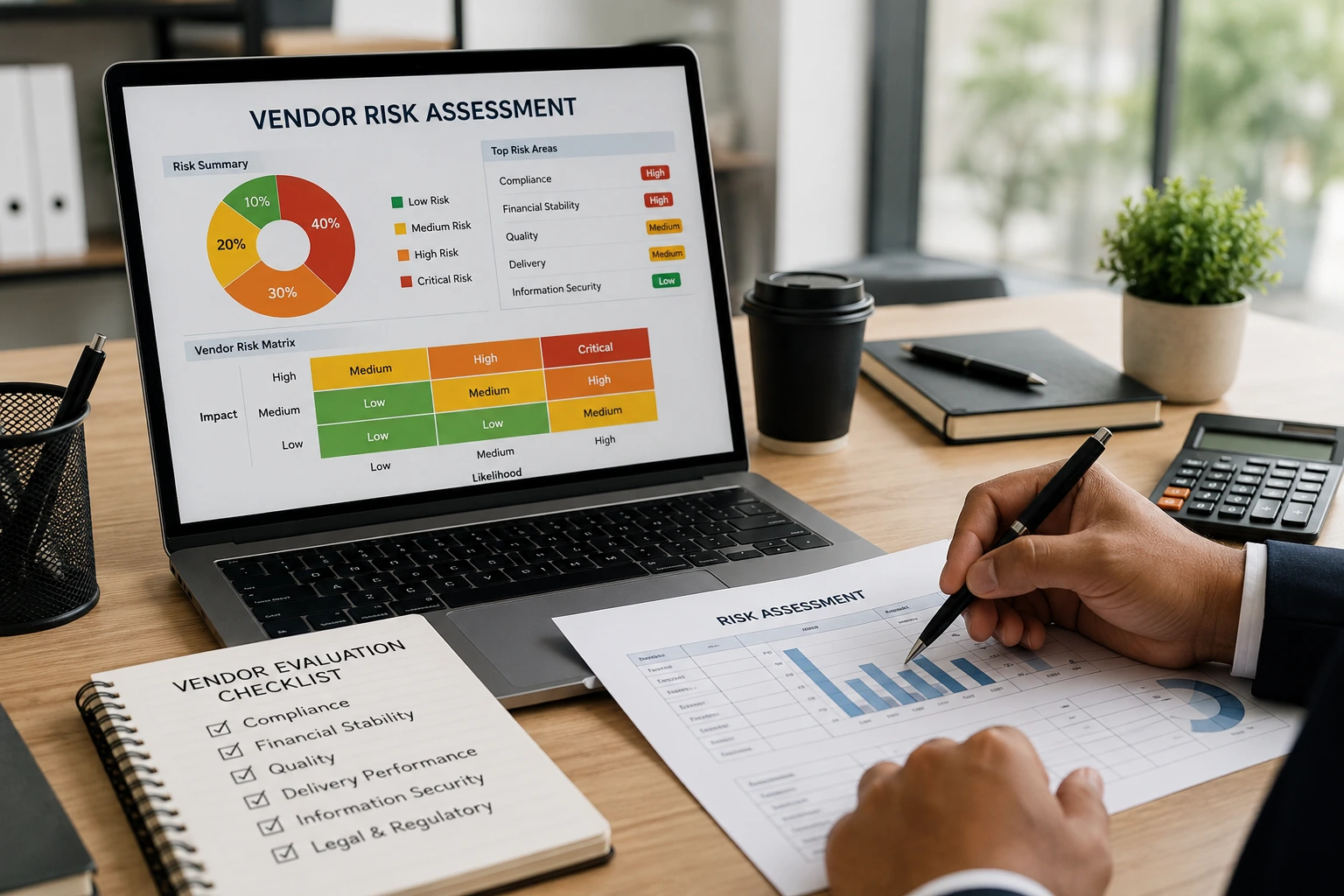
Vendor Risk Assessment Guide: How to Evaluate and Reduce Supplier Risk
Every organization depends on vendors, suppliers, contractors, and service providers to support its operations. While selecting the right vendor is important, continuously monitoring vendor risk is equally critical.
A supplier with expired compliance documents, poor financial health, inadequate cybersecurity controls, or weak operational processes can expose an organization to regulatory penalties, financial losses, operational disruptions, and reputational damage.
A structured vendor risk assessment process helps procurement and compliance teams identify potential risks before they become business problems.
In this guide, we’ll explain what vendor risk assessment is, why it matters, common risk categories, and best practices for building an effective vendor risk management program.
What Is Vendor Risk Assessment?
Vendor risk assessment is the process of identifying, evaluating, and monitoring the risks associated with suppliers, contractors, and third-party service providers.
The objective is to determine whether a vendor can meet business, legal, operational, security, and compliance requirements before and during the business relationship.
Vendor risk assessments are commonly performed during:
- Vendor onboarding
- Contract renewal
- Annual compliance reviews
- Procurement audits
- Supplier performance evaluations
Why Vendor Risk Assessment Is Important
Organizations work with multiple vendors across procurement, logistics, manufacturing, IT services, facility management, and construction.
Without regular risk assessments, organizations may face:
- Regulatory penalties
- Contractual disputes
- Operational disruptions
- Supply chain interruptions
- Data security risks
- Financial losses
- Poor vendor performance
- Reputation damage
A structured assessment process helps reduce these risks and supports informed procurement decisions.
Types of Vendor Risks
Vendor risk extends beyond document compliance. Organizations should evaluate multiple risk categories.
Compliance Risk
Compliance risk arises when vendors fail to maintain valid statutory or regulatory documents.
Examples include:
- Expired GST Registration
- Missing PF Registration
- Expired ESIC Registration
- Invalid Labour Licence
- Missing Insurance Policies
Financial Risk
Financially unstable vendors may struggle to deliver products or services.
Factors to consider include:
- Financial stability
- Creditworthiness
- Payment history
- Business continuity
Operational Risk
Operational risks affect a vendor’s ability to deliver products or services.
Examples include:
- Production delays
- Resource shortages
- Equipment failures
- Lack of skilled workforce
Legal Risk
Legal disputes involving vendors may impact business operations.
Organizations should review:
- Litigation history
- Regulatory actions
- Contract compliance
- Licence validity
Information Security Risk
Vendors with access to confidential information should be evaluated for cybersecurity practices.
Examples include:
- Data protection policies
- Access controls
- Password management
- Incident response procedures
Health and Safety Risk
For contractors working at industrial sites, organizations should evaluate:
- Safety training
- PPE compliance
- Incident history
- Safety certifications
Vendor Risk Assessment Process
A structured process improves consistency and transparency.
Step 1: Identify the Vendor
Collect:
- Business details
- Industry
- Services provided
- Business location
Step 2: Collect Compliance Documents
Request documents such as:
- GST Registration Certificate
- PAN Card
- PF Registration
- ESIC Registration
- Labour Licence
- Insurance Policies
- MSME Registration
Step 3: Verify Documents
Confirm that:
- Documents are authentic
- Information matches vendor records
- Expiry dates remain valid
Step 4: Evaluate Risk Factors
Assess:
- Compliance
- Financial stability
- Operational capability
- Safety performance
- Business continuity
Step 5: Assign a Risk Score
Organizations commonly classify vendors as:
| Risk Level | Score | Action |
|---|---|---|
| Low | 80–100 | Approve |
| Medium | 60–79 | Monitor |
| High | Below 60 | Review or Reject |
Using a standardized scoring model improves consistency across procurement decisions.
Step 6: Monitor Continuously
Vendor risk should not be assessed only once.
Organizations should review vendors periodically through:
- Document expiry monitoring
- Performance reviews
- Compliance audits
- Annual reassessments
Common Challenges in Vendor Risk Assessment
Many organizations still manage vendor risk manually.
Common challenges include:
Excel-Based Tracking
Risk scores become outdated quickly.
Missing Compliance Documents
Important records are not submitted or renewed.
Limited Visibility
Procurement teams cannot easily identify high-risk vendors.
Manual Follow-Up
Significant time is spent requesting updated documents.
Inconsistent Evaluation
Different departments use different assessment criteria.
Best Practices for Vendor Risk Assessment
Organizations can improve vendor governance by following these best practices.
Standardize Assessment Criteria
Use the same evaluation framework for all vendors.
Categorize Vendors
Group vendors by:
- Critical suppliers
- Contractors
- Service providers
- Logistics partners
Risk reviews can then be tailored to each category.
Automate Compliance Tracking
Monitor document validity and receive reminders before expiry dates.
Review Vendors Regularly
Conduct quarterly or annual risk assessments depending on the vendor’s criticality.
Maintain Audit Trails
Track approvals, document updates, risk scores, and assessment history.
Manual Assessment vs Automated Risk Management
| Manual Process | Automated Process |
|---|---|
| Excel spreadsheets | Centralized risk dashboard |
| Manual document review | Automated compliance tracking |
| Email follow-up | Automated notifications |
| Subjective scoring | Standardized risk scoring |
| Difficult reporting | Real-time analytics |
| Limited visibility | Complete vendor risk dashboard |
How VendorCompliancePro Helps
VendorCompliancePro helps organizations simplify vendor risk management by providing:
- Vendor onboarding
- Centralized document repository
- AI-powered document validation
- Automated expiry reminders
- Vendor risk scoring
- Compliance dashboards
- Audit-ready reports
- Approval workflows
- Document history
- Role-based access
Organizations can identify high-risk vendors early, improve procurement decisions, and maintain continuous compliance throughout the vendor lifecycle.
Frequently Asked Questions
What is vendor risk assessment?
Vendor risk assessment is the process of evaluating suppliers and contractors to identify financial, operational, legal, compliance, and security risks before and during the business relationship.
How often should vendor risk assessments be performed?
Organizations typically conduct assessments during onboarding, annual reviews, contract renewals, and whenever significant business changes occur.
What documents are required for vendor risk assessment?
Common documents include GST Registration Certificates, PAN Cards, PF Registration Certificates, ESIC Registration Certificates, Labour Licences, Insurance Policies, and MSME Registration Certificates.
Can vendor compliance software help with vendor risk assessment?
Yes. Modern vendor compliance software centralizes documents, automates compliance tracking, supports vendor risk scoring, generates audit-ready reports, and provides dashboards for continuous monitoring.
Conclusion
Vendor risk assessment is an essential component of modern procurement and supplier management. Organizations that regularly evaluate vendor compliance, operational capability, financial stability, and regulatory requirements are better positioned to reduce risk and maintain business continuity.
By replacing spreadsheets with a centralized vendor compliance platform, businesses can automate document management, standardize vendor evaluations, improve audit readiness, and make more informed procurement decisions.