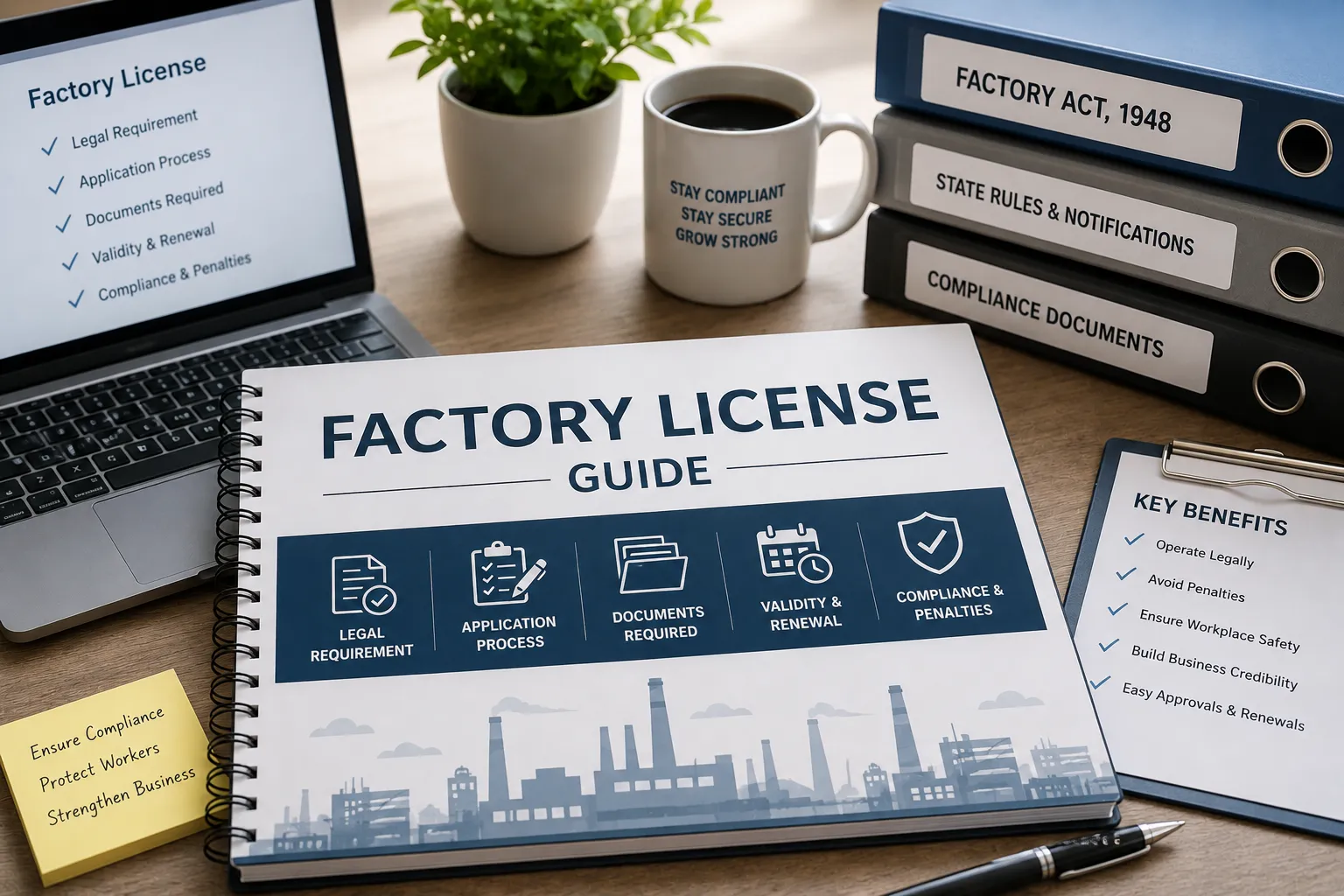
Factory License Guide: Requirements, Documents & Compliance for Indian Businesses (2026)
Manufacturing companies in India operate under various labour, safety, environmental, and statutory regulations. One of the most important legal requirements is obtaining a Factory License, which authorizes a factory to operate in accordance with applicable state laws.
For procurement and compliance teams, a Factory License is also one of the most commonly requested documents during vendor onboarding. Organizations working with manufacturers, engineering companies, packaging suppliers, food processors, textile units, and automotive vendors often verify Factory Licenses before approving suppliers.
Without a valid Factory License, a manufacturing unit may face legal action, penalties, operational restrictions, or difficulties participating in customer audits.
In this guide, we’ll explain what a Factory License is, who requires it, the documents needed, how to apply, renewal requirements, and why it plays a key role in vendor compliance.
What Is a Factory License?
A Factory License is an official authorization issued by the respective State Government’s Labour Department or Directorate of Factories, allowing a manufacturing facility to legally operate under applicable factory regulations.
The license confirms that the factory satisfies prescribed safety, health, welfare, and operational requirements.
It is generally required for manufacturing facilities that meet the applicable thresholds relating to the number of workers and the use of power, as specified under the relevant laws.
Many organizations request a copy of the Factory License during:
- Vendor onboarding
- Supplier qualification
- Vendor due diligence
- Customer audits
- ISO audits
- Compliance assessments
Why Is a Factory License Important?
A Factory License demonstrates that a manufacturing facility has been officially registered and is authorized to operate.
For businesses, it helps ensure compliance with applicable labour and safety regulations.
For procurement teams, it provides confidence that the supplier operates from a legally recognized manufacturing facility.
Benefits include:
- Legal authorization to operate
- Improved workplace safety compliance
- Better audit readiness
- Increased customer confidence
- Improved vendor credibility
- Easier supplier qualification
- Reduced compliance risks
Many organizations classify the Factory License as a mandatory vendor compliance document for manufacturing suppliers.
Who Needs a Factory License?
A Factory License is generally required for manufacturing units that meet the thresholds specified under applicable laws.
Industries commonly requiring Factory Licenses include:
- Engineering Companies
- Automobile Manufacturers
- Textile Units
- Packaging Industries
- Plastic Manufacturers
- Chemical Industries
- Pharmaceutical Manufacturers
- Food Processing Units
- Steel Fabrication Companies
- Electronics Manufacturers
Service companies and trading businesses typically do not require a Factory License unless they operate qualifying manufacturing facilities.
Information Available on a Factory License
A Factory License typically contains:
- Factory Name
- Factory Address
- License Number
- Occupier Name
- Manager Name
- Nature of Manufacturing Activity
- Maximum Number of Workers Permitted
- Installed Horsepower (where applicable)
- Date of Issue
- Validity Period
- Licensing Authority
Procurement teams should verify that the information matches the supplier’s submitted documents.
Documents Required for a Factory License
Although requirements vary slightly by state, common documents include:
- Company Registration Certificate
- PAN Card
- GST Registration Certificate
- Identity Proof of Occupier
- Address Proof
- Site Plan
- Building Layout Plan
- Land Ownership or Lease Documents
- Fire Safety Approval (where applicable)
- Pollution Control Board Consent (where applicable)
- Machinery Details
- List of Workers
- Electricity Connection Details
Additional documents may be required depending on the manufacturing activity.
Factory License Application Process
The application process is generally managed through the respective State Labour Department or Directorate of Factories.
Step 1: Register the Factory
Submit the prescribed application through the state’s online or offline registration process.
Step 2: Prepare Required Documents
Collect all mandatory documents, drawings, approvals, and declarations.
Step 3: Submit the Application
Upload or submit the required documents along with applicable government fees.
Step 4: Factory Inspection
The licensing authority may inspect the factory to verify:
- Safety measures
- Building suitability
- Machinery installation
- Worker welfare facilities
- Compliance with applicable regulations
Step 5: License Approval
If the inspection and documentation satisfy the prescribed requirements, the Factory License is issued.
Factory License Renewal
Many Factory Licenses require periodic renewal according to state-specific regulations.
Organizations should ensure:
- Renewal applications are submitted before expiry.
- Any changes in ownership, production capacity, or factory layout are reported where required.
- Supporting approvals remain valid.
Failure to renew a Factory License on time may lead to penalties or operational interruptions.
How Procurement Teams Verify Factory Licenses
As part of vendor onboarding, procurement teams generally verify:
- Factory name matches supplier records.
- Factory address is correct.
- License number is valid.
- Manufacturing activity matches supplied products.
- License validity period has not expired.
- Occupier details are accurate.
- Supporting statutory documents are available.
Maintaining verified copies improves audit readiness and supplier transparency.
Factory License vs Trade License
Although these documents are sometimes confused, they serve different purposes.
| Factory License | Trade License |
|---|---|
| Applicable to manufacturing facilities | Applicable to commercial establishments |
| Issued by Factory/Labour Authorities | Issued by Local Municipal Authorities |
| Focuses on factory operations and worker safety | Focuses on local business operations |
| Required for qualifying manufacturing units | Required for many businesses operating within municipal limits |
Organizations may request both documents depending on the vendor’s business activity.
Best Practices for Managing Factory Licenses
Organizations with mature vendor compliance programs typically:
- Collect Factory Licenses during vendor onboarding.
- Verify expiry dates before supplier approval.
- Maintain digital copies in a centralized repository.
- Track renewal dates automatically.
- Review supporting statutory registrations.
- Perform periodic vendor compliance reviews.
- Maintain document approval history for audits.
These practices reduce compliance risks and simplify vendor management.
Common Mistakes to Avoid
Many organizations experience compliance issues because Factory Licenses are not reviewed properly.
Avoid these common mistakes:
- Accepting expired Factory Licenses.
- Not verifying factory address.
- Ignoring changes in manufacturing activity.
- Missing renewal deadlines.
- Managing documents only through email.
- Not tracking license validity.
- Failing to maintain audit records.
A structured document management process helps eliminate these issues.
Why Vendor Compliance Software Helps
Managing Factory Licenses manually becomes increasingly difficult as the number of manufacturing suppliers grows.
Vendor compliance software helps organizations:
- Store Factory Licenses securely.
- Track expiry dates automatically.
- Send renewal reminders.
- Maintain approval workflows.
- Generate compliance dashboards.
- Improve audit readiness.
- Centralize all supplier documents.
This reduces manual effort while improving visibility across the vendor lifecycle.
Frequently Asked Questions
What is a Factory License?
A Factory License is an official authorization issued by the appropriate state authority that permits an eligible manufacturing facility to operate in compliance with applicable factory laws and regulations.
Who needs a Factory License?
Manufacturing facilities that meet the prescribed legal thresholds relating to workers and manufacturing operations generally require a Factory License. Requirements vary depending on applicable laws and state regulations.
What documents are required for a Factory License?
Common documents include the Company Registration Certificate, GST Registration, PAN Card, site plan, building layout, land documents, machinery details, Fire Safety approvals, and Pollution Control Board consents where applicable.
Does a Factory License require renewal?
In many states, Factory Licenses require periodic renewal. Businesses should check the requirements applicable in their state and renew the license before its expiry.
Why do companies request Factory Licenses during vendor onboarding?
Organizations verify Factory Licenses to ensure manufacturing suppliers operate legally, meet compliance requirements, and satisfy supplier qualification criteria.
Can vendor compliance software manage Factory Licenses?
Yes. Vendor compliance software can securely store Factory Licenses, automate expiry reminders, maintain approval workflows, and improve audit readiness by centralizing vendor documentation.
Conclusion
A Factory License is one of the most important statutory documents for manufacturing businesses in India. It demonstrates that a factory has obtained the necessary authorization to operate while meeting applicable safety, labour, and operational requirements.
For procurement and compliance teams, verifying Factory Licenses during vendor onboarding helps reduce supplier risks, improve audit readiness, and ensure manufacturing partners meet legal requirements.
As organizations expand their supplier base, managing Factory Licenses manually through spreadsheets and emails becomes increasingly difficult. A dedicated vendor compliance platform helps centralize document management, automate renewal reminders, and maintain complete visibility into supplier compliance.