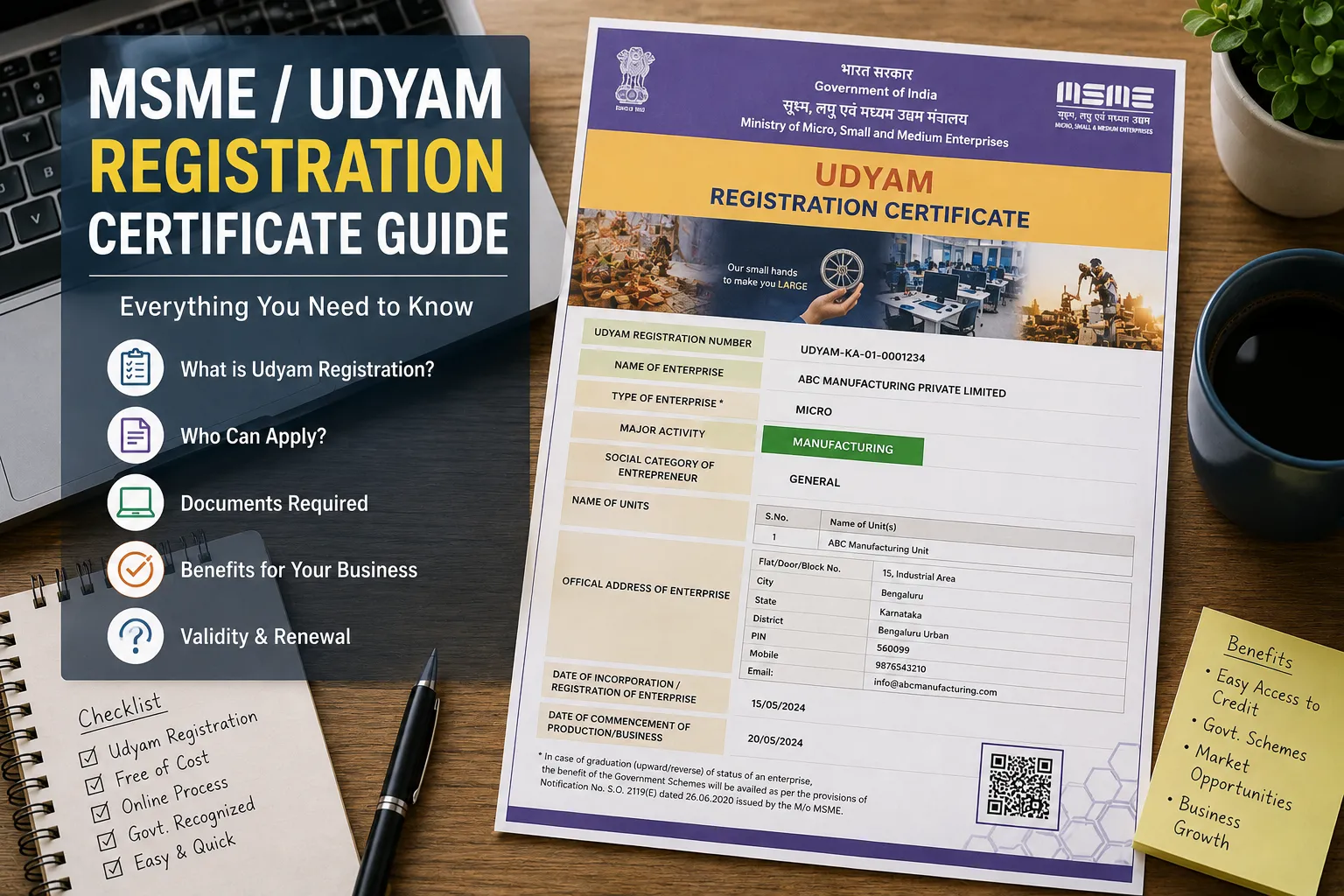
MSME / Udyam Registration Certificate Guide: Everything Businesses Need to Know (2026)
Micro, Small, and Medium Enterprises (MSMEs) play a vital role in India’s economy by contributing significantly to manufacturing, exports, employment, and innovation. To simplify the recognition of MSMEs and provide access to government benefits, the Government of India introduced the Udyam Registration system.
Today, many manufacturing companies, logistics providers, engineering firms, and large enterprises request an MSME (Udyam) Registration Certificate as part of their vendor onboarding and supplier qualification process. Verifying this certificate helps procurement teams confirm that a supplier is officially recognized as an MSME and eligible for various government schemes and procurement benefits.
If you’re a business owner applying for Udyam Registration or a procurement professional verifying vendor documents, understanding the certificate is essential.
In this guide, we’ll explain what the MSME (Udyam) Registration Certificate is, who needs it, how to obtain it, what information it contains, and why it is important for vendor compliance.
What Is an MSME (Udyam) Registration Certificate?
The Udyam Registration Certificate is an official recognition issued by the Government of India to eligible Micro, Small, and Medium Enterprises.
Introduced in July 2020, the Udyam Registration Portal replaced the earlier Udyog Aadhaar registration system, making registration simpler and fully online.
Once successfully registered, businesses receive a Udyam Registration Number (URN) along with a digital certificate that serves as proof of MSME registration.
The certificate is commonly requested during:
- Vendor onboarding
- Supplier qualification
- Government tenders
- Loan applications
- Corporate procurement
- Vendor due diligence
Why Is the Udyam Registration Certificate Important?
For businesses, Udyam Registration provides access to various government schemes and financial incentives.
For procurement teams, the certificate helps verify that a supplier has a valid MSME registration.
Benefits include:
- Easier access to government tenders
- Priority sector lending
- Protection against delayed payments
- Lower interest rates under eligible schemes
- Subsidies under government programs
- Easier vendor verification
- Increased business credibility
Many organizations include the Udyam Registration Certificate as part of their standard vendor compliance checklist.
Who Can Apply for Udyam Registration?
Businesses engaged in manufacturing, production, processing, or service activities may be eligible.
Eligible entities include:
- Proprietorships
- Partnership Firms
- Hindu Undivided Families (HUF)
- Limited Liability Partnerships (LLPs)
- Private Limited Companies
- One Person Companies (OPCs)
- Co-operative Societies
- Trusts
Eligibility is determined based on investment in plant & machinery/equipment and annual turnover, as prescribed by the Government of India.
Information Available on an MSME (Udyam) Registration Certificate
A typical Udyam Registration Certificate contains the following information.
- Udyam Registration Number
- Enterprise Name
- Type of Organization
- PAN Number
- GSTIN (if applicable)
- Date of Registration
- Business Address
- Major Business Activity
- National Industrial Classification (NIC) Code
- Enterprise Category (Micro, Small, or Medium)
Organizations often verify these details during supplier onboarding.
Documents Required for Udyam Registration
The registration process is designed to be simple and paperless.
Common information required includes:
- Aadhaar Number
- PAN Card
- GST Number (where applicable)
- Business Address
- Mobile Number
- Email Address
- Bank Account Details
- Business Activity Information
Most information is validated through government databases during registration.
How to Apply for Udyam Registration
The registration process is completely online.
Step 1: Visit the Udyam Registration Portal
Access the official government portal for MSME registration.
Step 2: Enter Aadhaar Details
Provide the Aadhaar number of the proprietor or authorized representative.
Step 3: Validate PAN Details
The portal validates business information using PAN records.
Step 4: Enter Business Information
Provide:
- Business Name
- Address
- Business Activity
- NIC Code
- Bank Details
- Employee Information
Step 5: Submit the Application
Review the information and submit the application online.
Step 6: Receive the Udyam Registration Certificate
Upon successful verification, the Udyam Registration Number and digital certificate are generated.
How Procurement Teams Verify an MSME Certificate
During vendor onboarding, procurement teams typically verify:
- Business name matches submitted documents.
- Udyam Registration Number is present.
- PAN and GST information are consistent.
- Enterprise category is correctly declared.
- Registration details match vendor records.
Many organizations maintain a copy of the certificate in their centralized vendor document repository.
Common Reasons for Requesting an MSME Certificate During Vendor Onboarding
Organizations request this certificate for several reasons.
- Verify vendor identity
- Confirm MSME status
- Support procurement policies
- Meet supplier qualification requirements
- Improve vendor documentation
- Simplify audits
- Maintain complete vendor records
Although not mandatory for every supplier, it is commonly requested from Indian SMEs.
Udyam Registration vs Udyog Aadhaar
| Udyam Registration | Udyog Aadhaar |
|---|---|
| Current registration system | Older registration system |
| Introduced in 2020 | Discontinued |
| Integrated with PAN & GST | Limited integration |
| Fully online | Earlier process |
| Generates Udyam Registration Number | Generated Udyog Aadhaar Number |
Businesses previously registered under Udyog Aadhaar were encouraged to migrate to the Udyam Registration system.
Best Practices for Managing MSME Certificates
Organizations with mature vendor compliance programs typically follow these best practices.
- Collect the Udyam Registration Certificate during vendor onboarding.
- Verify that business details match other submitted documents.
- Store certificates in a centralized document repository.
- Review supporting statutory registrations alongside the certificate.
- Maintain digital copies for audit purposes.
- Use standardized vendor document checklists.
- Periodically review vendor information for accuracy.
These practices improve supplier documentation and audit readiness.
Common Mistakes to Avoid
Many organizations overlook important verification steps.
Avoid these common mistakes:
- Accepting incomplete certificates.
- Not verifying business information.
- Ignoring mismatched GST or PAN details.
- Failing to store digital copies.
- Using outdated Udyog Aadhaar records without review.
- Managing vendor documents only through email.
A structured document verification process helps reduce these issues.
Why Vendor Compliance Software Helps
As organizations work with hundreds of suppliers, manually managing vendor documents becomes increasingly challenging.
Vendor compliance software helps procurement teams:
- Store MSME certificates securely.
- Track vendor documentation.
- Maintain audit trails.
- Automate document collection.
- Simplify vendor onboarding.
- Improve compliance visibility.
This reduces administrative effort while improving document accuracy.
Frequently Asked Questions
What is an MSME (Udyam) Registration Certificate?
An MSME (Udyam) Registration Certificate is an official document issued by the Government of India recognizing eligible Micro, Small, and Medium Enterprises under the Udyam Registration system.
Is Udyam Registration mandatory?
No. Udyam Registration is generally voluntary, but businesses often obtain it to access government benefits, participate in tenders, and improve credibility during vendor onboarding.
Does the Udyam Registration Certificate expire?
No. The Udyam Registration itself does not have a fixed expiry date. However, businesses should ensure that the information associated with the registration remains accurate and up to date in accordance with applicable government requirements.
Is Udyog Aadhaar the same as Udyam Registration?
No. Udyam Registration replaced the earlier Udyog Aadhaar registration system in 2020.
Why do companies request an MSME Certificate from vendors?
Organizations request the certificate to verify MSME status, maintain vendor records, support procurement policies, and streamline supplier qualification and compliance.
Can vendor compliance software manage MSME certificates?
Yes. Vendor compliance software can securely store MSME certificates, track vendor documentation, automate document collection, and improve audit readiness.
Conclusion
The MSME (Udyam) Registration Certificate is an important document for many Indian businesses and plays a valuable role in vendor qualification and supplier compliance.
For suppliers, it provides official MSME recognition and access to various government benefits. For procurement teams, it serves as a trusted document for verifying vendor information and maintaining complete compliance records.
As organizations expand their supplier base, managing certificates manually through spreadsheets and emails becomes increasingly difficult. Implementing a structured vendor compliance process supported by dedicated software helps simplify document management, improve visibility, and maintain audit readiness.