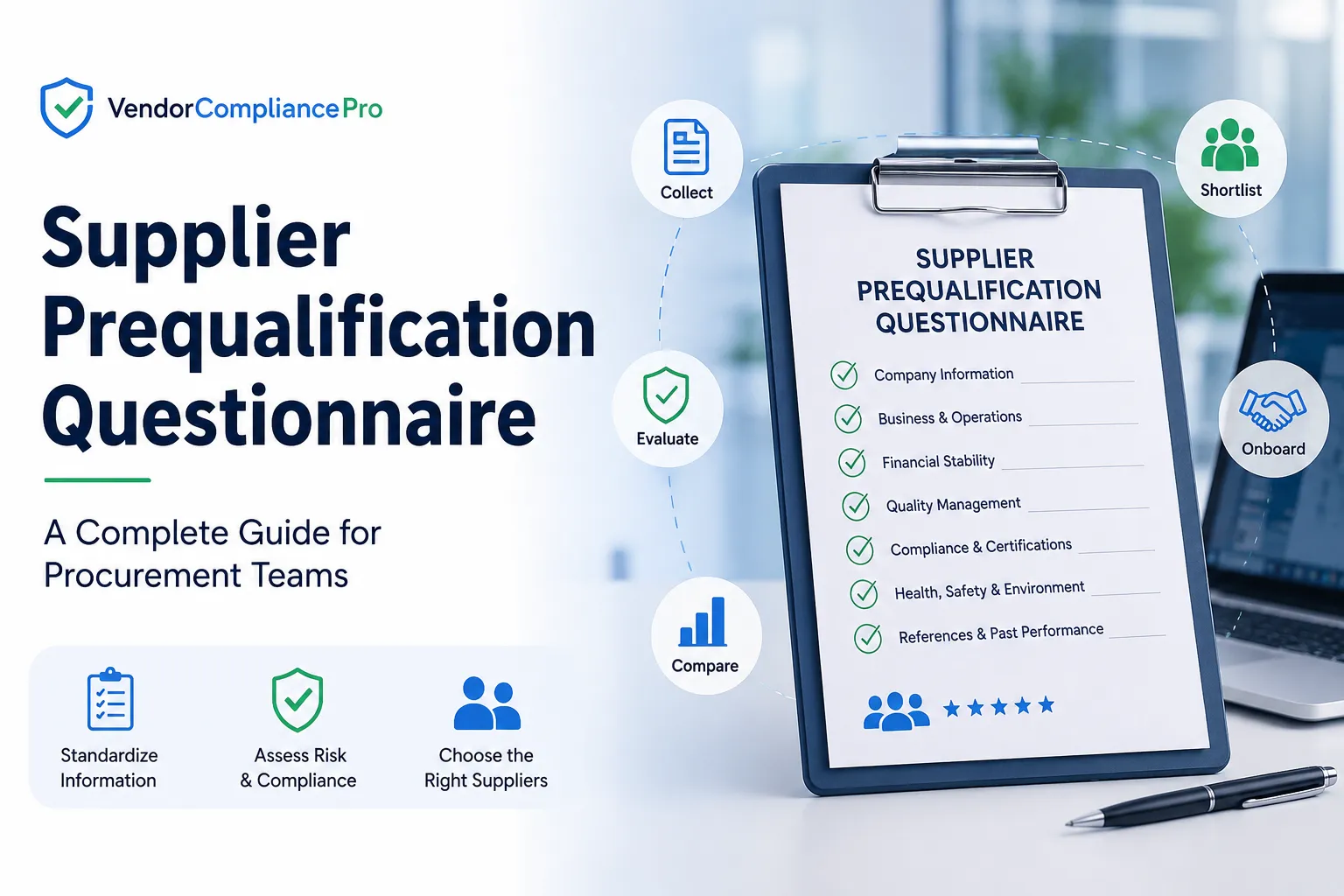
Supplier Prequalification Questionnaire: A Complete Guide for Procurement Teams
Selecting the right supplier is one of the most important decisions procurement teams make.
Before inviting a supplier to participate in an RFQ, approving them as a vendor, or awarding a contract, organizations often need to understand whether the supplier has the required capabilities, financial stability, quality processes, safety controls, insurance, experience, and regulatory compliance.
A supplier prequalification questionnaire provides a structured way to collect this information before moving forward with supplier selection.
Instead of asking suppliers for information through multiple emails and spreadsheets, procurement teams can use a standardized questionnaire to gather comparable information from every supplier.
In this guide, we’ll explain what a supplier prequalification questionnaire is, what information it should contain, and how procurement teams can use it to improve supplier onboarding and risk management.
What Is a Supplier Prequalification Questionnaire?
A supplier prequalification questionnaire is a structured set of questions used to assess whether a supplier is suitable to work with an organization.
The questionnaire is normally completed before a supplier is fully approved or invited to a formal sourcing process.
Depending on the organization and the type of supplier, the questionnaire may cover:
- Company information
- Business registration and tax information
- Products or services
- Financial information
- Quality management
- Health and safety
- Insurance
- Regulatory compliance
- Previous experience
- Business continuity
- Supplier declarations
The objective is not simply to collect documents.
The objective is to determine whether a supplier has the capability and compliance foundation required for the proposed business relationship.
Why Supplier Prequalification Matters
Supplier risk does not begin after a contract is signed.
A supplier can create operational, financial, quality, safety, or compliance risk before the first purchase order is issued.
For example, a supplier may:
- Lack the required licenses
- Have inadequate insurance
- Have weak quality controls
- Have insufficient production or service capacity
- Have poor financial stability
- Lack relevant industry experience
- Have unresolved regulatory issues
- Be unable to meet delivery requirements
A structured prequalification process helps procurement teams identify these issues earlier.
What Should a Supplier Prequalification Questionnaire Include?
A good questionnaire should be appropriate for the supplier’s role, industry, risk level, and proposed contract.
The following sections are commonly useful.
1. Company Information
Start with basic information about the supplier.
Typical questions include:
- What is the legal company name?
- What is the registered business address?
- What is the website?
- Who is the primary contact?
- When was the company established?
- How many employees does the company have?
- Where does the company operate?
This section establishes the supplier’s basic business identity.
2. Products, Services, and Capabilities
Procurement teams should understand exactly what the supplier can provide.
Questions may include:
- What products or services do you provide?
- What are your core capabilities?
- What is your current production or service capacity?
- What locations support the proposed contract?
- What equipment or technology do you use?
- Do you subcontract any part of the proposed work?
For manufacturing suppliers, capacity and production capabilities can be particularly important.
For logistics providers, procurement teams may focus more heavily on fleet capacity, service coverage, facilities, and operational capabilities.
3. Registration and Tax Compliance
The questionnaire should collect relevant business registrations and tax information.
Depending on the country and supplier type, this may include:
- Business registration
- Tax registration
- PAN
- GST registration
- Industry-specific licenses
- Statutory registrations
- Professional certifications
For Indian procurement teams, these requirements can be especially important when onboarding suppliers and contractors.
The exact requirements should always be determined by the supplier’s activities, location, contract, and applicable regulations.
4. Financial Information
Financial stability is an important part of supplier risk assessment.
A questionnaire may request:
- Audited financial statements
- Management accounts
- Banking references
- Credit information
- Annual turnover
- Material litigation disclosures
- Insolvency or restructuring information
The level of financial due diligence should depend on the value and risk of the proposed relationship.
A strategic supplier supporting a critical manufacturing process may require substantially more financial review than a low-value service provider.
5. Quality Management
Quality requirements should reflect the products or services being supplied.
Questions can cover:
- Quality management systems
- Quality policy
- Quality certifications
- Inspection and testing procedures
- Non-conformance management
- Corrective and preventive actions
- Customer complaint handling
- Quality performance history
For manufacturing organizations, this section can be particularly important because supplier quality problems can directly affect production and customer deliveries.
6. Health and Safety
For contractors and suppliers working on-site, health and safety information can be critical.
Questions may include:
- Do you have a documented health and safety policy?
- How do you train employees?
- How are incidents reported?
- What safety performance information can you provide?
- Do you perform task-specific risk assessments?
- How do you verify worker competency?
Higher-risk suppliers may require more detailed safety evidence before approval.
7. Insurance
Depending on the supplier’s activities, procurement teams may need evidence of appropriate insurance.
Possible requirements include:
- General liability
- Employee compensation
- Employers’ liability
- Commercial auto liability
- Professional indemnity
- Other contract-specific insurance
Insurance requirements should be based on the supplier’s activities, contract scope, jurisdiction, and company policy.
A questionnaire can ask suppliers to provide policy details and certificates for later review.
For a practical starting point, procurement teams can also use the Vendor & Contractor COI Requirement Checker to identify common certificate of insurance requirements based on vendor activity and risk.
8. Regulatory and Legal Compliance
Supplier prequalification should identify important legal and regulatory risks before onboarding.
Questions may cover:
- Applicable licenses and permits
- Labour compliance
- Tax compliance
- Anti-bribery requirements
- Data protection
- Trade and sanctions requirements
- Regulatory notices
- Investigations
- Material legal proceedings
The specific questions should be adapted to the supplier’s industry and operating jurisdiction.
9. Experience and References
Previous experience can help procurement teams determine whether a supplier has successfully delivered similar work.
Ask for:
- Relevant customer references
- Similar projects or contracts
- Duration of previous engagements
- Scope of previous work
- Industry experience
- Performance history
For a critical supplier, procurement teams may also verify references before approval.
10. Business Continuity and Resilience
A supplier may be technically capable but still create significant risk if it cannot recover from an operational disruption.
Questions can cover:
- Business continuity plans
- Disaster recovery arrangements
- Backup facilities
- Alternative suppliers
- Critical equipment
- Incident escalation procedures
- Recovery arrangements
This is particularly relevant for suppliers supporting critical manufacturing, logistics, warehousing, or distribution operations.
How to Structure the Questionnaire
A good questionnaire should be:
Relevant
Only ask questions that are useful for the supplier’s role and risk profile.
Consistent
Use a common structure so suppliers can be compared fairly.
Evidence-based
Where appropriate, ask suppliers to provide supporting documents rather than relying only on statements.
Risk-based
Higher-risk suppliers should generally receive more detailed due diligence.
Easy to complete
Long, confusing questionnaires can reduce supplier response rates.
Supplier Prequalification vs Supplier Evaluation
These two activities are related but serve different purposes.
Supplier Prequalification Supplier Evaluation
Determines basic eligibility Compares supplier performance
Usually performed before selection Can be performed during selection or review
Focuses on capability and compliance Focuses on scoring and ranking
Identifies unacceptable risks Helps identify the strongest supplier
Often uses questionnaires Often uses weighted scorecards
A procurement team may first prequalify suppliers and then use a supplier evaluation scorecard to compare the suppliers that pass the initial screening.
You can use the Supplier Evaluation Scorecard Generator to create a weighted supplier comparison.
Supplier Prequalification Process
A practical process can look like this.
Step 1: Define Requirements
Determine the information and documents required based on:
- Supplier type
- Industry
- Contract value
- Operational risk
- Regulatory requirements
- Internal procurement policy
Step 2: Send the Questionnaire
Send the questionnaire to prospective suppliers and provide clear instructions about required evidence.
Step 3: Collect Responses
Collect completed questionnaires and supporting documents in a consistent format.
Step 4: Review the Information
Check:
- Completeness
- Accuracy
- Required registrations
- Financial information
- Quality evidence
- Safety information
- Insurance
- Regulatory compliance
- Relevant experience
Step 5: Identify Exceptions
Flag missing or potentially problematic information for further review.
Examples include:
- Missing certificates
- Expired documents
- Incomplete answers
- Insufficient experience
- Financial concerns
- Regulatory issues
Step 6: Approve, Reject, or Request Clarification
Depending on the results, procurement teams can:
- Approve the supplier for the next stage
- Request additional information
- Apply conditions
- Escalate for management review
- Reject the supplier
Human review remains important for significant supplier decisions.
Common Mistakes in Supplier Prequalification
Asking the Same Questions to Every Supplier
A low-risk office service provider does not necessarily need the same questionnaire as a high-risk contractor.
Make the questionnaire risk-based.
Collecting Documents Without Reviewing Them
Document collection alone does not create effective supplier due diligence.
The information should be reviewed against the organization’s requirements.
Making the Questionnaire Too Long
Only include questions that support a procurement or risk decision.
Not Tracking Expiry Dates
Some supplier documents and certificates expire.
If the organization approves a supplier based on an expired document months later, the original prequalification process loses value.
Using Different Criteria for Different Suppliers
Inconsistent evaluation makes supplier comparison difficult.
Use standardized criteria wherever practical.
How a Supplier Prequalification Questionnaire Supports Vendor Compliance
Prequalification is the beginning of the supplier compliance lifecycle.
A typical process is:
Prequalification
→ Collect supplier information
→ Review compliance evidence
→ Approve supplier
→ Onboard supplier
→ Monitor documents and requirements
→ Track expirations
→ Request renewals
→ Maintain audit evidence
A questionnaire helps establish the initial compliance baseline.
Ongoing vendor compliance management is needed to maintain that baseline throughout the supplier relationship.
Use Our Free Supplier Prequalification Questionnaire Generator
Creating a supplier questionnaire from scratch can take significant time.
Our Supplier Prequalification Questionnaire Generator lets procurement teams generate a practical questionnaire based on:
- Supplier type
- Industry
- Risk level
- Compliance requirements
The generated questionnaire can be reviewed, customized, and printed or saved as a PDF.
It is designed as a starting point that procurement teams can adapt to their own policies and contract requirements.
How VendorCompliancePro Helps After Prequalification
A questionnaire helps you decide whether a supplier should move forward.
The next challenge is managing the supplier after approval.
VendorCompliancePro helps organizations centralize:
- Vendor documents
- Compliance requirements
- Expiry dates
- Approval workflows
- Audit evidence
- Vendor communication
- Compliance reporting
This allows procurement and compliance teams to move from a one-time prequalification exercise to ongoing vendor compliance management.
Industries That Can Benefit
Supplier prequalification is useful across many industries.
Manufacturing
Manufacturers can evaluate supplier quality, production capacity, certifications, safety, financial stability, and regulatory compliance.
Logistics
Logistics organizations can assess carriers and service providers based on operational capacity, insurance, safety, compliance, and service experience.
Warehousing
Warehouse operators can prequalify contractors and service providers such as security, housekeeping, maintenance, pest control, material handling, and transportation providers.
Construction and Engineering
Contractors can be assessed for safety, insurance, licenses, technical capability, financial stability, and previous project experience.
Frequently Asked Questions
What is a supplier prequalification questionnaire?
A supplier prequalification questionnaire is a structured set of questions used to assess whether a supplier has the capabilities, experience, financial stability, compliance, and other requirements needed to work with an organization.
When should a supplier prequalification questionnaire be used?
It is commonly used before supplier approval, sourcing events, RFQs, or contract award. The exact timing depends on the organization’s procurement process.
What documents should suppliers provide?
Documents vary by supplier type and industry. Common examples include business registration, tax registrations, licenses, insurance certificates, quality certifications, safety records, and financial information.
How long should a supplier questionnaire be?
There is no universal length. It should contain enough questions to support the procurement decision without creating unnecessary work for suppliers.
Should every supplier receive the same questionnaire?
Not necessarily. A risk-based approach is usually more practical. Critical or high-risk suppliers may require additional questions and evidence.
Is supplier prequalification the same as supplier evaluation?
No. Prequalification generally determines whether a supplier meets baseline requirements, while supplier evaluation compares suppliers using defined criteria and scoring.
Conclusion
A supplier prequalification questionnaire gives procurement teams a structured way to assess suppliers before entering into a business relationship.
By covering company information, capabilities, financial stability, quality, safety, insurance, regulatory compliance, experience, and business continuity, organizations can identify potential supplier risks earlier.
The most effective approach is standardized but risk-based. The questionnaire should reflect the supplier’s role, industry, contract scope, and risk level.
Prequalification is only the beginning. Once a supplier is approved, organizations still need to collect, validate, monitor, and renew compliance documents throughout the supplier lifecycle.
Use our Supplier Prequalification Questionnaire Generator to create a starting questionnaire, then use VendorCompliancePro to keep supplier documents, approvals, expiry dates, and audit evidence under control.
Related Articles
Procurement & Supplier Management
- Supplier Evaluation Scorecard: How to Evaluate and Rank Suppliers
- What Is Vendor Compliance?
- Vendor Compliance Checklist India
- Vendor Risk Assessment Guide
- Vendor Audit Readiness Checklist