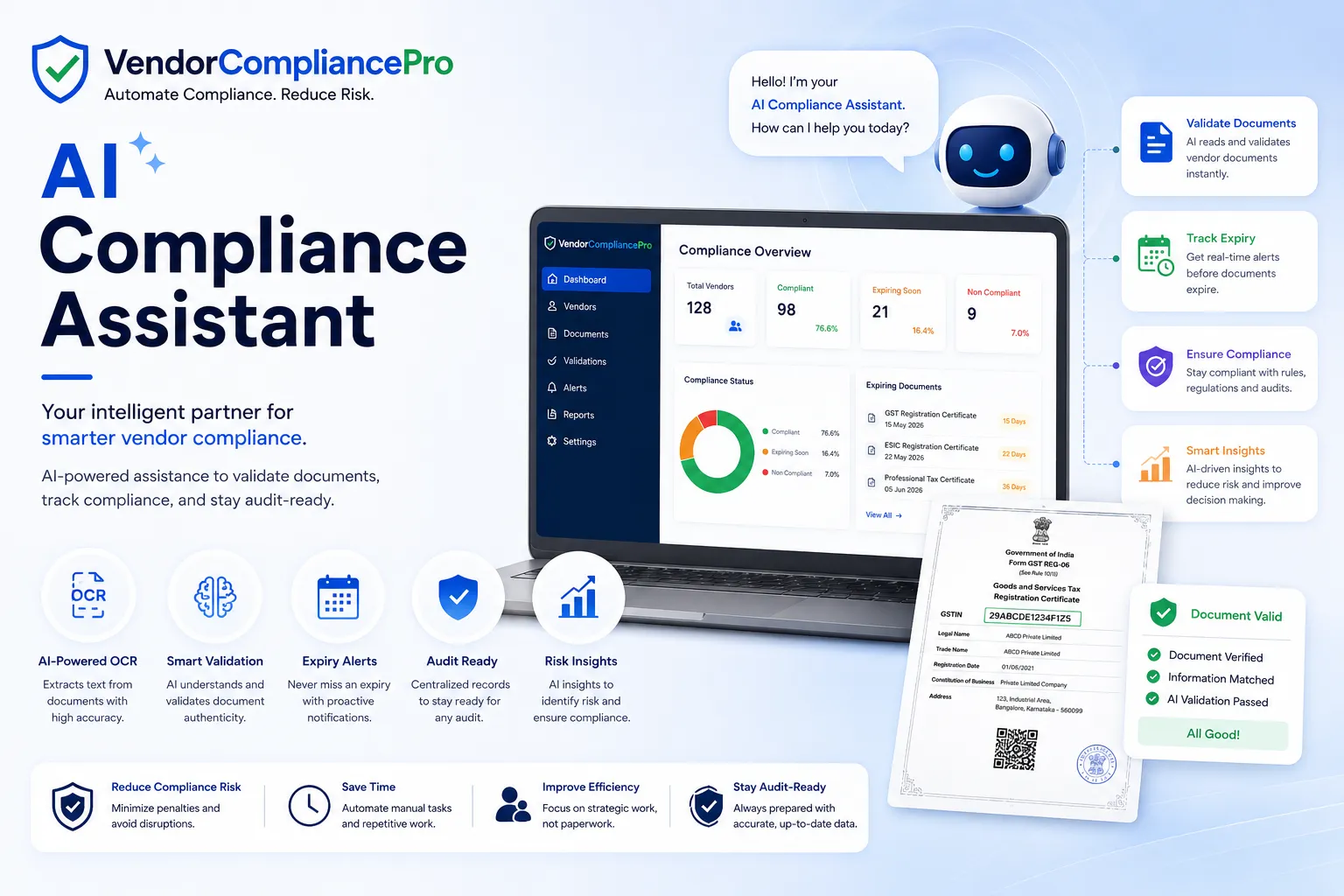
AI Compliance Assistant: The Future of Vendor Management
Vendor management has become increasingly complex. Procurement and compliance teams must collect hundreds of compliance documents, monitor expiry dates, review approvals, manage vendor risks, and prepare for audits—all while ensuring suppliers remain compliant with regulatory requirements.
Traditional vendor management relies heavily on spreadsheets, emails, and manual reviews, making the process time-consuming and prone to human error.
Artificial Intelligence is changing this landscape. Modern AI Compliance Assistants act as intelligent digital assistants that help procurement and compliance teams automate routine tasks, identify compliance risks, and make faster decisions.
In this guide, we’ll explore what an AI Compliance Assistant is, how it works, and why it represents the future of vendor management.
What Is an AI Compliance Assistant?
An AI Compliance Assistant is an intelligent software system that helps organizations automate vendor compliance activities using Artificial Intelligence (AI), Optical Character Recognition (OCR), workflow automation, and business rules.
Instead of manually reviewing every vendor document, the assistant continuously analyzes compliance data and provides actionable recommendations.
It acts as a digital compliance assistant—not a replacement for compliance professionals.
Why Traditional Vendor Management Is Challenging
As organizations grow, vendor management becomes increasingly difficult.
Common challenges include:
- Managing hundreds of vendors
- Collecting compliance documents
- Following up for missing documents
- Reviewing every uploaded file
- Tracking expiry dates
- Managing approval workflows
- Preparing for audits
- Monitoring vendor compliance continuously
Manual processes become difficult to scale.
What Can an AI Compliance Assistant Do?
An AI Compliance Assistant helps automate many repetitive compliance activities.
Common capabilities include:
- Document verification
- OCR-based text extraction
- Vendor onboarding assistance
- Expiry tracking
- Compliance monitoring
- Risk assessment
- Approval workflow automation
- Audit preparation
- Compliance reporting
- Smart notifications
Rather than replacing compliance officers, AI handles repetitive work so teams can focus on decision-making.
How an AI Compliance Assistant Works
A typical workflow looks like this.
Step 1: Vendor Uploads Documents
Suppliers upload required documents through a vendor portal.
Examples include:
- GST Registration Certificate
- PAN Card
- MSME Certificate
- Labour License
- PF Registration
- ESIC Registration
- Insurance Policies
Step 2: OCR Reads the Documents
OCR extracts machine-readable text from uploaded PDFs and scanned documents.
This eliminates manual data entry.
Step 3: AI Understands the Document
The AI assistant identifies:
- Document type
- Registration numbers
- License numbers
- Vendor name
- Organization name
- Issue date
- Expiry date
The assistant understands the document rather than simply reading its text.
Step 4: Compliance Validation
The AI assistant automatically checks:
- Required documents uploaded?
- Correct document submitted?
- Missing information?
- Expired certificates?
- Duplicate uploads?
- Compliance rules satisfied?
Any issues are highlighted immediately.
Step 5: Risk Analysis
The assistant evaluates vendor risk based on:
- Missing documents
- Compliance history
- Expired certificates
- Previous audit observations
- Submission delays
High-risk vendors are flagged for review.
Step 6: Smart Recommendations
Instead of simply displaying data, the AI assistant provides suggestions.
Examples include:
- Approve vendor
- Request missing document
- Reject expired certificate
- Escalate for manual review
- Send renewal reminder
This helps compliance teams make decisions faster.
Practical Use Cases
Vendor Onboarding
Automatically validate vendor registration documents.
Compliance Monitoring
Continuously monitor vendor compliance status.
Document Verification
Classify and validate uploaded documents automatically.
Expiry Management
Detect expiring certificates and notify vendors.
Audit Preparation
Organize documents and generate audit reports.
Vendor Risk Assessment
Identify vendors requiring additional review.
Approval Assistance
Route approvals automatically to the correct stakeholders.
AI Compliance Assistant vs Traditional Compliance Management
| Traditional Management | AI Compliance Assistant |
|---|---|
| Manual document review | AI document validation |
| Spreadsheet tracking | Real-time dashboards |
| Manual follow-ups | Automated notifications |
| Human data entry | OCR extraction |
| Manual expiry tracking | Automatic expiry detection |
| Reactive compliance | Continuous monitoring |
| Manual risk assessment | AI-assisted risk scoring |
| Time-consuming audits | Audit-ready documentation |
Benefits of an AI Compliance Assistant
Faster Vendor Onboarding
AI reduces document verification time dramatically.
Reduced Administrative Work
Routine compliance activities are automated.
Improved Accuracy
AI reduces manual errors and improves consistency.
Better Compliance Visibility
Real-time dashboards provide a complete view of vendor compliance.
Proactive Risk Management
The assistant identifies compliance issues before they become business risks.
Improved Audit Readiness
Compliance records remain organized and accessible throughout the year.
Real Example
A contractor uploads:
- GST Certificate
- PAN Card
- Labour License
- Insurance Policy
The AI Compliance Assistant automatically:
- Reads every document using OCR
- Identifies document types
- Extracts registration numbers
- Detects expiry dates
- Finds missing documents
- Assigns a compliance status
- Routes approvals
- Sends notifications if additional documents are required
Instead of manually reviewing every document, compliance officers only review exceptions.
The Future of AI Compliance Assistants
AI technology continues to evolve rapidly.
Future AI Compliance Assistants may be able to:
- Verify GST numbers through government APIs
- Validate PAN information automatically
- Detect fake compliance documents
- Verify digital signatures
- Predict future compliance risks
- Recommend corrective actions
- Answer compliance questions using natural language
- Generate audit reports automatically
Instead of simply storing information, AI assistants will actively help organizations remain compliant.
Best Practices for Implementing an AI Compliance Assistant
Organizations should:
- Define mandatory compliance documents
- Standardize approval workflows
- Implement OCR-based document extraction
- Automate expiry reminders
- Maintain audit trails
- Combine AI recommendations with human approvals
- Continuously improve validation rules
AI should support compliance professionals rather than replace them.
How VendorCompliancePro Uses AI
VendorCompliancePro incorporates AI technologies to simplify vendor compliance management.
Key capabilities include:
- AI-powered document validation
- OCR-based information extraction
- Automatic document classification
- Compliance dashboards
- Vendor self-service portal
- Automated approval workflows
- Document expiry tracking
- Reminder notifications
- Audit reporting
- Centralized document repository
These features help organizations reduce manual work while improving compliance visibility and audit readiness.
Frequently Asked Questions
What is an AI Compliance Assistant?
An AI Compliance Assistant is software that uses Artificial Intelligence to automate vendor compliance activities such as document validation, compliance monitoring, expiry tracking, and approval workflows.
Can an AI Compliance Assistant replace compliance officers?
No. AI assists compliance professionals by automating repetitive tasks while humans continue making approval and risk management decisions.
What technologies power an AI Compliance Assistant?
Most solutions combine:
- Artificial Intelligence (AI)
- Optical Character Recognition (OCR)
- Intelligent Document Processing (IDP)
- Workflow Automation
- Compliance Rules Engine
Which industries benefit from AI Compliance Assistants?
Manufacturing, logistics, construction, engineering, healthcare, warehousing, retail, facility management, and any organization managing large vendor networks.
Is an AI Compliance Assistant suitable for small businesses?
Yes. Organizations of all sizes can benefit from reduced administrative work, faster vendor onboarding, and improved compliance monitoring.
Conclusion
Vendor management is becoming more complex as organizations work with larger supplier networks and stricter regulatory requirements.
An AI Compliance Assistant helps procurement and compliance teams automate repetitive tasks, reduce manual effort, identify risks earlier, and maintain continuous compliance.
Rather than replacing compliance professionals, AI empowers them with intelligent recommendations, faster document verification, and real-time compliance insights.
As AI technology continues to mature, AI Compliance Assistants will become an essential part of modern vendor management, enabling organizations to build stronger supplier relationships while remaining audit-ready and compliant.
Related Articles
AI & Automation
- AI-Based Vendor Document Validation Explained
- OCR vs Manual Vendor Document Verification
- How AI Can Reduce Vendor Onboarding Time
- AI vs Traditional Vendor Compliance Software
- AI-Powered Vendor Risk Assessment
- AI for Procurement Teams: Practical Use Cases
- How AI Is Transforming Vendor Compliance