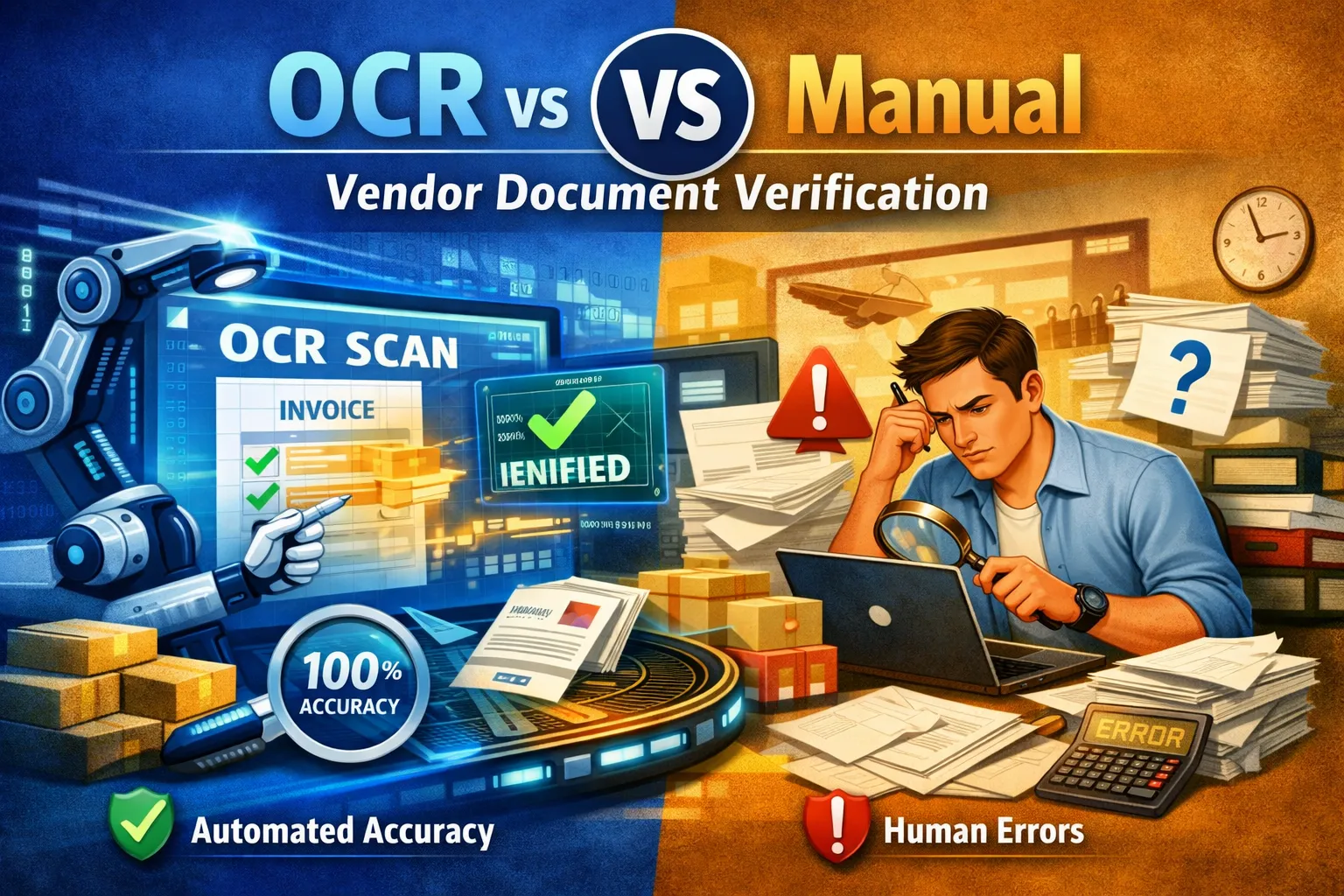
OCR vs Manual Vendor Document Verification: Which Is Better for Compliance?
Vendor compliance teams spend countless hours reviewing GST certificates, PAN cards, labour licenses, PF registrations, insurance documents, and many other compliance records submitted by vendors and contractors.
Traditionally, this process has been completely manual. Compliance officers open each document, verify the information, record expiry dates in Excel, and decide whether the document is valid.
Today, Optical Character Recognition (OCR) combined with Artificial Intelligence (AI) is transforming this process by automating document verification and significantly reducing manual effort.
In this guide, we’ll compare OCR with manual vendor document verification, explain their advantages and limitations, and help you determine which approach is best for your organization.
What Is Manual Vendor Document Verification?
Manual document verification is the traditional process where compliance officers or procurement teams review every vendor document individually.
The reviewer typically:
- Opens the uploaded document
- Confirms the document type
- Checks registration numbers
- Verifies expiry dates
- Confirms mandatory information
- Records details in spreadsheets or software
- Approves or rejects the document
Although this process works for small businesses, it becomes increasingly difficult as the number of vendors grows.
What Is OCR?
OCR (Optical Character Recognition) is a technology that converts scanned documents, PDFs, and images into machine-readable text.
Instead of manually reading documents, OCR automatically extracts text such as:
- GST Numbers
- PAN Numbers
- License Numbers
- Employer Codes
- Policy Numbers
- Issue Dates
- Expiry Dates
OCR acts as the foundation for modern AI-powered document validation systems.
How Manual Verification Works
A typical manual verification process looks like this:
- Vendor uploads a document.
- Compliance officer opens the PDF.
- Reviewer checks the document type.
- Important information is copied manually.
- Expiry dates are entered into Excel.
- Missing information is identified.
- Document is approved or rejected.
This process may take several minutes per document.
When organizations manage thousands of documents, manual verification quickly becomes a bottleneck.
How OCR-Based Verification Works
With OCR, much of the repetitive work is automated.
The process becomes:
- Vendor uploads the document.
- OCR extracts all readable text.
- AI identifies the document type.
- Required information is extracted automatically.
- Expiry dates are detected.
- Business rules validate the document.
- Compliance officer reviews only flagged exceptions.
Instead of reviewing every document, teams focus only on documents that require attention.
OCR vs Manual Verification
| Manual Verification | OCR-Based Verification |
|---|---|
| Human reads every document | OCR extracts text automatically |
| Manual data entry | Automatic data extraction |
| High administrative effort | Minimal manual effort |
| Slower onboarding | Faster onboarding |
| Greater chance of human error | Consistent processing |
| Difficult to scale | Easily scalable |
| Manual expiry tracking | Automatic expiry detection |
Advantages of Manual Verification
Manual review still offers certain benefits.
Human Judgment
Experienced compliance officers can identify unusual situations that automated systems may not recognize.
Better Exception Handling
Complex documents sometimes require manual interpretation.
No Technology Investment
Small businesses with only a handful of vendors may not require OCR software.
Limitations of Manual Verification
As vendor numbers increase, manual verification creates several challenges.
Time-Consuming
Reviewing hundreds of documents every month consumes significant time.
Human Errors
Typing mistakes and overlooked information are common.
Inconsistent Reviews
Different reviewers may interpret documents differently.
Missed Expiry Dates
Tracking expiry dates manually often results in missed renewals.
Difficult Audits
Finding historical documents during audits becomes slow and stressful.
Advantages of OCR-Based Verification
OCR dramatically improves document management.
Faster Processing
Documents can be processed within seconds instead of minutes.
Improved Accuracy
OCR eliminates repetitive manual typing.
Better Productivity
Compliance teams spend more time handling exceptions rather than routine verification.
Automated Data Extraction
Important information is extracted automatically.
Better Audit Readiness
All extracted information is stored digitally for future audits.
Scalable Operations
Whether you manage 100 documents or 100,000, OCR scales efficiently.
OCR Alone Is Not Enough
A common misconception is that OCR alone performs document validation.
In reality, OCR simply extracts text.
It does not:
- Understand document types
- Detect incorrect uploads
- Validate compliance rules
- Identify missing information
- Make approval decisions
That is where Artificial Intelligence becomes essential.
OCR + AI: A Smarter Approach
Modern vendor compliance platforms combine OCR with AI.
The workflow typically looks like this:
Vendor Upload
↓
OCR extracts text
↓
AI identifies document type
↓
AI validates business rules
↓
Expiry dates detected
↓
Missing fields highlighted
↓
Compliance officer reviews only exceptions
This combination significantly reduces manual work while maintaining high accuracy.
Real Example
Imagine a contractor uploads a PF Registration Certificate.
Manual Process
- Open document
- Read contents
- Verify document type
- Find Establishment Code
- Check expiry
- Record details
- Approve
Time required: 5–10 minutes
OCR + AI Process
- OCR reads document
- AI detects PF Registration Certificate
- Establishment Code extracted
- Expiry date identified
- Validation rules applied
- Compliance officer reviews result
Time required: Less than one minute
When Should Organizations Adopt OCR?
OCR becomes valuable when organizations:
- Manage hundreds of vendors
- Receive thousands of compliance documents
- Conduct regular compliance audits
- Need faster vendor onboarding
- Track document expiry dates
- Want to reduce administrative effort
Manufacturing companies, logistics firms, construction companies, engineering organizations, and facility management companies benefit significantly from OCR.
Best Practices
To maximize the benefits of OCR:
- Combine OCR with AI-powered validation
- Maintain centralized document storage
- Define document validation rules
- Automate expiry reminders
- Keep complete audit trails
- Continue human review for exceptions
Automation should assist compliance officers rather than replace them.
How VendorCompliancePro Uses OCR
VendorCompliancePro combines OCR and AI to simplify vendor compliance.
Key capabilities include:
- OCR-based text extraction
- AI-powered document classification
- Automatic expiry detection
- Vendor document validation
- Compliance dashboards
- Vendor self-service portal
- Automated reminders
- Approval workflows
- Centralized document repository
- Complete audit history
Organizations can process vendor documents faster while maintaining compliance and audit readiness.
Frequently Asked Questions
What is OCR?
OCR (Optical Character Recognition) converts scanned documents and images into machine-readable text.
Can OCR verify compliance documents?
OCR extracts information from documents, but AI is required to validate compliance rules.
Is OCR more accurate than manual data entry?
Yes. OCR significantly reduces manual typing errors while improving consistency.
Can OCR detect expiry dates?
Yes. OCR can extract expiry dates, and AI can interpret and validate them.
Does OCR replace compliance officers?
No. OCR automates repetitive work while allowing compliance teams to review exceptions.
Which industries benefit from OCR?
Manufacturing, logistics, construction, healthcare, engineering, warehousing, retail, and facility management all benefit from OCR-based compliance management.
Conclusion
Manual vendor document verification has served organizations for years, but it struggles to keep pace with today’s growing compliance requirements.
OCR automates text extraction, reduces administrative effort, and improves processing speed. When combined with AI, it enables intelligent document validation, automatic expiry detection, and faster vendor onboarding.
Organizations looking to improve compliance efficiency, reduce manual work, and stay audit-ready should consider adopting OCR and AI-powered vendor compliance solutions.
Related Articles
AI & Automation
- AI-Based Vendor Document Validation Explained
- How AI Is Transforming Vendor Compliance
- How AI Can Reduce Vendor Onboarding Time
- AI + OCR: How Intelligent Document Processing Works
Vendor Compliance
- What Is Vendor Compliance?
- Vendor Compliance Software India
- Vendor Compliance Checklist India
- Vendor Compliance Best Practices for Manufacturing