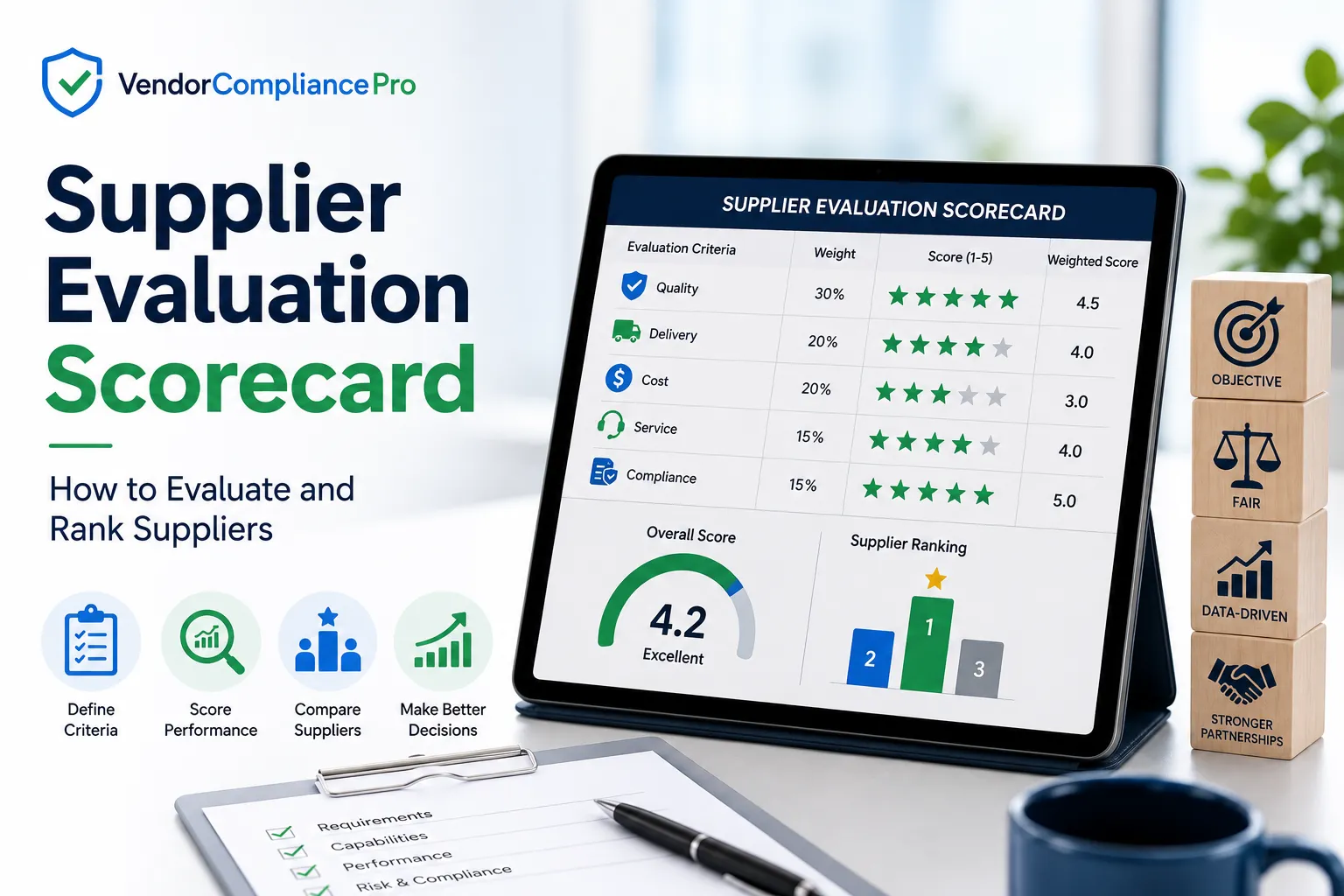
Supplier Evaluation Scorecard: How to Evaluate and Rank Suppliers
Choosing a supplier based only on price can create problems later.
A supplier may offer a competitive price but have poor delivery performance, weak quality controls, limited capacity, inadequate compliance, or insufficient experience.
A supplier evaluation scorecard gives procurement teams a structured way to compare suppliers using consistent criteria.
Instead of relying entirely on subjective opinions, procurement teams can assign weights to important criteria, score each supplier, and calculate an overall result.
In this guide, we’ll explain what a supplier evaluation scorecard is, which criteria to include, how weighting works, and how procurement teams can use scorecards to make better supplier selection and performance decisions.
What Is a Supplier Evaluation Scorecard?
A supplier evaluation scorecard is a structured framework used to assess and compare suppliers against defined criteria.
Each criterion receives a score, and important criteria can receive a higher weight.
Common evaluation criteria include:
- Quality
- Cost or pricing
- Delivery performance
- Compliance
- Service and support
- Financial stability
- Safety
- Capacity
- Experience
The final weighted score provides a consistent way to compare suppliers.
The exact criteria and weights should reflect the organization’s procurement strategy, contract scope, supplier risk, and business priorities.
Why Use a Supplier Evaluation Scorecard?
Supplier selection often involves multiple stakeholders.
Procurement may focus on cost.
Operations may focus on delivery and capacity.
Quality teams may focus on quality systems and defect performance.
Compliance teams may focus on documentation and regulatory requirements.
Finance may focus on financial stability.
Without a structured scoring method, each stakeholder may evaluate suppliers differently.
A scorecard creates a common evaluation framework.
It can help procurement teams:
- Compare suppliers consistently
- Reduce subjective decision-making
- Make evaluation criteria transparent
- Prioritize important supplier characteristics
- Document supplier selection decisions
- Identify strengths and weaknesses
- Support internal approvals
- Create evidence for procurement reviews
Supplier Evaluation vs Supplier Prequalification
Supplier prequalification and supplier evaluation are closely related but serve different purposes.
Supplier Prequalification Supplier Evaluation
Determines whether a supplier meets Compares suppliers against baseline requirements evaluation criteria
Usually performed before supplier Often performed during supplier selection selection or supplier reviews
Focuses on eligibility, capability, and Focuses on relative performance compliance and suitability
Identifies suppliers that should Helps rank suppliers proceed
Often uses questionnaires Often uses weighted scorecards
A practical procurement process can use both.
First, prequalify suppliers to remove suppliers that do not meet baseline requirements.
Then, evaluate and rank the qualified suppliers using a scorecard.
You can use the Supplier Prequalification Questionnaire Generator to create a starting questionnaire.
Key Supplier Evaluation Criteria
There is no universal set of criteria that works for every procurement decision.
The criteria should reflect what matters most for the particular supplier relationship.
1. Quality
Quality is often one of the most important supplier evaluation criteria.
Questions may include:
- Does the supplier have an established quality management system?
- What is the supplier’s defect or rejection history?
- How does the supplier manage non-conforming products or services?
- How quickly are corrective actions completed?
- Does the supplier hold relevant quality certifications?
For manufacturing suppliers, quality may receive a particularly high weight because supplier defects can affect production and customer satisfaction.
2. Cost and Pricing
Cost is important, but it should not always receive the highest weight.
Procurement teams can consider:
- Unit price
- Total cost of ownership
- Transportation costs
- Payment terms
- Price stability
- Volume discounts
- Additional service costs
A supplier with the lowest quoted price is not necessarily the supplier with the lowest total cost.
For example, poor quality, late deliveries, or additional logistics costs can make a low-price supplier more expensive over time.
3. Delivery Performance
Delivery performance measures the supplier’s ability to meet agreed schedules.
Possible measures include:
- On-time delivery rate
- Lead time
- Order fulfillment
- Delivery consistency
- Response to urgent requirements
- Geographic coverage
Delivery may deserve a higher weight when a supplier supports time-sensitive manufacturing or logistics operations.
4. Compliance
Supplier compliance can include:
- Business registrations
- Licenses
- Certifications
- Insurance
- Regulatory requirements
- Labour compliance
- Contractual documentation
- Required supplier declarations
A supplier with strong operational performance but poor compliance may still create significant risk.
For organizations that manage large supplier networks, compliance should therefore be considered as part of the supplier evaluation process.
5. Service and Support
Service quality can be critical for suppliers that provide ongoing support.
Consider:
- Response time
- Communication
- Issue resolution
- Account management
- Technical support
- Escalation process
- After-sales support
For service providers and technology vendors, support quality may be more important than it is for a commodity supplier.
6. Financial Stability
Financial stability can indicate whether a supplier is likely to remain capable of supporting the relationship.
Depending on supplier risk, procurement teams may review:
- Financial statements
- Revenue trends
- Credit information
- Banking references
- Debt exposure
- Material litigation
- Business continuity
Critical suppliers may require more detailed financial due diligence.
7. Safety
Safety is particularly important for suppliers and contractors working on-site or performing higher-risk activities.
Evaluation factors can include:
- Safety policies
- Incident history
- Safety training
- Worker competency
- Risk assessments
- Corrective actions
- Safety certifications
For manufacturing, warehousing, construction, and logistics operations, safety may deserve a significant weight.
8. Capacity
A supplier must have enough capacity to meet current and expected demand.
Consider:
- Production capacity
- Workforce capacity
- Equipment
- Warehouse capacity
- Fleet capacity
- Geographic coverage
- Ability to scale
A supplier may be highly rated in other areas but still be unsuitable if it cannot support the required volume.
9. Experience
Relevant experience can reduce execution risk.
Consider:
- Years in business
- Similar customers
- Similar contracts
- Industry experience
- Technical expertise
- Previous project performance
Experience should be evaluated in context rather than simply using the number of years a company has operated.
How Supplier Evaluation Weighting Works
Not every criterion has equal importance.
A weighted scorecard assigns a percentage to each criterion.
For example:
Criterion Weight
Quality 20% Cost / Pricing 15% Delivery Performance 20% Compliance 15% Service / Support 10% Financial Stability 5% Safety 10% Capacity 5% Total 100%
The weights should always total 100%.
The higher the weight, the greater the influence that criterion has on the final score.
Example of Weighted Supplier Scoring
Suppose a procurement team scores suppliers from 1 to 5, where:
- 1 = Poor
- 2 = Below expectations
- 3 = Acceptable
- 4 = Good
- 5 = Excellent
A supplier receives the following scores:
Criterion Weight Score
Quality 20% 4 Cost 15% 5 Delivery 20% 3 Compliance 15% 5 Service 10% 4 Financial Stability 5% 4 Safety 10% 5 Capacity 5% 3
The weighted score is calculated by multiplying each score by its weight and adding the results.
This creates a standardized overall score that can be compared with other suppliers.
The scoring scale and calculation method should be defined consistently before suppliers are evaluated.
How to Choose the Right Weights
Weighting should be based on business risk rather than convenience.
Ask:
- What happens if this supplier fails?
- Which supplier characteristics have the greatest impact on operations?
- What risks are unacceptable?
- Which criteria are contractual requirements?
- Which criteria affect customer commitments?
- Which criteria affect safety or regulatory compliance?
For example:
Manufacturing Supplier
Possible priorities:
- Quality
- Delivery
- Capacity
- Compliance
- Cost
Logistics Provider
Possible priorities:
- Delivery performance
- Safety
- Capacity
- Compliance
- Service
- Cost
Warehouse Service Provider
Possible priorities:
- Safety
- Compliance
- Service
- Capacity
- Experience
- Cost
There is no single correct weighting model.
Supplier Evaluation Process
A practical evaluation process can follow these steps.
Step 1: Define Evaluation Criteria
Select criteria relevant to the supplier and contract.
Avoid including criteria that do not influence the decision.
Step 2: Assign Weights
Assign percentage weights according to business priorities and risk.
Make sure the total equals 100%.
Step 3: Define the Scoring Scale
Use a consistent scoring scale.
A simple 1–5 scale is easy for stakeholders to understand.
Define what each score means before evaluating suppliers.
Step 4: Collect Supplier Evidence
Use information from:
- Supplier questionnaires
- RFQ responses
- References
- Certifications
- Performance history
- Financial information
- Compliance documents
- Site assessments
Scores should be supported by evidence wherever practical.
Step 5: Score Each Supplier
Each evaluator scores suppliers against the agreed criteria.
Avoid changing the scoring methodology from one supplier to another.
Step 6: Calculate Weighted Scores
Apply the agreed weights and calculate the overall score.
This creates a consistent ranking.
Step 7: Review the Results
The highest score does not automatically mean the supplier should be selected.
Procurement teams should review:
- Critical risks
- Mandatory requirements
- Large score differences
- Missing evidence
- Conflicts of interest
- Commercial considerations
The scorecard should support decision-making rather than replace professional judgment.
Step 8: Document the Decision
Keep the evaluation evidence and final decision.
This helps with:
- Internal approvals
- Procurement governance
- Supplier reviews
- Audit evidence
- Future sourcing decisions
Common Supplier Evaluation Mistakes
Giving Price Too Much Weight
The cheapest supplier is not always the best supplier.
Consider total cost and operational risk.
Using Too Many Criteria
A scorecard with dozens of criteria can become difficult to use consistently.
Focus on criteria that actually influence the decision.
Changing Weights During Evaluation
Changing weights after seeing supplier scores can introduce bias.
Define the methodology before scoring.
Scoring Without Evidence
A score should have a reasonable basis.
Where possible, retain the evidence supporting each score.
Ignoring Mandatory Requirements
A supplier should not necessarily win because of a high overall score if it fails a mandatory legal, safety, quality, or compliance requirement.
Treating the Score as the Final Decision
Procurement decisions often require professional judgment in addition to numerical scoring.
Using Scorecards for Existing Suppliers
Supplier evaluation scorecards are not only useful for new supplier selection.
They can also support ongoing supplier performance reviews.
Organizations can periodically evaluate existing suppliers on:
- Quality
- Delivery
- Compliance
- Service
- Safety
- Cost
- Responsiveness
This creates a structured supplier performance management process.
The evaluation frequency can depend on supplier criticality and risk.
Supplier Evaluation in Manufacturing
Manufacturing organizations often depend on suppliers for materials, components, equipment, packaging, and services.
A manufacturing scorecard may place greater emphasis on:
- Quality
- On-time delivery
- Production capacity
- Technical capability
- Compliance
- Cost
- Safety
Supplier performance can directly affect production schedules and customer commitments.
Supplier Evaluation in Logistics
Logistics organizations can evaluate carriers, transport providers, freight partners, and other service providers.
Relevant criteria may include:
- Delivery performance
- Safety
- Fleet or operational capacity
- Geographic coverage
- Compliance
- Service responsiveness
- Cost
- Experience
The appropriate weighting depends on the type of logistics service.
Supplier Evaluation in Warehousing
Warehouse operators may evaluate:
- Security providers
- Housekeeping contractors
- Pest control providers
- Maintenance contractors
- Material handling providers
- Transport partners
- Facility management providers
Evaluation criteria can include:
- Safety
- Compliance
- Service quality
- Response time
- Capacity
- Experience
- Cost
Use Our Free Supplier Evaluation Scorecard Generator
Creating a supplier scorecard manually can take time, especially when procurement teams need to compare multiple suppliers.
Our Supplier Evaluation Scorecard Generator provides a simple starting point.
You can:
- Select an evaluation type
- Select an industry
- Adjust evaluation weights
- Add suppliers
- Score suppliers on a 1–5 scale
- Calculate weighted results
- Rank suppliers
- Print or save the scorecard as a PDF
The tool is designed to help procurement teams create a structured evaluation quickly.
From Supplier Evaluation to Ongoing Vendor Compliance
Supplier selection is only one stage of the supplier lifecycle.
After a supplier is selected, organizations still need to manage:
- Compliance documents
- Insurance
- Certifications
- Licenses
- Approvals
- Expiry dates
- Renewal requests
- Audit evidence
A supplier that scores highly during selection can still become a compliance risk later if required documents expire or are not renewed.
That is why supplier evaluation should connect with ongoing vendor compliance management.
VendorCompliancePro helps organizations centralize supplier documents, approvals, expiry dates, audit evidence, and compliance workflows.
Frequently Asked Questions
What is a supplier evaluation scorecard?
A supplier evaluation scorecard is a structured framework that uses defined criteria, weights, and scores to compare suppliers consistently.
What criteria should be included in a supplier scorecard?
Common criteria include quality, cost, delivery, compliance, service, financial stability, safety, capacity, and experience. The appropriate criteria depend on the supplier and contract.
What scoring scale should I use?
A 1–5 scale is a simple option:
- 1 = Poor
- 2 = Below expectations
- 3 = Acceptable
- 4 = Good
- 5 = Excellent
Organizations can use other scales if they define them clearly and apply them consistently.
Should supplier evaluation weights total 100%?
Yes. A percentage-based weighted scorecard should normally have weights totaling 100%.
Should price have the highest weight?
Not necessarily. The appropriate weight depends on the supplier’s importance, risk, and business impact.
Can a supplier with the highest score still be rejected?
Yes. Mandatory requirements, legal issues, safety concerns, compliance failures, or other critical risks may override the overall score.
Can supplier scorecards be used for existing suppliers?
Yes. Scorecards can be used for periodic supplier performance reviews as well as new supplier selection.
Conclusion
A supplier evaluation scorecard gives procurement teams a consistent framework for comparing suppliers across the criteria that matter most to the business.
By combining weighted criteria with evidence-based scoring, organizations can reduce subjective decision-making, document supplier selection decisions, and identify supplier strengths and weaknesses more clearly.
The most effective scorecards are simple, risk-based, and consistent.
They should support procurement judgment rather than replace it.
For new suppliers, a strong process can begin with prequalification, continue with supplier evaluation, and then move into ongoing vendor compliance management.
Use our Supplier Evaluation Scorecard Generator to create a structured scorecard, compare suppliers, and rank results.
Once suppliers are approved, VendorCompliancePro can help keep their documents, approvals, expiry dates, and compliance evidence under control.
Related Articles
Procurement & Supplier Management
- Supplier Prequalification Questionnaire: A Complete Guide for Procurement Teams
- What Is Vendor Compliance?
- Vendor Risk Assessment Guide
- Vendor Audit Readiness Checklist
- Vendor Compliance Checklist India