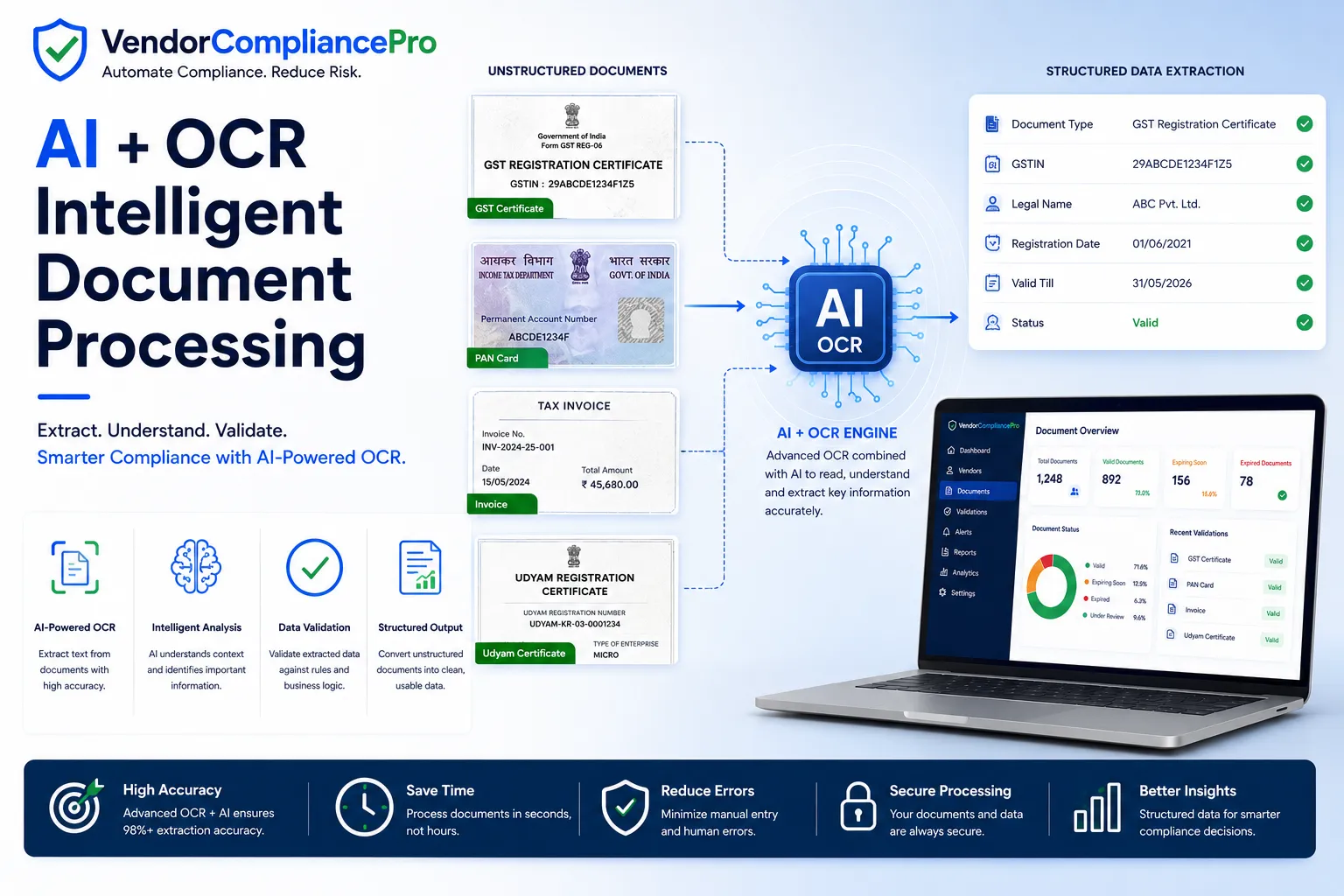
AI + OCR: How Intelligent Document Processing Works for Vendor Compliance
Organizations today receive thousands of vendor documents every year, including GST certificates, PAN cards, PF registrations, insurance policies, labour licenses, and many other compliance records.
Traditionally, procurement and compliance teams manually reviewed every document, extracted important information, tracked expiry dates, and stored records for future audits. This process is slow, repetitive, and prone to human error.
Modern organizations are replacing manual document handling with Intelligent Document Processing (IDP)—a combination of Artificial Intelligence (AI), Optical Character Recognition (OCR), and automation.
In this guide, we’ll explain how AI and OCR work together, what Intelligent Document Processing is, and why it is transforming vendor compliance management.
What Is Intelligent Document Processing (IDP)?
Intelligent Document Processing (IDP) is a technology that combines OCR, Artificial Intelligence, Machine Learning, and business rules to automatically understand, extract, validate, and process information from documents.
Unlike traditional OCR, which only converts images into text, IDP understands the content and context of documents.
This enables organizations to automate document-intensive processes such as vendor onboarding, compliance verification, invoice processing, and audit preparation.
What Is OCR?
OCR (Optical Character Recognition) converts scanned images and PDF documents into machine-readable text.
For example, OCR can extract:
- GST Number
- PAN Number
- Company Name
- License Number
- Issue Date
- Expiry Date
- Policy Number
OCR is the first step in Intelligent Document Processing.
What Is Artificial Intelligence?
Artificial Intelligence analyzes the text extracted by OCR.
Instead of simply reading words, AI understands:
- Document type
- Important fields
- Compliance requirements
- Missing information
- Expiry dates
- Business rules
AI transforms raw text into meaningful business information.
How AI and OCR Work Together
Think of OCR as the “eyes” and AI as the “brain.”
OCR reads the document.
AI understands what the document means.
Together they create an intelligent document processing system capable of automating vendor compliance tasks.
Intelligent Document Processing Workflow
A typical IDP workflow consists of several stages.
Step 1: Vendor Uploads Document
The vendor uploads documents through a secure portal.
Examples include:
- GST Registration Certificate
- PAN Card
- MSME Certificate
- Labour License
- PF Registration
- ESIC Registration
- Insurance Policy
Step 2: OCR Extracts Text
OCR scans the document and converts it into editable text.
Examples of extracted information:
- Company Name
- GST Number
- Registration Number
- Policy Number
- Issue Date
- Expiry Date
Step 3: AI Classifies the Document
AI determines what type of document has been uploaded.
For example:
- GST Certificate
- Labour License
- Insurance Certificate
- PAN Card
- PF Registration
This works even if the uploaded filename is incorrect.
Step 4: AI Extracts Key Information
AI identifies important business information such as:
- Registration Numbers
- License Numbers
- Vendor Name
- Organization Name
- Issue Date
- Expiry Date
This eliminates manual data entry.
Step 5: Business Rule Validation
The system validates the extracted information.
Examples include:
- Correct document uploaded?
- Required fields present?
- Document expired?
- Mandatory keywords available?
- Duplicate upload detected?
Step 6: Compliance Decision
The document is automatically marked as:
- Valid
- Expired
- Missing Information
- Incorrect Document
- Requires Manual Review
Only exceptions require human attention.
OCR vs Intelligent Document Processing
Many people confuse OCR with IDP.
They are different technologies.
| OCR | Intelligent Document Processing |
|---|---|
| Reads text | Understands documents |
| Extracts characters | Extracts business information |
| No decision-making | Applies compliance rules |
| Cannot classify documents | AI identifies document type |
| Requires manual review | Automates validation |
| Limited automation | End-to-end automation |
OCR is one component of IDP—not the complete solution.
Documents That Can Be Processed
Modern IDP systems support a wide range of compliance documents.
Registration Documents
- GST Registration Certificate
- PAN Card
- MSME Certificate
- IEC Certificate
Labour Compliance
- PF Registration
- ESIC Registration
- Labour License
- Contractor License
Insurance Documents
- Workmen Compensation Policy
- Public Liability Insurance
- Employee Insurance
Operational Records
- Salary Register
- Attendance Register
- Employee List
- Wage Register
Safety Documents
- Safety Certificates
- Training Records
- Risk Assessment Reports
Benefits of Intelligent Document Processing
Faster Processing
Documents are processed within seconds instead of minutes.
Improved Accuracy
AI eliminates repetitive manual data entry.
Reduced Administrative Work
Compliance teams focus only on exceptions.
Better Compliance
Missing information and expired documents are detected automatically.
Improved Audit Readiness
Documents remain organized with complete audit trails.
Scalable Operations
Organizations can process thousands of documents efficiently.
Real Example
A contractor uploads a Labour License.
Traditional Process
- Open PDF
- Read document
- Verify document type
- Enter license number
- Record expiry date
- Save document
- Approve manually
Time Required: 10 Minutes
AI + OCR Process
- OCR extracts text
- AI identifies Labour License
- License number extracted
- Expiry date detected
- Business rules validated
- Approval workflow initiated
Time Required: Less than One Minute
Industries Using Intelligent Document Processing
IDP is widely adopted across industries including:
- Manufacturing
- Logistics
- Warehousing
- Construction
- Engineering
- Healthcare
- Banking
- Insurance
- Retail
- Facility Management
Any organization managing large volumes of documents can benefit from IDP.
Best Practices for Intelligent Document Processing
Organizations should:
- Use high-quality document scans
- Define document validation rules
- Combine OCR with AI
- Automate expiry reminders
- Maintain centralized document storage
- Keep complete audit trails
- Review AI exceptions manually
AI should assist human reviewers rather than replace them.
The Future of Intelligent Document Processing
IDP technology continues to evolve rapidly.
Future capabilities may include:
- Government database verification
- GST validation
- PAN verification
- Digital signature validation
- QR code verification
- Fraud detection
- Predictive compliance alerts
- AI-powered compliance assistants
- Natural language search
- Autonomous compliance workflows
These innovations will make document processing even faster and more intelligent.
How VendorCompliancePro Uses AI and OCR
VendorCompliancePro combines OCR, Artificial Intelligence, and business rules to simplify vendor compliance.
Key capabilities include:
- OCR-based text extraction
- AI document classification
- Automatic expiry detection
- Compliance rule validation
- Vendor self-service portal
- Approval workflows
- Compliance dashboards
- Centralized document repository
- Automated reminder emails
- Complete audit history
These features help procurement and compliance teams process vendor documents faster while improving compliance accuracy and audit readiness.
Frequently Asked Questions
What is Intelligent Document Processing?
Intelligent Document Processing (IDP) combines OCR, Artificial Intelligence, Machine Learning, and automation to understand and process documents automatically.
Is OCR the same as IDP?
No. OCR extracts text from documents, while IDP uses AI to understand, validate, and process the extracted information.
Can IDP validate compliance documents?
Yes. IDP can classify documents, extract key information, detect expiry dates, and validate documents against predefined compliance rules.
Which industries benefit from IDP?
Manufacturing, logistics, construction, healthcare, engineering, warehousing, retail, banking, insurance, and facility management.
Does IDP replace compliance officers?
No. IDP automates repetitive tasks while compliance professionals continue reviewing exceptions and making final approval decisions.
Conclusion
Managing vendor compliance documents manually is becoming increasingly difficult as organizations grow and regulatory requirements become more complex.
By combining OCR and Artificial Intelligence, Intelligent Document Processing enables organizations to automate document verification, improve compliance accuracy, reduce manual effort, and accelerate vendor onboarding.
As businesses continue their digital transformation, AI-powered Intelligent Document Processing will become a standard component of modern vendor compliance and procurement systems.
Related Articles
AI & Automation
- AI-Based Vendor Document Validation Explained
- OCR vs Manual Vendor Document Verification
- How AI Can Reduce Vendor Onboarding Time
- AI vs Traditional Vendor Compliance Software
- AI-Powered Vendor Risk Assessment
- AI Compliance Assistant: The Future of Vendor Management
- Can AI Detect Fake Compliance Documents?
- How AI Is Transforming Vendor Compliance